
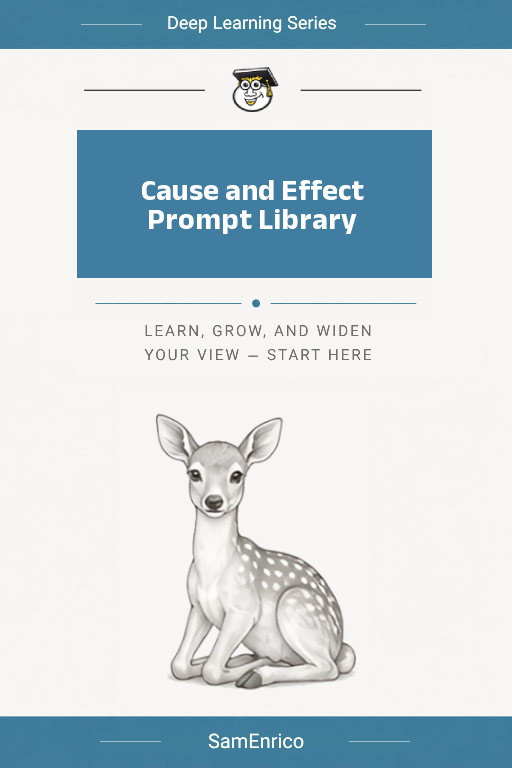
Cause and Effect Prompt Library
Trace chains of causality in history or science us
Trace chains of causality in history or science using GPT prompts that distinguish correlation from causation and identify root causes.
Formats
About this book
Free sample
Chapter 1: The Ice Cream Killer--–- The first time I asked GPT why my startup failed, it gave me twenty perfectly plausible reasons. Low market fit. Poor pricing strategy. Weak distribution channels. Aggressive competitors.
Each explanation came wrapped in confident prose, bristling with data points pulled from successful post-mortems. I nodded along, copied the answers into a presentation, and fired my head of product. Six months later, the same problems persisted. I had treated correlation as causation—and paid $200,000 to learn the difference.This chapter is about that difference. Not in the abstract, statistical sense that puts graduate students to sleep.
But in the visceral, real-world sense where bad causal thinking costs you money, time, reputation, and sometimes lives. You are about to learn why your brain—and GPT—constantly confuse “happens together” with “causes each other.” And you will acquire the first and most important prompt pattern in this book: the one that forces GPT to stop making up causal stories and start showing you what it actually knows.Why This Matters More Than Ever Large language models are pattern-matching engines. They have ingested trillions of sentences from the internet, books, academic papers, and social media. In that vast ocean of text, certain pairs of words and concepts appear together frequently. Ice cream and drowning.
Education and income. Storks and babies. The model learns that when you see “ice cream sales rise,” you are likely to also see “drowning deaths rise” in the same context. So when you ask “What causes drowning?” GPT will happily retrieve “ice cream sales” as a plausible answer—not because it believes in causality, but because statistical association is all it has.This is not a bug. It is a feature of how language models work.
But it becomes a dangerous bug when you, the human, interpret that statistical output as causal truth. The model does not have a hidden layer labeled “causation.” It does not run randomized controlled trials in its silicon valleys. It gives you what is probable in language, not what is true in the world.The cognitive psychologist Daniel Kahneman, in…
This is the end of the free sample. Get the eBook to keep going. Buy now
Contents
- Chapter 1
- Chapter 2
- Chapter 3
- Chapter 4
- Chapter 5
- Chapter 6
- Chapter 7
- Chapter 8
- Chapter 9
- Chapter 10
- Chapter 11
- Chapter 12
Details
- Author
- Santiago Georgia
- Publisher
- SamEnrico
- Language
- English
- Genre
- Non-Fiction, Student's Shortcut
- Released
- 2026-05-29
- Pages (approx.)
- 160
- Available as
- eBook, Audiobook

Read better in the ZLOADR app
Your eBooks on your phone or tablet. Sign in with your SamEnrico account and start reading.
More by Santiago Georgia
 Second Generation FriendshipSantiago Georgia$11.99
 Sam Hunt Montevallo LifeSantiago Georgia$11.99
 Keto Diet Weight Loss GuideSantiago Georgia$11.99
 Working Memory in Math AbilitySantiago Georgia$11.99
 Sleep Environment Memory BoostSantiago Georgia$11.99
 The Criticism Immunity CourseSantiago Georgia$11.99
 Live Event Streaming ChurnSantiago Georgia$11.99
 Detox For VeteransSantiago Georgia$11.99
 The Silk Road Cyclists: Love, Rivalry, and the Birth of Endurance RacingSantiago Georgia$11.99
 Frozen Echoes: The Vanishing of the Franklin ExpeditionSantiago Georgia$11.99
 Middle East Digital Sales BlueprintSantiago Georgia$12.99
 How to Produce Signal BoostersSantiago Georgia$11.99
You may also like
 Hong Kong Handover 1997Dunn Johnnie$11.99
 Zumba For Postnatal Recovery CourseNeal Christian$11.99
 Zumba for BeginnersLadner Nikia$11.99
 YouTube Comment Mining GuideHumes Pandora$12.99
 Worry Box MeditationCarlin Rudy$11.99
 Workplace Stress MeditationNguyen Lynn$11.99
 Workplace Stress and Sleep RepairHawley Ivory$11.99
 Workplace Perfectionism CureDelaney Jeffry$11.99
 Workplace Injustice Anger GuideWallen Isabelle$11.99
 Work Addiction and Burnout LinkGreenwood Ester$11.99
 Women in Yoga and WellnessBeattie Galina$11.99
 Women in Stand Up ComedyChun Evangeline$11.99