
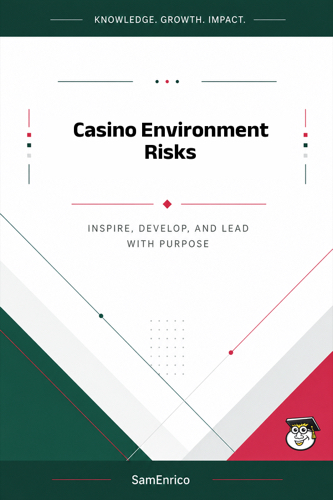
Non-FictionHealth & WellnessEnvironmental Psychology
Casino Environment Risks eBook
Understand how casino design manipulates behavior
by Mayes Dede
Understand how casino design manipulates behavior and fuels addiction.
Formats
Free sample
Chapter 1: The Walled Garden...–- Maria remembers the exact moment she lost three hours. She had walked into the casino at 8:15 PM, a Tuesday, planning to play for twenty minutes – just enough to unwind after work. She sat down at a slot machine near the entrance, inserted a twenty-dollar bill, and pressed the button. The next thing she knew, a security guard was tapping her shoulder. "Ma'am, it's 11:30.
We need to close this section for cleaning." Maria looked at the machine's credit meter. It read zero. She had no memory of the last three hours. No memory of the hundreds of button presses. No memory of the other two twenty-dollar bills she had inserted.
Her phone, which she had set on the machine's ledge, showed seven missed calls from her husband. She had not heard a single one.Maria is not a fictional character. She is a composite of dozens of interviews conducted with former gamblers over fifteen years of research. Her story is not unusual. It is typical.
Ask any regular casino visitor about "losing time," and they will have a version of Maria's story. Some lost an hour. Some lost a day. Some lost a weekend. The specific duration varies.
The underlying mechanism does not. Casinos are designed to make you lose time. This is not an accident. It is not a side effect. It is the primary engineering goal of casino architecture.This chapter is about the physical space of casinos – the walls, the floors, the ceilings, the placement of bathrooms and restaurants, the absence of windows and clocks, the confusing carpets, the uncomfortable benches, the meandering pathways.
It is about how these design features work together to create what architects call a "behavioral containment system." A place that is easy to enter and difficult to leave. A place where time dissolves. A place where your normal decision-making abilities are systematically undermined.By the end of this chapter, you will understand why Maria lost three hours. You will be able to identify the manipulative design features in any casino, from the largest Las Vegas resort to your local slot machine parlor. And you will have a practical tool – the Environmental Audit – that you can use to protect yourself the next time you walk through those doors.The Absence of Time Let us begin with the most obvious manipulation: there are no clocks in casinos.
Walk through any gaming floor in the world – Las Vegas, Macau, Monaco, London – and you will search in vain for a clock. This is not an oversight. It is not a design flaw. It is a deliberate, calculated choice.Clocks remind us of time passing. Time passing reminds us of other obligations.
Other obligations remind us that we should probably leave. Casinos cannot have that. So the clocks disappear.But the absence of clocks is only the beginning. Windows are equally absent from most casino gaming floors. Natural light is the body's primary Zeitgeber – a German word meaning "time giver." Sunlight tells your internal clock whether it is morning, afternoon, or evening.
Without windows, your body loses this external reference. You cannot tell if it is 10 AM or 10 PM. You cannot tell if you have been playing for twenty minutes or twenty hours.The combination is devastating. No clocks + no windows = no time. Your brain, deprived of external time cues, relies on internal estimation.
But internal time estimation is famously unreliable – especially when you are engaged in a high-stimulation, rewarding activity. Minutes feel like seconds. Hours feel like minutes. Maria thought she had played for twenty minutes. She had played for three hours and fifteen minutes.
She was not stupid. She was human. And her humanity was being exploited.Destination Layout: The Amenity Trap Now consider the placement of amenities. In a normal building – a shopping mall, an airport, a hotel – the most frequently used amenities are placed near the entrances. Bathrooms near the food court.
Restaurants near the parking garage. Elevators near the lobby. This is called user-centered design. It respects your time and energy.Casinos do the opposite. They use what architects call "destination layout." Restaurants are placed deep inside the gaming floor.
Bathrooms are hidden behind rows of slot machines. Hotel elevators require walking past hundreds of games. Even the cashier cage – the place where you exchange chips for actual money – is often located in the most remote corner of the casino.Why? Because every trip to the bathroom becomes a journey past dozens of machines. Every walk to dinner becomes an obstacle course of temptation.
Every return to your hotel room requires navigating the gaming floor twice – once to reach the elevator, once to leave it. Each pass is an opportunity to sit down "just for a minute."The mathematics of destination layout are simple. If the average player walks past fifty machines to reach the bathroom, and one percent of those walks results in a spontaneous gambling session, the casino has just increased its revenue by thousands of dollars per day. The cost to the casino? Nothing.
The cost to the player? Everything.Hostile Architecture: No Rest for the Weary Let us now discuss a phenomenon that urban planners call "hostile architecture." This is the practice of designing public spaces to discourage certain behaviors – usually behaviors that the designer finds undesirable. You have seen hostile architecture before. The metal spikes on window ledges that prevent homeless people from sleeping there. The armrests on park benches that prevent lying down.
The sloped surfaces that make sitting impossible.Casinos are full of hostile architecture. But here, the targeted behavior is not sleeping – it is resting. Specifically, resting without gambling.Consider the benches. In a normal public space, benches are designed for comfort. They are long enough to lie on.
They have backrests. They are placed in quiet, pleasant areas. In a casino, benches are designed for discomfort. They are too short to lie on. They lack backrests.
They are placed in noisy, high-traffic areas. They are often positioned so that the only comfortable seating is at the machines themselves.Consider the window sills. In a normal building, window sills are flat – potentially sit-able. In many casinos, window sills are sloped or fitted with metal balls that prevent sitting. The message is clear: you are either gambling or standing.
There is no third option.Consider the pathways. In a normal building, pathways are designed for efficient movement – straight lines, clear sightlines, minimal turns. In a casino, pathways meander. They curve. They split.
They dead-end. There are no straight lines. There are no clear sightlines to exits. You cannot see the door from the gaming floor. You must wander.This is not accidental.
Wandering increases exposure. The longer it takes you to find the bathroom, the more machines you pass. The more machines you pass, the more likely you are to sit down "just for a minute." The more you sit down, the more money you lose. The casino has designed your walking path. And they have designed it to keep you inside.The Confusion Carpets Now let us look down.
At your feet. At the floor.Casino carpets are famous for their garish patterns – swirls, zigzags, exploding stars, psychedelic colors. Most…
This is the end of the free sample. Get the eBook to keep going. Buy now
About this book
Details
- Author
- Mayes Dede
- Publisher
- SamEnrico
- Language
- English
- Genre
- Non-Fiction, Health & Wellness, Environmental Psychology
- Released
- 2026-06-10
- Pages (approx.)
- 123
- Available as
- eBook, Audiobook

Read better in the ZLOADR app
Your eBooks on your phone or tablet. Sign in with your SamEnrico account and start reading.
More by Mayes Dede
 Workplace Stress Reduction for ScientistsMayes Dede$11.99
 Greece Photovoltaics Incentive GuideMayes Dede$11.99
 Group Flow State Triggers CourseMayes Dede$11.99
 Weight Loss After 40 GuideMayes Dede$11.99
 The Great Flu Cover-Up: How a 1918 Pandemic Was Buried in TimeMayes Dede$11.99
 How to Become a Cable Television InstallerMayes Dede$11.99
 Founder Liability Protection GuideMayes Dede$12.99Founder Liability Protection GuideMayes Dede$12.99
 Trello Roadmap Validation GuideMayes Dede$12.99
 Understanding Chromosome 4, Trisomy 4qMayes Dede$17.99
 Operational Performance ManagerMayes Dede$11.99
You may also like
 Hong Kong Handover 1997Dunn Johnnie$11.99
 Zumba For Postnatal Recovery CourseNeal Christian$11.99
 Zumba for BeginnersLadner Nikia$11.99
 YouTube Comment Mining GuideHumes Pandora$12.99
 Worry Box MeditationCarlin Rudy$11.99
 Workplace Stress MeditationNguyen Lynn$11.99
 Workplace Stress and Sleep RepairHawley Ivory$11.99
 Workplace Perfectionism CureDelaney Jeffry$11.99
 Workplace Injustice Anger GuideWallen Isabelle$11.99
 Work Addiction and Burnout LinkGreenwood Ester$11.99
 Women in Yoga and WellnessBeattie Galina$11.99
 Women in Stand Up ComedyChun Evangeline$11.99