
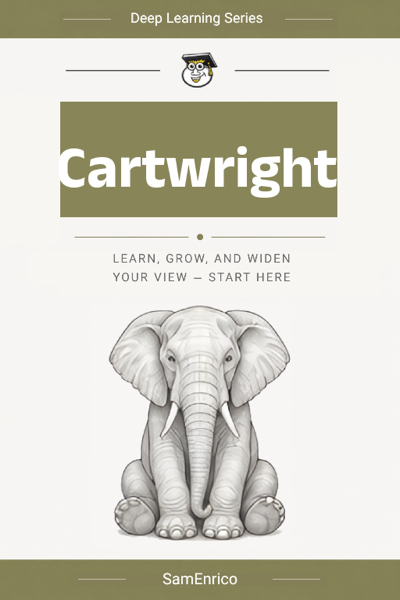
Non-FictionInformativeEducational
Cartwright eBook
A Coursebook on Cartwright
by Shuler Tran
A Coursebook on Cartwright
Formats
Free sample
Chapter 1: The Ecosystem Lie--–- Your org chart is a lie. Not a small lie, like a typo in a quarterly report, but a fundamental, strategic lie that is quietly killing your ability to compete. Every executive I have ever met believes, at some deep, unexamined level, that they run a machine. Departments are cogs. Employees are replaceable parts.
Strategy is a lever you pull to get a predictable output. This metaphor feels good because machines are controllable, predictable, and obedient. But your organization is not a machine. It is a living organism embedded in a dynamic, messy, unpredictable web of relationships—suppliers who might collapse, customers who might vanish, regulators who might pivot, competitors who might become partners, and communities who might suddenly decide you are the villain. Treating an organism like a machine does not make it more efficient.
It makes it blind. And blindness, in business, is fatal.I have watched this blindness destroy companies that appeared invincible. They had market share. They had loyal customers. They had decades of profitability.
And then they disappeared—not because their products became bad, but because they stopped watching the ecosystem shift around them. Blockbuster had the best video rental machine in history. Kodak had the best film photography machine. Nokia had the best mobile phone machine. Each one looked at their org chart, saw healthy departments, and assumed the environment outside the walls was stable.
It was not. By the time they looked up, the ecosystem had already evolved without them.This chapter is about seeing what you have been trained to ignore. It introduces the foundational shift from closed-system thinking (the org chart lie) to open-system thinking (the ecosystem reality). You will learn the Organizational Lifecycle and why most businesses fail at maturity—not because of incompetence but because of attention blindness. You will learn stakeholder mapping, not as a theoretical exercise but as a practical tool for identifying hidden dependencies and opportunities.
And you will learn the law of requisite variety—the uncomfortable truth that your organization must be as complex as the environment it operates in, or it will die. By the end of this chapter, you will never look at an org chart the same way again.The Death of the Closed System The idea that organizations are closed systems is seductive because it simplifies the world. In a closed system, everything that matters is inside the walls. You control inputs, you control processes, you control outputs. The environment outside is either ignored or treated as a source of noise.
This is how most companies are still managed. Budgets are set internally. Strategies are crafted internally. Performance metrics are defined internally. And then, once a year, someone does a "market analysis" that is really just confirmation bias dressed up as research.But here is the truth: there are no closed systems in business.
Not one. Every organization, from a solo freelancer to a multinational conglomerate, is an open system. It depends on resources from outside: raw materials, labor, capital, information, legitimacy. It depends on customers outside to buy its outputs. It depends on regulators outside to grant permission to operate.
It depends on communities outside to tolerate its presence. The moment you pretend otherwise, you start making decisions based on an imaginary world.I once consulted for a mid-sized manufacturing company that was proud of its "efficient internal processes." They had lean manufacturing. They had just-in-time inventory. They had a highly motivated workforce. Their org chart was a thing of beauty.
And they went bankrupt in eighteen months. What happened? A single supplier—their only supplier of a critical component—had a family emergency that led to a change in their leave policy. That policy change caused a slowdown. That slowdown caused a two-week delay in a single shipment.
That delay caused the manufacturer to miss a delivery to their biggest customer. That customer, angry and embarrassed in front of their own clients, terminated the contract. The manufacturer, suddenly missing 40% of their revenue, could not cover fixed costs. Bankruptcy followed.Notice what did not happen. There was no quality problem with the manufacturer's product.
There was no internal mismanagement. There were no labor strikes or technology failures. The manufacturer did everything "right" by closed-system logic. And they died anyway, because they were not watching the ecosystem. They had not mapped their dependencies.
They had not asked: what happens if our only supplier changes something? They had treated a living, fragile relationship as a reliable machine part.This is the ecosystem lie. You believe you are running a machine. You are actually swimming in an ocean.The Organizational Lifecycle: Where Most Businesses Die Every organization follows a predictable pattern of development. Understanding this pattern is not about fortune-telling.
It is about knowing which mistakes you are most likely to make at each stage—and therefore, which warnings you need to watch for. Cartwright's research, drawn from decades of observing businesses across industries, identifies four stages: Birth, Growth, Maturity, and Decline or Renewal.Birth: The organization is small, hungry, and externally focused. Survival depends on understanding customers, suppliers, and competitors. There is no internal bureaucracy because there is no internal structure to speak of. Everyone watches the environment because the environment is all that matters.
The typical mistake at this stage is under-resourcing—failing to build enough internal capacity to handle growth.Growth: The organization has found product-market fit and is expanding. Revenue is increasing. Headcount is increasing. Processes are being formalized. This is when org charts first appear—not as strategic tools but as attempts to coordinate a growing number of people.
The typical mistake at this stage is over-expansion: growing faster than the ecosystem can support, hiring people before the culture is ready, entering markets before the infrastructure is built.Maturity: The organization is stable, profitable, and internally focused. This is the most dangerous stage, because it feels safe. Processes are efficient. Departments are functional. Everyone knows their role.
And precisely because everything feels under control, the organization stops watching the ecosystem. Customer needs shift? The mature company notices too late. A new competitor emerges? The mature company dismisses them as irrelevant.
Regulation changes? The mature company is caught flat-footed. The typical mistake at this stage is attention blindness: looking inward while the outside world changes.Decline or Renewal: At this point, the organization either wakes up or dies. Renewal requires a brutal external reorientation: admitting that the internal processes that worked for years are now liabilities. Decline happens when leadership doubles down on what used to work, insisting that "the market will come back to us." Spoiler: it will not.Here is the insight that most executives miss.
The transition from Growth to Maturity is not caused by anything the organization does wrong. It is caused by success. Profitability creates comfort. Comfort creates attention blindness. Attention blindness creates vulnerability.
The businesses that survive long-term are not the ones that avoid mistakes. They are the ones that, at maturity, deliberately force themselves to look outward again—even when everything seems fine.I worked with a successful retail chain that had reached maturity. Sales were stable. Profits were healthy. The leadership team was proud of their "smooth operations."…
This is the end of the free sample. Get the eBook to keep going. Buy now
About this book
Details
- Author
- Shuler Tran
- Publisher
- SamEnrico
- Language
- English
- Genre
- Non-Fiction, Informative, Educational
- Released
- 2026-06-03
- Pages (approx.)
- 148
- Available as
- eBook, Audiobook

Read better in the ZLOADR app
Your eBooks on your phone or tablet. Sign in with your SamEnrico account and start reading.
More by Shuler Tran
 The Joy of ParentingShuler Tran$11.99
 New Leader Imposter SyndromeShuler Tran$11.99
 Graduation Without CapShuler Tran$11.99
 Assertive Leadership CommunicationShuler Tran$11.99
 Mindfulness for Teen Beginners GuideShuler Tran$11.99
 The Vanished Troubadours: The Lost Songs of Al-AndalusShuler Tran$11.99
 How to Become a Laboratory MillerShuler Tran$11.99
 Understanding Myopathy Congenital Multicore With External OphthalmoplegiaShuler Tran$17.99
 Bad Debt Formula PrimerShuler Tran$12.99
 Okta SWOT Analysis GuideShuler Tran$12.99
You may also like
 Hong Kong Handover 1997Dunn Johnnie$11.99
 Zumba For Postnatal Recovery CourseNeal Christian$11.99
 Zumba for BeginnersLadner Nikia$11.99
 YouTube Comment Mining GuideHumes Pandora$12.99
 Worry Box MeditationCarlin Rudy$11.99
 Workplace Stress MeditationNguyen Lynn$11.99
 Workplace Stress and Sleep RepairHawley Ivory$11.99
 Workplace Perfectionism CureDelaney Jeffry$11.99
 Workplace Injustice Anger GuideWallen Isabelle$11.99
 Work Addiction and Burnout LinkGreenwood Ester$11.99
 Women in Yoga and WellnessBeattie Galina$11.99
 Women in Stand Up ComedyChun Evangeline$11.99