
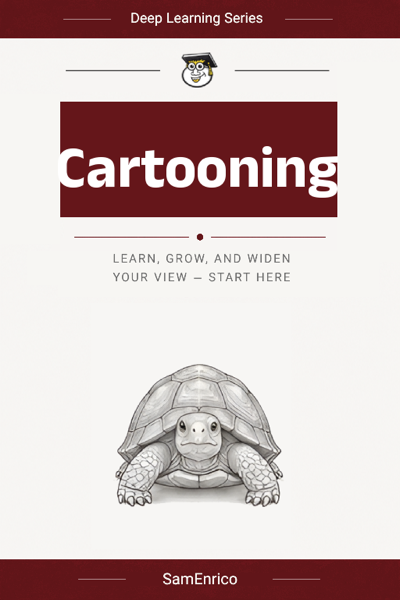
Non-FictionInformativeEducational
Cartooning eBook
A Coursebook on Cartooning
by Trent Vanesa
A Coursebook on Cartooning
Formats
Free sample
Chapter 1: The Forgotten Superpower--Everyone draws as a child. Every single person. You scribbled stick figures with heads too large for their bodies, suns in the corner of every page, and monsters under beds that looked suspiciously like potatoes with teeth. You did this without fear, without judgment, without once asking "Is this good enough?" Then somewhere along the way – probably around the same time you learned that "blue trees" were wrong and that the sun should be yellow and in the corner – you stopped. You decided you weren't an artist.
You decided cartooning was a talent you either had or didn't, like being born with curly hair or perfect pitch.That was a lie.Cartooning is not a talent. It is a language. And like any language – French, Mandarin, Python code, or musical notation – it can be learned by anyone willing to practice. The only difference between you and the cartoonists whose work makes you laugh, cry, or nod in recognition is that they learned the grammar of this language earlier. That's all.
They figured out the secret that this book will teach you on page one, a secret that the top ten bestselling cartooning books all agree on but rarely state plainly enough:Cartooning is the art of controlled distortion.You are not trying to draw realistic human beings. Photographs exist for that. You are not trying to draw architectural blueprints. Engineers exist for that. You are drawing cartoons – simplified, exaggerated, emotionally amplified versions of reality that speak directly to the part of the human brain that processes symbols faster than it processes detail.Consider this: You can recognize a smiley face drawn in three seconds with a Sharpie.
That circle, those two dots, that curved line – it is not a face. It is barely a suggestion of a face. Yet you see happiness in it. You feel something. That is the magic and the mechanics of cartooning.
And you already know how to do it. You just forgot.The Three Lies You Were Told About Drawing Before we touch a single pencil, we need to demolish three beliefs that are currently living in your head, rent-free, sabotaging every drawing you have ever attempted or avoided.Lie #1: "You need to learn realistic drawing first."This is the most destructive lie in art education. It is spread by well-meaning teachers who studied classical realism and assume it is the only foundation. They are wrong for cartooning specifically. Realistic drawing trains you to observe and replicate.
Cartooning trains you to simplify and invent. They are different skill sets. Many brilliant cartoonists cannot draw a realistic portrait to save their lives – and they don't need to. Jack Kirby, the legendary comic book artist who co-created Captain America, the X-Men, and the Avengers, drew bodies with proportions that would horrify an anatomy teacher. Huge hands.
Tiny feet. Shoulders like football pads. And his work is among the most influential visual storytelling of the twentieth century. You do not need to draw a perfect human before you draw a perfect cartoon. You need to draw a convincing cartoon.
This book will teach you convincing.Lie #2: "Some people are just born with it."Talent exists, yes. Some children pick up a crayon at three and seem to understand perspective intuitively. But talent is a head start, not a finish line. Every professional cartoonist you admire has thousands of hours of practice behind them – most of which you will never see because those drawings were bad. They were ugly.
They were embarrassing. They were thrown away or burned out of shame. What you see on Instagram or in the newspaper is the highlight reel, not the blooper reel. The difference between the amateur and the pro is not that the pro never made bad drawings. It is that the pro made so many bad drawings that they eventually, gradually, accidentally bumped into good ones and learned to find their way back.Lie #3: "I can't even draw a straight line."Neither can the pros.
That is why they use rulers. That is why they use French curves. That is why they use the side of their pencil and rotate the page. The idea that real artists draw perfect freehand lines is a myth perpetuated by time-lapse videos that edit out the twenty attempts that came before the one perfect take. Cartooning is not line perfection.
It is line intention. A wobbly line drawn with confidence looks like character. A straight line drawn with hesitation looks like a mistake. This book will teach you intention before perfection.How This Book Works (And How You Should Use It)Before we continue, let me explain the architecture of what you are holding. This book is divided into four parts, each building on the previous one, but with a crucial flexibility that most instruction books lack.Part I: The Foundations teaches you to see like a cartoonist – breaking reality into shapes, capturing gesture, building faces that express emotion.
You will learn the "Ball-and-Sausage" method that every professional animator uses to build characters from simple geometry. This is the non-negotiable bedrock. Do not skip these chapters even if you think you already know how to draw.Part II: Character Creation takes those foundational shapes and turns them into specific, memorable characters – heroes, villains, sidekicks, animals, objects, and everything in between. You will learn why Mickey Mouse works and why your cousin's webcomic character does not. You will learn the shape language of personality.Part III: Worldbuilding and Storytelling teaches you to put those characters into panels, pages, and jokes.
You will learn camera angles, composition, gag structures, lettering, and how to thumbnail an entire comic on one sheet of paper. This section has a special feature: at the end of Chapter 6, you will find a flowchart titled "Which Cartoonist Are You?" If you only want to draw single-panel editorial cartoons (like The New Yorker or political cartoons), you will be directed to skip Chapters 7 through 9 and proceed directly to the business chapters. If you want to draw multi-panel comic strips or webtoons, you will read everything. The book respects your time and your goals.Part IV: Professional Production bridges the gap from your sketchbook to the world. You will learn digital inking and coloring (with analog alternatives for every step), how to pitch your work to syndicates and webtoon platforms, and the real math of self-publishing on Amazon KDP versus chasing traditional deals.
The final chapter offers two tracks: a realistic six-month roadmap for beginners still learning, and a thirty-day launch plan for readers ready to publish now.Throughout the book, every chapter ends with at least one exercise. Do them. Do not read the exercise, nod, and turn the page. The exercise is where the learning happens. The words in this book are the map.
The exercises are the journey.The Tool Question (Solve This Now)One of the most common ways aspiring cartoonists procrastinate is by obsessing over tools. They spend weeks researching pencils, months comparing tablets, years waiting for the "right time" to buy the "right gear." This is a trap. The best cartooning tool is the one you have right now.That said, you will eventually need some tools, and the…
This is the end of the free sample. Get the eBook to keep going. Buy now
About this book
Details
- Author
- Trent Vanesa
- Publisher
- SamEnrico
- Language
- English
- Genre
- Non-Fiction, Informative, Educational
- Released
- 2026-05-11
- Pages (approx.)
- 148
- Available as
- eBook, Audiobook

Read better in the ZLOADR app
Your eBooks on your phone or tablet. Sign in with your SamEnrico account and start reading.
More by Trent Vanesa
 Letting Go of Financial ShameTrent Vanesa$11.99
 The Travel for Work GuideTrent Vanesa$11.99
 Values And Mission Alignment Value Based Innovation GuideTrent Vanesa$11.99
 Mediterranean Meal TimingTrent Vanesa$11.99
 The Complicated Grief Therapy GuideTrent Vanesa$11.99
 The Last Flight of Amelia Earhart: A Voice Lost in the PacificTrent Vanesa$11.99
 Balance Sheet Online GuideTrent Vanesa$12.99
 Visa and Immigration for FranchiseesTrent Vanesa$12.99
 Understanding Trihydroxycholestanoylcoa Oxidase Isolated DeficiencyTrent Vanesa$17.99
 How to Become a Plant PathologistTrent Vanesa$11.99
You may also like
 Hong Kong Handover 1997Dunn Johnnie$11.99
 Zumba For Postnatal Recovery CourseNeal Christian$11.99
 Zumba for BeginnersLadner Nikia$11.99
 YouTube Comment Mining GuideHumes Pandora$12.99
 Worry Box MeditationCarlin Rudy$11.99
 Workplace Stress MeditationNguyen Lynn$11.99
 Workplace Stress and Sleep RepairHawley Ivory$11.99
 Workplace Perfectionism CureDelaney Jeffry$11.99
 Workplace Injustice Anger GuideWallen Isabelle$11.99
 Work Addiction and Burnout LinkGreenwood Ester$11.99
 Women in Yoga and WellnessBeattie Galina$11.99
 Women in Stand Up ComedyChun Evangeline$11.99