
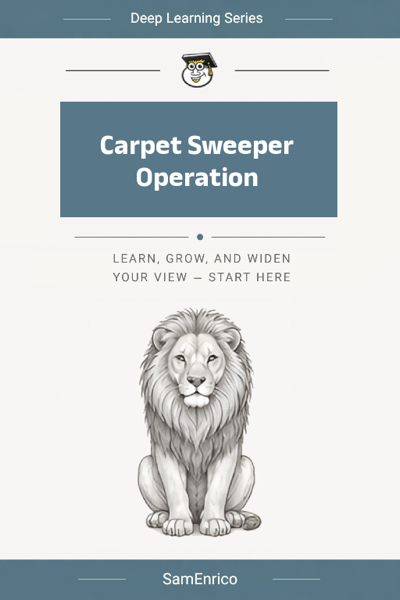
Non-FictionInformativeEducational
Carpet Sweeper Operation eBook
A Coursebook on Carpet Sweeper Operation
A Coursebook on Carpet Sweeper Operation
Formats
Free sample
Chapter 1: The $800 Lie...–- In the spring of 2019, I found myself standing in a closet that contained six vacuum cleaners. There was a bulky upright for the living room carpet, a stick vacuum for the kitchen tiles, a handheld for the car, a cordless for quick messes, a robotic one that spent most of its time trapped under the couch, and a shop vac for the garage. Together, they represented over two thousand dollars of consumer investment. And on that particular Tuesday morning, as I stared at this plastic graveyard of half-empty dust cups and tangled brush rolls, I realized something that would change the way I thought about clean floors forever: not a single one of them was ready to use.The cordless was dead. The stick vacuum had a full bin.
The upright’s belt had snapped two weeks earlier. The robot had beached itself on a throw rug at 3 AM and given up on life. The shop vac was in the garage, which might as well have been another country. And the handheld—well, the handheld had never really worked.So I did what any reasonable person would do. I swept.
I grabbed a broom and dustpan from the laundry room, bent over to scoop up the Cheerios and cat fur, created a small mushroom cloud of dust that settled back onto the floor within minutes, and asked myself the question that became the foundation of this book: Why is this so hard?The answer, as it turned out, was not that I needed a seventh vacuum cleaner. The answer was that I had been thinking about floor cleaning completely backward.The Vacuum Industrial Complex Let me tell you a story that the vacuum cleaner industry would prefer you never hear. In 1901, Hubert Cecil Booth invented the first powered vacuum cleaner—a massive, horse-drawn contraption that parked outside London homes while workers fed hoses through the windows. It was loud, expensive, and absurd. But it worked.
And within a century, the vacuum had completely erased an older, quieter, more sensible technology from the public consciousness: the manual carpet sweeper.Here is what the vacuum industry has spent a hundred years convincing you of. They want you to believe that cleaning your floors requires electricity, bags or filters, regular maintenance, replacement parts, and a significant financial investment. They want you to believe that more suction is always better. They want you to believe that a 800Dysonora800 Dyson or a 800Dysonora1,200 Miele is a sensible purchase for picking up a few crumbs from under the kitchen table. They want you to believe that cleaning should be loud, because loudness equals power.
And they want you to believe that the manual carpet sweeper—that humble, quiet, $30 gadget your grandmother kept in the pantry—is an obsolete relic of a less civilized age.Here is what they will never tell you: the manual carpet sweeper is not a replacement for a vacuum. It is something much more valuable. It is a different category of tool altogether, and for the vast majority of daily floor cleaning tasks, it is objectively superior.Defining Our Terms: Sweeper vs. Vacuum Before we go any further, we need to establish a clear distinction that will serve as the backbone of this entire book. A manual carpet sweeper (hereafter referred to simply as a "sweeper") is a mechanical device that uses rotating brushes powered exclusively by the motion of its wheels to lift debris from carpet and deposit it into a collection bin.
No electricity. No batteries. No suction. Just gears, brushes, and physics.An electric vacuum cleaner uses a motor to create suction, which pulls air (and whatever debris is light enough to be lifted) into a bag or dust cup. Most vacuums also include a beater bar or brush roll to agitate the carpet fibers, but the primary cleaning mechanism is suction, not mechanical pickup.These two tools are not competitors.
They are partners. And the single biggest mistake most households make is using a vacuum when they should be using a sweeper, and vice versa.Think of it this way: you would not use a sledgehammer to hang a picture frame. You would not use a chainsaw to trim your fingernails. And you should not use a $500 vacuum cleaner to clean up a handful of popcorn kernels and a dust bunny. That is not cleaning.
That is performative overkill.The Silent Advantage Let me paint you a picture. It is 2:47 AM. You are a nurse who works the night shift, and you have just gotten home from a twelve-hour shift. You are exhausted, but you cannot sleep because the kitchen floor is covered in crumbs from your spouse’s midnight snack. What do you do?If you own a vacuum, you do nothing.
Because running a vacuum at 3 AM would wake up your spouse, your children, your neighbors, and possibly the family pet three blocks away. Vacuums are loud. Even the "quiet" ones produce 70 to 80 decibels—roughly the volume of a garbage disposal or heavy city traffic. That is not background noise. That is a noise complaint waiting to happen.Now consider the sweeper.
A well-maintained manual carpet sweeper produces approximately 50 to 55 decibels at cruising speed. To put that in perspective, that is quieter than a normal conversation (60 decibels). That is quieter than a refrigerator hum (55 decibels). That is, in many cases, quieter than the central heating system kicking on. You could run a sweeper in the room next to a sleeping baby, and the baby would not stir.But the silent advantage is not just about waking people up.
It is about the psychological freedom to clean whenever you want, without negotiation, without guilt, and without announcing your cleaning activities to the entire household. I have interviewed dozens of sweeper owners for this book, and the most common phrase I hear is some variation of "I can clean while my husband watches TV without him even noticing." That is not a trivial benefit. That is a marriage saver.For elderly users, silence is about safety. Sudden loud noises can startle, increase heart rate, and even trigger falls in people with balance issues or certain medical conditions. A sweeper eliminates that risk entirely.
For individuals with sensory processing disorders, autism, or misophonia, the roar of a vacuum can be genuinely painful or distressing. The sweeper offers a path to a clean home without sensory trauma.And for pet owners? This is where the silent advantage becomes almost magical. Watch a cat or dog react to a vacuum being pulled out of the closet. The ears go back.
The tail tucks. They flee to the farthest corner of the house. Now watch the same animal react to a sweeper. Often, they do not react at all. Some will sit and watch.
A few, I have been told, will follow the sweeper around as if it were a gentle, boring companion rather than a roaring monster. If you love your animals, you owe it to them to consider the sweeper.The Broom and Dustpan Were Always the Enemy Here is a confession that might surprise you: I do not actually hate vacuums. Vacuums have their place, and…
This is the end of the free sample. Get the eBook to keep going. Buy now
About this book
Details
- Author
- Stevens Lydia
- Publisher
- SamEnrico
- Language
- English
- Genre
- Non-Fiction, Informative, Educational
- Released
- 2026-05-06
- Pages (approx.)
- 156
- Available as
- eBook, Audiobook

Read better in the ZLOADR app
Your eBooks on your phone or tablet. Sign in with your SamEnrico account and start reading.
More by Stevens Lydia
 Body Scan for OCDStevens Lydia$11.99
 Mindfulness Based Long Term RegulationStevens Lydia$11.99
 Merchant Marine Convoy RunStevens Lydia$11.99
 Stress and Depression in PartnershipStevens Lydia$11.99
 The Iron Crown: Frederick the Great and the Birth of Modern WarfareStevens Lydia$11.99
 How to Produce Body and Hand Moisturizer With SunscreenStevens Lydia$11.99
 Semantic Preservation GuideStevens Lydia$12.99
 Ultimate Handbook Guide to Hermosillo : (Mexico) Travel GuideStevens Lydia$11.99
You may also like
 Hong Kong Handover 1997Dunn Johnnie$11.99
 Zumba For Postnatal Recovery CourseNeal Christian$11.99
 Zumba for BeginnersLadner Nikia$11.99
 YouTube Comment Mining GuideHumes Pandora$12.99
 Worry Box MeditationCarlin Rudy$11.99
 Workplace Stress MeditationNguyen Lynn$11.99
 Workplace Stress and Sleep RepairHawley Ivory$11.99
 Workplace Perfectionism CureDelaney Jeffry$11.99
 Workplace Injustice Anger GuideWallen Isabelle$11.99
 Work Addiction and Burnout LinkGreenwood Ester$11.99
 Women in Yoga and WellnessBeattie Galina$11.99
 Women in Stand Up ComedyChun Evangeline$11.99