
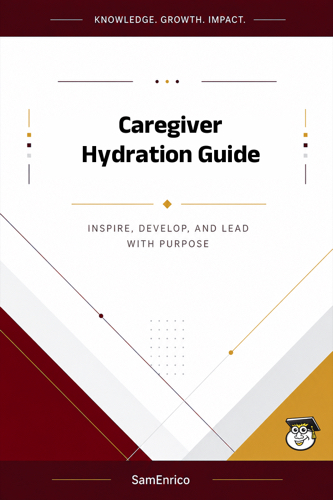
Caregiver Hydration Guide eBook
Drink enough water when you forget to care for you
Drink enough water when you forget to care for yourself.
Formats
Free sample
Chapter 1: The Empty Glass...–- The call came at 2:17 AM. Margaret had been a family caregiver for her husband Edward for three years, ever since his stroke left him partially paralyzed on his left side. She had mastered the medication schedule, the transfers from bed to wheelchair, the pureed meals, and the bedtime routine that took forty-five minutes from start to finish. What she had not mastered—what no one had warned her about—was the simple act of drinking a glass of water for herself.On that February night, Margaret woke to the sound of Edward coughing. She stood up too quickly from the chair beside his bed, felt the room tilt, and collapsed onto the floor.
The paramedics who arrived twenty minutes later found her conscious but confused, her blood pressure alarmingly low, her heart rate elevated to 118 beats per minute. Her lips were cracked. Her skin, when pinched, stayed tented for several seconds before slowly settling back. Her urine, the emergency medical technician later noted in his report, was the color of strong iced tea.Margaret was dehydrated. Not severely enough to require hospitalization—they gave her two liters of intravenous fluids in the emergency room and discharged her six hours later—but severely enough to cause a fall that could have broken her hip.
Severely enough to leave Edward alone in his bed for twenty minutes, unable to call for help because his left side was paralyzed and the phone was on the nightstand to his right. Severely enough that the paramedics, when they arrived, found Edward crying silently, unable to reach the glass of water that Margaret had placed on his bedside table for herself, still full, the ice long since melted into a warm puddle.The paramedics did not write this in their report. But Margaret remembered it. She remembered looking at that full glass of water—her water, poured eight hours earlier, untouched—and realizing that she could not remember the last time she had finished a glass of anything. She could pour.
She could offer. She could hold a cup to Edward's lips and tilt it carefully so he did not choke. But she could not, for the life of her, drink for herself.This is the hidden crisis of family caregiving. It is not the sleeplessness, though that is real. It is not the financial strain, though that is crushing.
It is the quiet, gradual, almost invisible erosion of the most basic act of self-preservation: putting liquid into your own body. And it is happening to millions of people right now, in homes across the country, while the medical establishment focuses almost entirely on the hydration of the patient—the care recipient—and says nothing at all about the person holding the cup.The Invisible Second Patient Every day in the United States, approximately 53 million family caregivers provide unpaid care to an adult family member or friend. This is not a small population. It is nearly one in five American adults. These caregivers spend an average of twenty-four hours per week on direct care tasks, and for those caring for someone with dementia or a severe disability, the number climbs to forty or more hours—a full-time job on top of whatever paid work they are already doing.The economic value of this unpaid labor is estimated at roughly six hundred billion dollars per year, nearly double the annual spending on home health care and nursing homes combined.
But the human cost is measured in something that does not appear on any balance sheet. Caregivers have higher rates of depression, anxiety, and social isolation than non-caregivers. Their risk of developing chronic illness increases by as much as sixty-three percent over the course of a multi-year caregiving episode. They report worse sleep, less exercise, poorer nutrition, and fewer preventive health visits than their peers. And they are significantly more likely to neglect their own basic needs—including the need for water.The medical literature has a name for this phenomenon.
It is called "caregiver neglect of self," and it is defined as the failure to attend to one's own health needs as a direct result of caregiving responsibilities. But this clinical language misses something essential. It sounds as though caregivers are making a choice, a rational calculation that their own health is simply less important. That is not what is happening. What is happening is closer to what psychologists call "inattentional blindness"—the well-documented phenomenon in which a person fails to notice a fully visible object because their attention is focused elsewhere.
You have probably seen the famous video experiment in which people watching a basketball game fail to notice a person in a gorilla suit walking directly through the frame. That is inattentional blindness. And it is exactly what happens when a caregiver pours a glass of water for herself, places it on the table beside her, and then never drinks it. The glass is not invisible. The water is not hidden.
But the caregiver's attention is so completely absorbed by the needs of another person that the glass might as well not exist.This book is called The Caregiver Hydration Guide, but its true subject is not water. Its true subject is attention. Specifically, how to redirect a small fraction of your attention—the tiniest sliver—back toward your own physical self, without guilt, without significant time, and without the feeling that you are abandoning the person you are caring for.Why Dehydration Is Different from Other Forms of Self-Neglect You might be thinking: I already know I am not taking care of myself. I don't sleep enough. I don't exercise.
I eat whatever is fastest. Why should I care specifically about water?This is a fair question, and it deserves a direct answer. Dehydration is different from other forms of self-neglect for three reasons.First, dehydration has a lower threshold for harm. You can skip exercise for weeks without a measurable decline in physical function. You can eat poorly for months before your cholesterol rises.
You can lose sleep for days before your reaction time measurably slows. But you cannot skip water for even a single day without experiencing physiological consequences. A loss of just one to two percent of your body's water content—which can happen after a single day of insufficient drinking—is enough to impair cognitive performance, reduce energy, elevate cortisol, and increase perceived stress. You do not need to be hospitalized to be harmed by dehydration. You just need to be slightly, persistently, almost imperceptibly dry.Second, dehydration is cumulative in ways that other forms of neglect are not.
If you miss a meal, you will feel hungry, and you will likely eat at the next opportunity. If you miss a night of sleep, you will feel tired, and you will likely sleep more the following night. But dehydration does not trigger a strong compensatory drive. Thirst is a notoriously weak signal, especially in older adults and in people who are chronically stressed. By the time you feel thirsty, you are already dehydrated.
And once you are dehydrated, your body's ability to recognize and respond to thirst gets worse. This is a downward spiral. The…
This is the end of the free sample. Get the eBook to keep going. Buy now
About this book
Details
- Author
- Gerber Arcelia
- Publisher
- SamEnrico
- Language
- English
- Genre
- Non-Fiction, Self-Help, Hydration
- Released
- 2026-06-06
- Pages (approx.)
- 129
- Available as
- eBook, Audiobook

Read better in the ZLOADR app
Your eBooks on your phone or tablet. Sign in with your SamEnrico account and start reading.
More by Gerber Arcelia
 Self Hypnosis for Athletic RecoveryGerber Arcelia$11.99
 Military Nap Operational GuideGerber Arcelia$11.99
 Root Cause of RageGerber Arcelia$11.99
 The Training Delivery HandbookGerber Arcelia$11.99
 The Blue Collar TourGerber Arcelia$11.99
 Imposter Syndrome For First Gen ProfessionalsGerber Arcelia$11.99
 Property Management AccountingGerber Arcelia$11.99
 Fibromyalgia Sleep Apnea LinkGerber Arcelia$11.99
 The Crown of the Waves: Portugal's Navigators and the Dawn of Global TradeGerber Arcelia$11.99
 Echoes of the Last Speakers: The Vanishing Tongue of the AinuGerber Arcelia$11.99
 Dien Bien Phu: The Valley That Broke EmpiresGerber Arcelia$11.99
 The Strategist's Guide to Marketing Warfare StrategiesGerber Arcelia$11.99
You may also like
 Hong Kong Handover 1997Dunn Johnnie$11.99
 Zumba For Postnatal Recovery CourseNeal Christian$11.99
 Zumba for BeginnersLadner Nikia$11.99
 YouTube Comment Mining GuideHumes Pandora$12.99
 Worry Box MeditationCarlin Rudy$11.99
 Workplace Stress MeditationNguyen Lynn$11.99
 Workplace Stress and Sleep RepairHawley Ivory$11.99
 Workplace Perfectionism CureDelaney Jeffry$11.99
 Workplace Injustice Anger GuideWallen Isabelle$11.99
 Work Addiction and Burnout LinkGreenwood Ester$11.99
 Women in Yoga and WellnessBeattie Galina$11.99
 Women in Stand Up ComedyChun Evangeline$11.99