
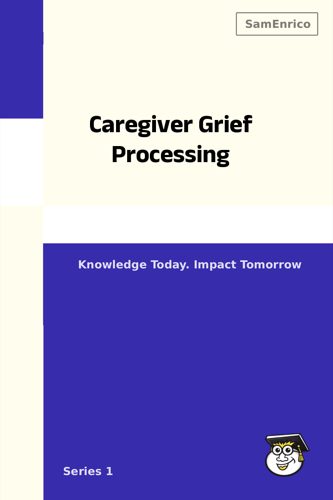
Caregiver Grief Processing eBook
Mourns gradual loss of pre-illness loved one.
by Nolan Elenor
Mourns gradual loss of pre-illness loved one.
Formats
Free sample
Chapter 1: The Living Funeral...--There is a particular silence that exists in the homes of ambiguous loss. It is not the silence of an empty house — that silence at least has the clarity of absence. This silence is heavier. It is the sound of a person sitting in the chair across from you, breathing the same air, occupying the same space, yet somehow not there. You reach for a memory you both once shared — a vacation, a joke, a private moment — and you watch their face register nothing.
Not rejection. Not forgetting. Nothing. That is the silence that wakes you at three in the morning, not with a scream, but with a question you cannot answer: Who am I grieving, and why won't anyone else see it?This chapter is called The Living Funeral for a reason. It is not meant to be dramatic.
It is meant to be accurate.Every day, thousands of caregivers wake up to a person they love who has already left. The body remains. The medical charts have a name. The insurance cards still work. But the person who once laughed at your terrible jokes, who knew your middle name, who held your hand during your own hardest moments — that person is gone.
Not dead. Gone. And because they are not dead, no one brings casseroles. No one takes you to lunch and says, "Tell me about them." No one gives you bereavement leave from work. Instead, you are expected to be grateful.
"At least they're still here," people say. And you nod, because you don't have the words to explain that here is not the same as present.This chapter exists to give you those words. By the time you finish reading it, you will have a name for what you are experiencing. You will understand why it feels different from any grief you have known before. And you will learn a framework for hope that does not require you to pretend the loss hasn't happened.
The name is ambiguous loss. The framework is the distinction between curative hope and connective hope. Together, they will become the foundation for everything else in this book.But first, we have to sit in the silence together. Because before you can heal from something, you have to be able to say what it is.The Woman Who Learned to Stop Saying "Fine"Let me tell you about a woman named Eleanor. I have changed her name and some identifying details, but her story is real, and it is the story of thousands of caregivers who will never tell their own.Eleanor was seventy-three years old when her husband of forty-nine years, David, was diagnosed with early-onset Alzheimer's.
He was sixty-eight. For the first two years, she managed. She learned the language of neurologists and care plans. She hid his car keys gently, then firmly, then with tears. She learned to answer the same question seventeen times in an hour without screaming.
She learned to lie to friends who asked, "How is David doing?" She would say, "Oh, you know. Some days are better than others." This was a lie. There were no better days. There were only days when the forgetting was slower.The moment she realized she was grieving came on a Tuesday. David had been asking for his mother for three hours.
His mother had been dead for thirty-one years. Eleanor finally stopped correcting him and just said, "She's not here right now, sweetheart. But I am." David looked at her — really looked at her, which he rarely did anymore — and said, "Who are you?"Eleanor excused herself, went to the bathroom, closed the door, sat on the edge of the tub, and cried for twenty minutes. Then she washed her face, went back to the living room, and helped David find the television remote for the ninth time that hour.That night, she called her sister. "I feel like I'm at a funeral," she said.
"But no one died." Her sister said, "At least you still have him." Eleanor stopped calling her sister after that.What Eleanor was experiencing was ambiguous loss — a term coined by Dr. Pauline Boss, a family therapist and researcher who spent decades studying families of missing soldiers, kidnapping victims, and later, caregivers of dementia patients. Boss discovered that certain losses defy the normal grieving process because they lack resolution. When someone dies, you have a body. You have a funeral.
You have a before and an after. But when someone is physically present and psychologically absent, you are suspended in a state of frozen grief. You cannot move forward because the person is still there. You cannot go back because the person is gone. You are trapped in the middle, and the middle has no expiration date.This is not a failure of love.
It is not a failure of coping. It is a structural problem with how we understand loss. Our culture has rituals for death. It has no rituals for ambiguous loss. So caregivers like Eleanor are left to invent their own — or more commonly, to swallow their grief and pretend it isn't there.The Three Losses You Are Grieving Right Now (Even If You Can't Name Them)One of the most confusing aspects of ambiguous loss is that you are not grieving one thing.
You are grieving three things simultaneously, and they often contradict each other.First, you are grieving the past. You are grieving the person they used to be — not in a nostalgic, sentimental way, but in a practical, daily way. You are grieving the inside jokes that no longer land. The shared history that now belongs only to you. The way they used to finish your sentences, or the particular sound of their laugh, or the fact that they remembered your birthday without a calendar reminder.
This grief is not abstract. It shows up every time you reach for your phone to tell them something funny and realize they won't understand. Every time you look at an old photograph and feel a punch in your chest because that person is never coming back, even though this person is still breathing.Second, you are grieving the future. This is the grief that catches you off guard. You are not just mourning who they were; you are mourning everything you will never have together.
The retirement you planned. The grandchildren they will barely know. The conversations you assumed you would have about your own aging, your own fears, your own life. This future grief is especially cruel because it is invisible. No one can see the vacation you will never take.
No one sends sympathy cards for the anniversary that will now be spent in silence. You carry this grief alone, and it grows heavier each time you witness another family living the life you were supposed to have.Third, you are grieving the relationship itself. This is the most subtle loss and sometimes the hardest to admit. You are grieving who you were in relation to them. You were a spouse, a child, a sibling, a partner — and now you are a caregiver.
Those are not the same thing. You may still call yourself a wife or a son or a best friend…
This is the end of the free sample. Get the eBook to keep going. Buy now
About this book
Details
- Author
- Nolan Elenor
- Publisher
- SamEnrico
- Language
- English
- Genre
- Non-Fiction, Self-Help, Grief
- Released
- 2026-06-06
- Pages (approx.)
- 145
- Available as
- eBook, Audiobook

Read better in the ZLOADR app
Your eBooks on your phone or tablet. Sign in with your SamEnrico account and start reading.
More by Nolan Elenor
 Micro Movement BreaksNolan Elenor$11.99
 Forest Dream ArchetypeNolan Elenor$11.99
 Traffic Frustration Relief GuideNolan Elenor$11.99
 Loving Kindness for a StillbirthNolan Elenor$11.99
 Depreciation for Real Estate InvestorsNolan Elenor$11.99
 Ojas Vitality GuideNolan Elenor$11.99
 The Business Constraints InnovationNolan Elenor$11.99
 Ilya YashinNolan Elenor$11.99
 Silk Roads and Silver Tongues: The Untold Journey of the First Chinese Diplomat in EuropeNolan Elenor$11.99
 The Billion-Dollar Bet: How a Gambler Built the World's Most Powerful Casino EmpireNolan Elenor$11.99
 Shadows Over the Pacific: The Untold Story of the 1960 U-2 Spy Plane IncidentNolan Elenor$11.99
 The Complete Guide to Fat: The Weight Loss SecretNolan Elenor$11.99
You may also like
 Hong Kong Handover 1997Dunn Johnnie$11.99
 Zumba For Postnatal Recovery CourseNeal Christian$11.99
 Zumba for BeginnersLadner Nikia$11.99
 YouTube Comment Mining GuideHumes Pandora$12.99
 Worry Box MeditationCarlin Rudy$11.99
 Workplace Stress MeditationNguyen Lynn$11.99
 Workplace Stress and Sleep RepairHawley Ivory$11.99
 Workplace Perfectionism CureDelaney Jeffry$11.99
 Workplace Injustice Anger GuideWallen Isabelle$11.99
 Work Addiction and Burnout LinkGreenwood Ester$11.99
 Women in Yoga and WellnessBeattie Galina$11.99
 Women in Stand Up ComedyChun Evangeline$11.99