
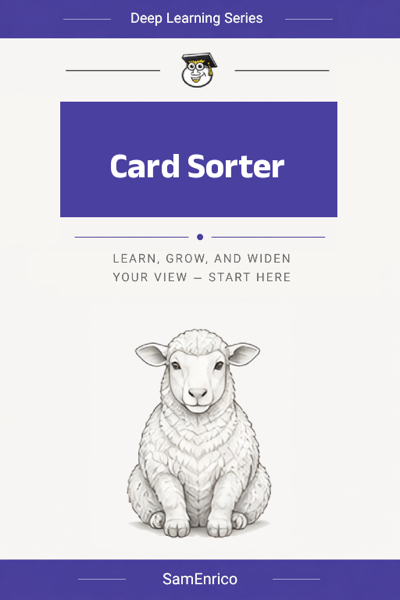
Non-FictionInformativeEducational
Card Sorter eBook
A Coursebook on Card Sorter
by Orosco Kevin
A Coursebook on Card Sorter
Formats
Free sample
Chapter 1: The Sorting Tax...–- Every collector remembers the moment. The moment when a simple question — “Where is that card?” — turns into a forty-five-minute excavation through boxes, binders, and the growing suspicion that the card you need has either been stolen by a younger sibling, eaten by a pet, or somehow phased into another dimension. You pull out stack after stack. You flip. You shuffle.
You sigh. Somewhere in this mountain of cardboard is a single card worth fifty dollars, or five hundred, or perhaps just five dollars of sentimental value that no price tag can capture. But you cannot find it. The pile grows larger. Your frustration grows faster.
And eventually, you give up, close the box, and tell yourself you will organize it “someday.”That moment has a name. It is called the Sorting Tax.The Sorting Tax is the hidden cost of disorganization. It is measured in time, money, and missed opportunities. For the casual collector, the Sorting Tax might mean ten lost minutes before a friendly trade. For a hobbyist with a few thousand cards, it might mean an entire Saturday afternoon wasted searching for a single playset.
For a professional card shop processing tens of thousands of cards per week, the Sorting Tax can rise to thousands of dollars in lost labor, missed sales, and inventory that simply vanishes into the chaos of unsorted stacks.This book is about eliminating the Sorting Tax. It is about understanding how sorting works — not just as a chore, but as a fundamental process that sits at the heart of computing, logistics, and modern commerce. And it is about mastering the tools that make sorting fast, accurate, and even satisfying.But before we can eliminate the Sorting Tax, we must understand what sorting actually is.What Is Sorting, Really?At its most basic level, sorting is the transformation of disorder into order. You begin with an input — a random pile of cards, a messy inbox, a cluttered garage — and you produce an output — a sorted binder, a clean email folder, a garage where you can actually park your car. The input is characterized by entropy, randomness, and unpredictability.
The output is characterized by structure, predictability, and utility.This definition might sound abstract, but it is deliberately so. Because sorting is not just about playing cards. It is about everything. When a spreadsheet sorts a column of numbers from smallest to largest, it is sorting. When a warehouse robot places boxes on a shelf by destination zip code, it is sorting.
When your brain prioritizes your to-do list by urgency, it is sorting. The underlying logic is the same whether the objects are Pokémon cards, census records, or thoughts in your head.The psychologist and Nobel laureate Daniel Kahneman once observed that the human mind is a “machine for jumping to conclusions.” We are pattern recognition engines. We see a seven of hearts and instantly know where it belongs between the six and the eight. We glance at a messy room and immediately identify the largest category of objects — books, clothes, dishes — that needs attention first. This intuitive ability is one of our greatest strengths.
But it is also a trap.Because machines do not have intuition.The Human Card Sorter Exercise To understand why machines sort differently than humans, you need to experience the difference firsthand. I want you to try a simple exercise. Take a standard deck of fifty-two playing cards. Shuffle them thoroughly. Now sort them by suit and number — all the hearts in order from ace to king, then all the diamonds, and so on.
Use your hands. Use your eyes. Do it as quickly as you can.If you are like most people, you will finish in somewhere between sixty and ninety seconds. You will probably use a method that feels natural: you might spread the cards out on a table, pick out all the hearts first, then arrange them by number. Or you might build four separate piles simultaneously, dropping each card onto the correct pile as you flip through the deck.
Either way, you are relying on your brain’s remarkable ability to recognize patterns instantly. You see a club, and without thinking, your hand moves toward the club pile. You see a king, and you know it goes at the high end of the sequence.Now try something different. Sort the same deck again, but this time, you are not allowed to use your eyes. You can only use your sense of touch.
You must flip through the cards one at a time, and for each card, you may only compare it to one other card at a time. You cannot spread them out. You cannot see all the clubs at once. You can only hold two cards in your hands at any moment and ask: “Is this card higher or lower than that card?”What happens? The task becomes dramatically slower.
You lose your intuitive grasp of where each card belongs. You find yourself comparing the same cards multiple times. You forget which cards you have already placed. The process becomes mechanical, laborious, and frustrating.Congratulations. You are now thinking like a sorting machine.The Machine’s Dilemma A machine does not have intuition.
A machine does not have peripheral vision. A machine does not have a mental map of where everything belongs. All a machine has is a set of explicit, step-by-step instructions called an algorithm. An algorithm must be so precise that a literal-minded entity — a machine with no common sense, no context, and no ability to infer — can follow it perfectly.Consider what this means for sorting. When you sort cards manually, you might glance at a seven of diamonds and think, “That goes between the six and the eight of diamonds, three inches to the left of my thumb.” You do not consciously calculate this.
You just see it. A machine, by contrast, cannot “see” where the seven belongs. It can only execute comparisons. It can take the seven, compare it to the six, determine that seven is higher, then compare it to the eight, determine that seven is lower, and then — only then — insert the seven between them.This might sound inefficient. And for small piles, it is.
But here is the paradox that drives the entire field of sorting theory: machines are incredibly good at doing simple, repetitive tasks very quickly. A human might sort fifty cards in sixty seconds with minimal mental effort. A machine might need to make hundreds of individual comparisons to sort those same fifty cards — but it can make those comparisons in milliseconds. The machine’s per-comparison time is thousands of times faster than a human’s. So even though the machine needs more comparisons overall, it finishes far sooner.The challenge, then, is not whether machines can sort.
The challenge is designing algorithms that minimize the number of comparisons and movements required. Because every extra comparison costs time. Every unnecessary movement costs energy. And when you are sorting millions of cards — as a major card shop might do in a year — those small costs add up to real money.The Vocabulary of Sorting Before we go further…
This is the end of the free sample. Get the eBook to keep going. Buy now
About this book
Details
- Author
- Orosco Kevin
- Publisher
- SamEnrico
- Language
- English
- Genre
- Non-Fiction, Informative, Educational
- Released
- 2026-05-07
- Pages (approx.)
- 133
- Available as
- eBook, Audiobook

Read better in the ZLOADR app
Your eBooks on your phone or tablet. Sign in with your SamEnrico account and start reading.
More by Orosco Kevin
 The Chronic Fatigue Meditation GuideOrosco Kevin$11.99
 Pinterest VA Portfolio From ScratchOrosco Kevin$11.99
 Hormone Therapy for Breast CancerOrosco Kevin$11.99
 Email Smart Folder SystemOrosco Kevin$11.99
 Small Talk for Fundraising EventsOrosco Kevin$11.99
 The Billion-Dollar Bet: How a Poker Pro Built a Tech EmpireOrosco Kevin$11.99
 The Whale Hunters and the Plastic Revolution: How Industrial Chemistry Changed the PacificOrosco Kevin$11.99
 Theme Day Blocking GuideOrosco Kevin$12.99
 Termii YC Application GuideOrosco Kevin$12.99
 How to Start a Cartons and Similar Containers for Carrying Liquids (waxed) Business (Beginners GuideOrosco Kevin$11.99
 Understanding Cogan–reese SyndromeOrosco Kevin$17.99
You may also like
 Hong Kong Handover 1997Dunn Johnnie$11.99
 Zumba For Postnatal Recovery CourseNeal Christian$11.99
 Zumba for BeginnersLadner Nikia$11.99
 YouTube Comment Mining GuideHumes Pandora$12.99
 Worry Box MeditationCarlin Rudy$11.99
 Workplace Stress MeditationNguyen Lynn$11.99
 Workplace Stress and Sleep RepairHawley Ivory$11.99
 Workplace Perfectionism CureDelaney Jeffry$11.99
 Workplace Injustice Anger GuideWallen Isabelle$11.99
 Work Addiction and Burnout LinkGreenwood Ester$11.99
 Women in Yoga and WellnessBeattie Galina$11.99
 Women in Stand Up ComedyChun Evangeline$11.99