
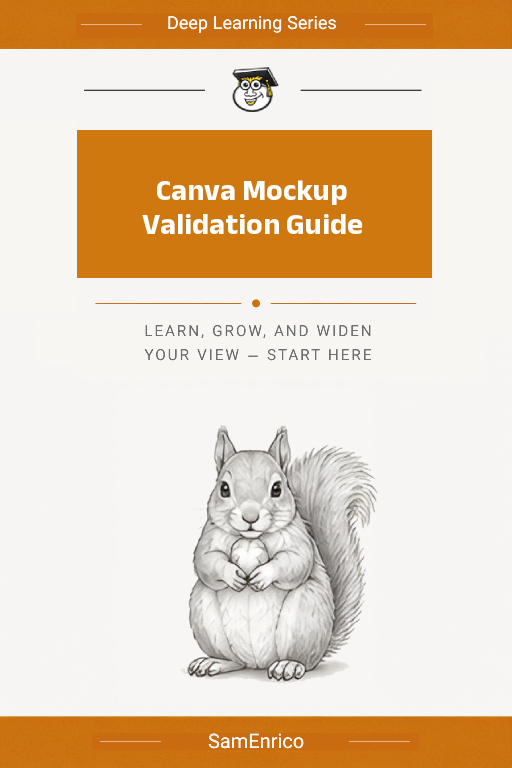
Non-FictionStartup GuideCanvaMockups
Canva Mockup Validation Guide eBook
Create free product mockups using Canva to test vi
by Post Nenita
Create free product mockups using Canva to test visual appeal and packaging with potential customers.
Formats
Free sample
Chapter 1: The Visual Trap--–- Most entrepreneurs discover they have a problem the same way I did: sitting in a warehouse surrounded by boxes of something nobody wants.My name isn’t important, but my mistake is. Two years ago, I spent $7,400 on 2,000 units of a “revolutionary” kitchen gadget. I had validated everything. I surveyed one hundred people (friends and family, mostly). I built a prototype that worked flawlessly.
I even had a patent pending. What I didn’t have was a single customer who actually wanted to look at the thing.The gadget was ugly. Not “subjectively not to my taste” ugly. I mean painfully, obviously, clunkily ugly. The colors clashed.
The logo was unreadable at arm’s length. On a crowded Amazon search result, it looked like a gray brick next to competitors’ sleek, colorful, inviting product shots. And I had spent seven thousand dollars learning this lesson that I could have learned in one afternoon with a free Canva account.This book exists because that warehouse still haunts me. And because I’ve since watched hundreds of other entrepreneurs make the exact same mistake—spending thousands on inventory, molds, packaging, and prototypes before ever testing whether their product looked like something a stranger would want to pick up.This chapter dismantles the single most dangerous myth in product development: that customers make decisions based on features, quality, or logic. They don’t.
Not at first. Before the brain engages in rational thought—before it processes your “premium materials” or “lifetime warranty”—it has already decided, in less than three seconds, whether your product is worth a second glance.That decision is almost entirely visual.The Three Seconds That Decide Everything In 2006, Princeton psychologists Janine Willis and Alexander Todorov published a study that should be required reading for every entrepreneur. They showed participants photographs of faces for as little as one-tenth of a second and asked them to rate attractiveness, likeability, competence, and trustworthiness. The results were astonishing: the ratings given after one-tenth of a second correlated almost perfectly with ratings given when participants had unlimited time.One-tenth of a second.Your product doesn’t get one-tenth of a second on Amazon or Instagram. It gets about three.
But the principle is identical: visual judgments happen before conscious thought. They are emotional, instantaneous, and remarkably stable. If your product fails that three-second visual test, it will never reach the feature-evaluation stage. No one will read your bullet points about “ergonomic design” or “sustainable materials” because they’ve already scrolled past.I call this the Visual First Hypothesis: For any consumer product, visual appeal is the primary gatekeeper. Functionality, price, and quality only matter after the product has passed the three-second visual audition.Consider these examples:Product A: A beautifully packaged cold brew coffee can.
Matte black finish. Minimalist typography. A small window showing the liquid inside. Launches on Instagram with a waiting list of 5,000 people. Sells out in four hours.Product B: The exact same cold brew recipe.
Same price. Same quality. But packaged in a generic white can with Comic Sans labeling. Launches to crickets. The founder posts on Reddit: “I don’t understand.
The coffee is amazing. Why isn’t anyone buying?”The coffee didn’t change. The visuals did.This is not superficial. This is not “judging a book by its cover.” This is how the human brain has evolved to process information in an environment of overwhelming abundance. Your customer sees hundreds, sometimes thousands, of product images every day.
The brain has developed a rapid filtering system: interesting? click. not interesting? scroll. Your product’s visuals are not decoration.
They are the filter through which every other attribute must pass.The Cost of Getting It Wrong Let me be specific about what “getting it wrong” actually costs, because vague warnings about “lost sales” don’t motivate action. Real numbers do.The Prototype Trap: A hardware entrepreneur I know spent 18,000oninjectionmoldsforaphoneaccessorybeforeshowingasinglevisualtoastranger.Theproductworkedperfectly.Itwasdurable,functional,andclever.Butwhenshefinallypostedaphotoonsocialmedia,theresponsewasbrutal:“Lookslikeamedicaldevice.”“Whyisitgray?”“Idon’tgetwhat I’mlookingat.”Shehadspenteighteenthousanddollarstolearnthatherproductlookedlikesomethingfromahospitalsupplycatalog.A18,000 on injection molds for a phone accessory before showing a single visual to a stranger. The product worked perfectly. It was durable, functional, and clever. But when she finally posted a photo on social media, the response was brutal: “Looks like a medical device.” “Why is it gray?” “I don’t get what I’m looking at.” She had spent eighteen thousand dollars to learn that her product looked like something from a hospital supply catalog.
A 18,000oninjectionmoldsforaphoneaccessorybeforeshowingasinglevisualtoastranger.Theproductworkedperfectly.Itwasdurable,functional,andclever.Butwhenshefinallypostedaphotoonsocialmedia,theresponsewasbrutal:“Lookslikeamedicaldevice.”“Whyisitgray?”“Idon’tgetwhat I’mlookingat.”Shehadspenteighteenthousanddollarstolearnthatherproductlookedlikesomethingfromahospitalsupplycatalog.A20 mockup test would have told her the same thing in 48 hours.The Packaging Disaster: A food startup founder ordered 10,000 custom boxes for his artisanal granola. The boxes were beautiful—to him. Forest green with gold foil. Hand-illustrated squirrels. He showed them to his mother (she cried, said they were gorgeous) and his business partner (he approved).
Six months later, the granola was failing on shelves. The problem? In a sea of bright, energetic breakfast packaging, his forest green boxes looked muddy and unappetizing. Customers literally couldn’t see them. He spent $12,000 on boxes that made his product invisible.
A simple shelf-mockup test, placing his design next to five competitors, would have revealed the problem in minutes.The Social Media Black Hole: A fashion brand launched a new line of totes. They had beautiful product photography on a white background—clean, professional, expensive. They spent $5,000 on Instagram ads. Zero sales. Why?
Because on Instagram, surrounded by lifestyle shots of people using bags in coffee shops and farmers markets, their sterile white-background photos looked like catalog images. Boring. Unremarkable. The product itself was fine. But the visual context was wrong for the platform.
A simple A/B test with two different mockup styles would have saved that ad spend.I could fill this entire chapter with stories like these. I’ve collected more than fifty of them over the past two years. The pattern is always the same: a founder invests in manufacturing, packaging, or inventory before validating the visual appeal of their product. The investment ranges from 2,000to2,000 to 2,000to200,000. The failure is almost always predictable—and avoidable.The average cost of these mistakes, across the fifty cases I’ve analyzed, is $14,300.That’s not a typo.
Fourteen thousand, three hundred dollars. The price of a used car. A semester of college. A year of rent in many cities. Wasted because someone didn’t spend an afternoon making a mockup and showing it to strangers.The Mockup Versus the Prototype (Critical Distinction)Before we go any further, I need to clarify a distinction that will save you enormous time and money.
It’s the difference between a mockup and a prototype, and most entrepreneurs confuse them.A prototype is a functional model. It works. It may be made of different materials (3D-printed plastic instead of injection-molded ABS), and it may look rough, but it demonstrates that the product can perform its intended function. Prototypes answer the question: Does it work?A mockup is a visual representation. It doesn’t work.
It may be entirely digital. It may be a photograph of a box with a printed label wrapped around it.…
This is the end of the free sample. Get the eBook to keep going. Buy now
About this book
Details
- Author
- Post Nenita
- Publisher
- SamEnrico
- Language
- English
- Genre
- Non-Fiction, Startup Guide, Canva, Mockups
- Released
- 2026-06-01
- Pages (approx.)
- 124
- Available as
- eBook, Audiobook

Read better in the ZLOADR app
Your eBooks on your phone or tablet. Sign in with your SamEnrico account and start reading.
More by Post Nenita
 New Zealand Warmer Kiwi HomesPost Nenita$11.99
 Gaming Dopamine DetoxPost Nenita$11.99
 Idea Evaluation Group Methods WorkbookPost Nenita$11.99
 Bodyweight 30 Day ChallengePost Nenita$11.99
 Workplace Stress Reduction for Physical TherapistsPost Nenita$11.99
 Codex of the Lost: The Forbidden Library of AlexandriaPost Nenita$11.99
 How to Become a Caddie SupervisorPost Nenita$11.99
 Startup Funding Sources GuidePost Nenita$12.99
 Understanding Chromosome 5, Trisomy 5pPost Nenita$17.99
 Peanut HarvestingPost Nenita$11.99
You may also like
 Hong Kong Handover 1997Dunn Johnnie$11.99
 Zumba For Postnatal Recovery CourseNeal Christian$11.99
 Zumba for BeginnersLadner Nikia$11.99
 YouTube Comment Mining GuideHumes Pandora$12.99
 Worry Box MeditationCarlin Rudy$11.99
 Workplace Stress MeditationNguyen Lynn$11.99
 Workplace Stress and Sleep RepairHawley Ivory$11.99
 Workplace Perfectionism CureDelaney Jeffry$11.99
 Workplace Injustice Anger GuideWallen Isabelle$11.99
 Work Addiction and Burnout LinkGreenwood Ester$11.99
 Women in Yoga and WellnessBeattie Galina$11.99
 Women in Stand Up ComedyChun Evangeline$11.99