
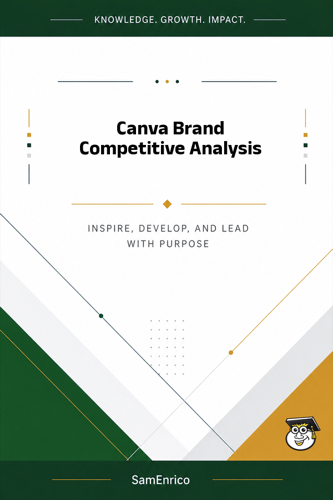
Non-FictionZero-to-One Creator
Canva Brand Competitive Analysis
Research competitor brands and design a distinctiv
Research competitor brands and design a distinctive identity that stands out.
Formats
About this book
Free sample
Chapter 1: The Canva Paradox--–- In 2013, a free online design tool launched with a mission to "democratize design." Over the next decade, Canva grew to over 150 million monthly active users, generated billions in revenue, and became synonymous with accessible creativity. Small business owners, nonprofit managers, social media coordinators, and solopreneurs rejoiced: finally, professional-looking design was available to everyone, regardless of skill level or budget. No more expensive agency retainers. No more steep learning curves of Adobe software. No more hiring freelancers for basic flyers and social posts.But something unexpected happened on the road to democratization.
Instead of a vibrant explosion of diverse, creative brand identities, we witnessed a quiet, creeping homogenization. Walk through any Instagram feed, browse Shopify stores, or flip through a stack of business cards collected at a local networking event. A disturbing pattern emerges. The same fonts appear again and again. The same color palettes.
The same layout structures. The same stock photography aesthetics. A visual monoculture has taken root, and at the center of it sits Canva—not as the villain, but as the enabler of an unintentional crisis.This chapter opens with a harsh but necessary truth: the tool that promised to set your brand free has, for the vast majority of its users, trapped it inside a visual prison of sameness. Understanding why this happened is the first and most critical step toward escaping it.The Rise of Template Fatigue Before Canva, there was a different problem. Small businesses produced ugly, inconsistent, amateurish design because they lacked access to both tools and training.
Business cards were created in Microsoft Word. Logos were clip art from the early internet. Social media graphics were pixelated screenshots of text. The barrier to entry was high, and the results were often embarrassing.Canva solved that problem brilliantly. It offered thousands of professionally designed templates.
It provided access to millions of stock photos. It curated font pairings that actually worked together. For the first time, anyone could produce something that looked undeniably "professional" in under ten minutes. This was a genuine revolution, and it should be celebrated.But success…
This is the end of the free sample. Get the eBook to keep going. Buy now
Contents
- Chapter 1
- Chapter 2
- Chapter 3
- Chapter 4
- Chapter 5
- Chapter 6
- Chapter 7
- Chapter 8
- Chapter 9
- Chapter 10
- Chapter 11
- Chapter 12
Details
- Author
- Crowley Larita
- Publisher
- SamEnrico
- Language
- English
- Genre
- Non-Fiction, Zero-to-One Creator
- Released
- 2026-06-07
- Pages (approx.)
- 152
- Available as
- eBook, Audiobook

Read better in the ZLOADR app
Your eBooks on your phone or tablet. Sign in with your SamEnrico account and start reading.
More by Crowley Larita
 Mobile Cart Product SamplingCrowley Larita$11.99
 Social Anxiety Body LanguageCrowley Larita$11.99
 Cigarette Money Savings TrackerCrowley Larita$11.99
 The Unseen Symphony: How a Deaf Musician Composed the World’s First Silent ConcertoCrowley Larita$11.99
 AI Lesson Planning for TeachersCrowley Larita$12.99
 Learn to Play the ShofarCrowley Larita$11.99
 Engineering ExecutiveCrowley Larita$11.99
 How to Become a Gas-leak Inspector HelperCrowley Larita$11.99
You may also like
 Hong Kong Handover 1997Dunn Johnnie$11.99
 Zumba For Postnatal Recovery CourseNeal Christian$11.99
 Zumba for BeginnersLadner Nikia$11.99
 YouTube Comment Mining GuideHumes Pandora$12.99
 Worry Box MeditationCarlin Rudy$11.99
 Workplace Stress MeditationNguyen Lynn$11.99
 Workplace Stress and Sleep RepairHawley Ivory$11.99
 Workplace Perfectionism CureDelaney Jeffry$11.99
 Workplace Injustice Anger GuideWallen Isabelle$11.99
 Work Addiction and Burnout LinkGreenwood Ester$11.99
 Women in Yoga and WellnessBeattie Galina$11.99
 Women in Stand Up ComedyChun Evangeline$11.99