
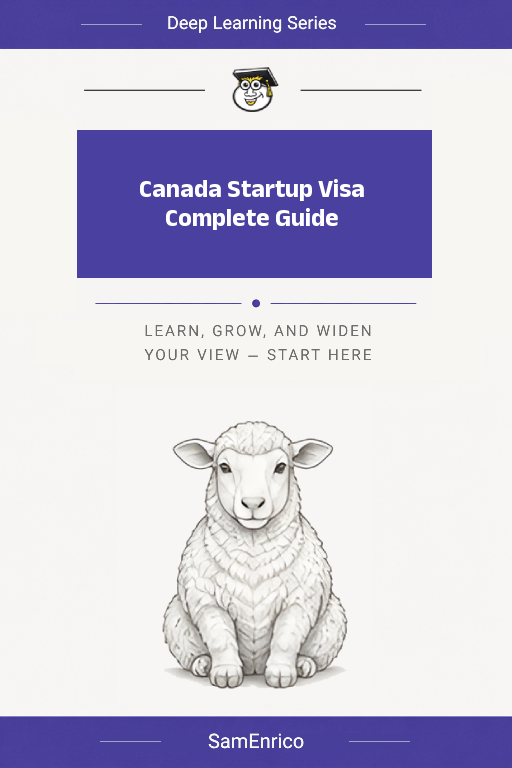
Non-FictionStartup GuideFounder Immigration
Canada Startup Visa Complete Guide eBook
Apply for Canada's Startup Visa as a founder. Lett
Apply for Canada's Startup Visa as a founder. Letter of support, designated organizations, and permanent residency.
Formats
Free sample
Chapter 1: The $15,000 Backdoor--Most founders believe they need a million dollars, a job offer, or a world-class lawyer to move to Canada. They are wrong on all three counts.The Canada Startup Visa (SUV) is the most misunderstood immigration program in the country's history. Immigration consultants charge 50,000to"guarantee"yourapplication.Onlineforumsarefilledwithhorrorstoriesoffounderswhospenttwoyearsand50,000 to "guarantee" your application. Online forums are filled with horror stories of founders who spent two years and 50,000to"guarantee"yourapplication.Onlineforumsarefilledwithhorrorstoriesoffounderswhospenttwoyearsand100,000 only to receive a refusal letter. Meanwhile, thousands of successful applicants land in Toronto, Vancouver, and Montreal every year with nothing more than a viable business idea, a committed team, and roughly CAD $15,000 in settlement funds.This chapter is not a gentle warm-up.
It is a blunt-force instrument designed to save you years of confusion, tens of thousands in wasted fees, and the soul-crushing experience of applying to the wrong immigration stream. By the end of these pages, you will know exactly whether the Startup Visa is your path — or whether you should walk away right now.The Great Canadian Immigration Myth Before we dive into the mechanics of the SUV, we need to dismantle a dangerous myth that has cost founders countless hours and dollars.The myth sounds like this: "Canada wants entrepreneurs, so any business owner can immigrate through the Startup Visa."This is false. Dangerously false.Canada wants a very specific type of entrepreneur. The government is not looking for restaurant owners, franchise operators, real estate developers, or independent consultants. These are all perfectly respectable businesses.
They create jobs. They pay taxes. They serve communities. But they do not belong in the Startup Visa program.What Canada wants, according to the Immigration and Refugee Protection Regulations (IRPR Section 216), is a startup that is "innovative," "scalable," and capable of "creating significant employment opportunities for Canadian citizens or permanent residents." In plain English: they want businesses that can grow from three founders to three hundred employees. They want intellectual property.
They want global reach. They want the next Shopify, not the next corner bakery.Understanding this distinction is the difference between spending eighteen months on a successful application and spending the same eighteen months heading toward an inevitable refusal.The Four Paths to Canada: A Brutal Comparison If you are a founder reading this book, you have four legitimate pathways to Canadian permanent residency. Each has different requirements, timelines, and success rates. Let me destroy any illusions about the alternatives before you commit to the SUV.Path One: The Intra-Company Transfer (C11). This route requires you to already own or work for a company with an established Canadian subsidiary.
You must have been employed by the foreign company for at least one year in a specialized role. The Canadian operation must be viable. The processing time is unpredictable. And most importantly, this is a work permit, not permanent residency. You will need to spend years in Canada before you can apply for PR, all while keeping the foreign and Canadian entities operational.
For most early-stage founders with a single startup, this is not feasible.Path Two: Provincial Nominee Program Entrepreneur Streams (PNP). Every province except Quebec runs its own entrepreneur program. On paper, these look attractive. In reality, they are brutal. You typically need a net worth of CAD 600,000to600,000 to 600,000to1.5 million.
You must make a minimum investment of CAD 200,000to200,000 to 200,000to400,000. You must create two to five jobs for Canadians. And here is the killer: you receive a work permit first, not PR. You must operate the business for one to two years, proving its success, before you can be nominated for permanent residency. If the business struggles, you are deported.
Tens of thousands of entrepreneurs have lost everything chasing PNP entrepreneur streams.Path Three: Owner/Operator LMIA. This used to be the go-to route for founders. You would incorporate in Canada, then apply for a Labour Market Impact Assessment (LMIA) to hire yourself as a worker. The system was gamed to death. In 2024, IRCC effectively killed this pathway by removing the owner-operator exemption from the LMIA process.
Today, you would need to prove that no Canadian can do your job — a nearly impossible standard for a founder who has unique knowledge of their own startup. This path is dead. Do not let any consultant tell you otherwise.Path Four: The Startup Visa (SUV). No net worth requirement. No minimum investment (beyond settlement funds).
No LMIA. No requirement to prove that no Canadian can do your job. You apply for permanent residency directly, not a work permit (though you can get a work permit first if you want to move early). Your entire team lands with PR simultaneously. If the business eventually fails, you keep your PR status as long as you acted in good faith.The SUV is not perfect.
It has its own challenges, which we will explore throughout this book. But for the right founder, it is the closest thing to a backdoor into Canadian permanent residency that exists.The Three Non-Negotiable Requirements Before you read another word, you need to understand the three things you absolutely must have to qualify for the Startup Visa. If you are missing any of these, stop reading and either fix the gap or pursue a different immigration pathway.Requirement One: A Qualifying Business Your business must meet three legal tests under IRPR Section 216(3):First, at the time you receive your Letter of Support (more on this in Chapter 6), each essential founder must hold at least 10% of the voting rights in the corporation. Collectively, the essential founders must hold more than 50% of the total voting rights. This means you cannot be a solo founder with passive investors who control the company.
You must have active co-founders, and together you must control the business.Second, the business must be incorporated in Canada. You cannot apply as a foreign entity and hope to move later. You will need to incorporate federally or provincially after receiving your Letter of Support but before filing your PR application. Chapter 7 provides the exact timeline.Third, the business must be "innovative." This is the vaguest requirement and the one that kills most applications. IRCC officers have broad discretion to decide what counts as innovative.
Based on thousands of approved and refused cases, we know that software-as-a-service (Saa S), artificial intelligence, fintech, cleantech, life sciences, and hardware with proprietary IP are consistently approved. Restaurants, retail stores, consulting firms, real estate agencies, and local service businesses are consistently refused. Chapter 3 provides the complete "Clean vs. Dirty" framework to evaluate your own business concept.Requirement Two: A Letter of Support from a Designated Organization You cannot apply for the Startup Visa on your own. You must first be accepted by a Designated Organization (DO) — an incubator, angel group, or venture capital fund approved by IRCC.
This DO will issue you a Letter of Support (also called a Commitment Certificate), which you will include with your PR application.The DO acts as a filter. IRCC trusts DOs to do initial due diligence on your business and team. If you cannot convince any DO to accept you, IRCC does not want your application.There are three types of DOs:Business Incubators (85% of SUV applicants use this route): You join…
This is the end of the free sample. Get the eBook to keep going. Buy now
About this book
Details
- Author
- Christianson Carson
- Publisher
- SamEnrico
- Language
- English
- Genre
- Non-Fiction, Startup Guide, Founder Immigration
- Released
- 2026-06-01
- Pages (approx.)
- 145
- Available as
- eBook, Audiobook

Read better in the ZLOADR app
Your eBooks on your phone or tablet. Sign in with your SamEnrico account and start reading.
More by Christianson Carson
 CrossFit Rope Climb MasteryChristianson Carson$11.99
 Anger Restructuring For MedicalChristianson Carson$11.99
 The Green Vehicle HuntChristianson Carson$11.99
 Body Scan for Long COVID FatigueChristianson Carson$11.99
 The Entrepreneur Networking GuideChristianson Carson$11.99
 The Silent War: Europe’s Supermax Prisons and the Psychology of IsolationChristianson Carson$11.99
 Understanding Vertical TalusChristianson Carson$17.99
 Factoring for Oil & GasChristianson Carson$12.99
 Operations Center EngineerChristianson Carson$11.99
 How to Start a Deposit Broker Business (Beginners Guide)Christianson Carson$11.99
You may also like
 Hong Kong Handover 1997Dunn Johnnie$11.99
 Zumba For Postnatal Recovery CourseNeal Christian$11.99
 Zumba for BeginnersLadner Nikia$11.99
 YouTube Comment Mining GuideHumes Pandora$12.99
 Worry Box MeditationCarlin Rudy$11.99
 Workplace Stress MeditationNguyen Lynn$11.99
 Workplace Stress and Sleep RepairHawley Ivory$11.99
 Workplace Perfectionism CureDelaney Jeffry$11.99
 Workplace Injustice Anger GuideWallen Isabelle$11.99
 Work Addiction and Burnout LinkGreenwood Ester$11.99
 Women in Yoga and WellnessBeattie Galina$11.99
 Women in Stand Up ComedyChun Evangeline$11.99