
Non-FictionInformativeEducational
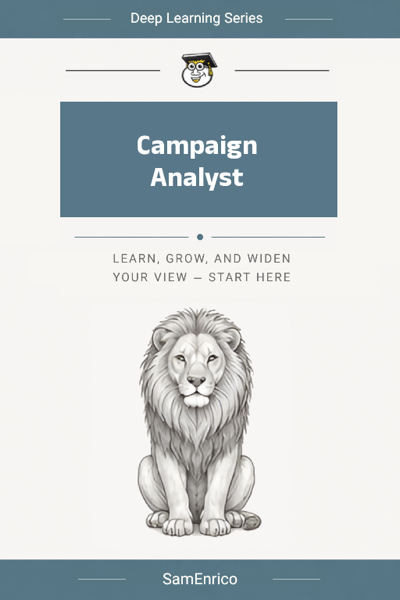
Campaign Analyst eBook
A Coursebook on Campaign Analyst
A Coursebook on Campaign Analyst
Formats
Free sample
Chapter 1: The Loser’s Epiphany--I was fired on a Tuesday.Not with drama. Not with shouting. The campaign manager pulled me into a conference room that smelled like stale coffee and desperation, handed me an envelope with two weeks of severance, and said, “You’re not a bad analyst. You’re just not a winner.”I was twenty-four years old. I had worked eighty-hour weeks for seven months.
I had built spreadsheets that tracked every known voter in a three-county district. I had written Python scripts to clean voter file data that no one else wanted to touch. And I had just watched my candidate—a charismatic, well-funded, endorsed-by-everyone prospect—lose by twelve points.The post-mortem was brutal. The campaign had raised more money than any challenger in district history. They had run television ads that tested well in focus groups.
They had recruited hundreds of volunteers. They had done everything the old playbook said to do.And they lost.Not because the opponent was popular. Not because the economy shifted in the final week. Not because of some scandal or October surprise. They lost because they confused activity with progress.
They knocked on doors—millions of them—but most of those doors belonged to people who had already decided. They sent mail pieces to every household, but the households that mattered most got the same generic message as everyone else. They raised money from everywhere, then spent it on everything, with no sense of which dollars moved votes and which dollars burned.I was part of that failure. My spreadsheets had looked beautiful. My Python scripts ran without errors.
But I had never asked the question that would have saved the campaign: What are we actually learning?That question became my obsession.The Activity Trap In the years that followed, I worked on fourteen campaigns across nine states. I lost five more times before I started winning. And in every loss, I saw the same pattern.Call it the Activity Trap.A campaign hires staff. Staff build lists. Lists generate tasks.
Tasks produce phone calls, door knocks, emails, texts, mail pieces, and ads. Everyone is busy. Everyone is exhausted. The candidate is traveling constantly, shaking hands at diners and Rotary clubs. The finance director is burning through call time.
The field organizer is driving two hundred miles a day.But when you ask the campaign manager a simple question—“How many persuadable voters have we contacted in the last seven days?”—the answer is usually a blank stare followed by a guess.The Activity Trap feels like momentum. It feels like hard work. It feels like a campaign that cares. But it is the single most common cause of well-funded, high-profile losses.Here is the hard truth that separates winning campaigns from losing ones: Activity is not strategy. Data is not insight.
And effort does not guarantee outcomes.The winning campaigns I studied—the ones that consistently overperformed their polls, their fundraising, and their historical baselines—had something the losers lacked. They had a learning loop.The Learning Loop vs. The Activity Trap The Learning Loop has four steps, repeated continuously from the day a campaign launches to the day voters go to the polls:Predict – Based on what you know, what do you expect to happen?Act – Execute a specific, measurable intervention.Measure – Collect data on what actually happened.Adapt – Change your prediction model and your next action based on what you learned.The Activity Trap skips steps. It jumps from Act to Act to Act, never pausing to Measure or Adapt. Or it Predicts once at the beginning of the campaign and never updates.
Or it Measures endlessly—collecting data for data’s sake—without ever using those measurements to change behavior.A campaign stuck in the Activity Trap spends $50,000 on mail pieces because “that’s what we’ve always done.” A campaign running the Learning Loop spends $5,000 on a small test of three different mail pieces, measures which one moved the most voters, then spends the remaining $45,000 on the winner.The difference is not resources. The difference is methodology.Consider two hypothetical congressional campaigns, each with a $2 million budget.Campaign A (The Activity Trap) allocates money by tradition: $800,000 on broadcast television, $400,000 on digital ads, $300,000 on mail, $300,000 on field, $200,000 on overhead. They run the same ads in the same markets from Labor Day to Election Day. They measure success by how many doors were knocked and how much money was raised. They end the campaign with no idea which tactics worked and which were waste.Campaign B (The Learning Loop) allocates 20% of their budget—$400,000—to rapid experimentation in the first sixty days.
They test ten different television creatives, twelve digital audiences, eight mail designs, and three field scripts. They measure incremental lift using control groups. By the final sixty days, they have eliminated the tactics that produced zero or negative return and doubled down on the three tactics that moved voters efficiently. They end the campaign with a precise understanding of which message, on which channel, delivered the final margin of victory.Campaign B wins more often. Not because they are smarter or luckier.
Because they learn faster.This book is the manual for Campaign B.The Analyst’s Job: Truth-Seeker, Not Number-Cruncher Before we go any further, we need to clear up a misunderstanding about the title Campaign Analyst.Most people—including many campaign managers—think an analyst is a glorified spreadsheet operator. Someone who pulls reports, formats data, and answers requests like “Can you tell me how many voters we have in precinct 47?” or “What’s the average donation amount from first-time givers?”That is clerical work. Important, yes. But clerical.A true campaign analyst is a truth-seeker. Someone who cuts through opinion, conventional wisdom, and political posturing to answer the questions that actually determine election outcomes:Which voters are genuinely undecided versus just telling pollsters they are undecided?Which messages change minds, and which messages only reinforce existing beliefs?Which channels deliver contact at a cost-per-persuasion that fits the budget?Is the campaign’s spending producing measurable movement, or is it just burning cash?If we change nothing between now and Election Day, what is our likely margin—and where are the leverage points to change it?These are not technical questions.
They are strategic questions. But they cannot be answered without technical skills. The analyst sits at the intersection of political strategy, behavioral science, statistics, and data engineering.That is why this book exists. There are plenty of books about political strategy. There are plenty of books about data science.
There are very few that teach you how to be the bridge between them.Political Math: The Language of Trade-offs Every campaign operates under constraints. Time. Money. Staff. Volunteers.
Attention. The analyst’s most fundamental job is to help the campaign make trade-offs explicit.This requires political math—the practice of converting campaign activities into comparable units so that trade-offs can be calculated.Here is a simple example.A campaign has $10,000 to spend in the final week. They are considering two options: a digital ad buy or an additional door-knocking shift. Which one moves more votes?To answer, the analyst needs to calculate the cost-per-persuasion-vote for each tactic.Let’s…
This is the end of the free sample. Get the eBook to keep going. Buy now
About this book
Details
- Author
- Boles Hildegard
- Publisher
- SamEnrico
- Language
- English
- Genre
- Non-Fiction, Informative, Educational
- Released
- 2026-06-02
- Pages (approx.)
- 130
- Available as
- eBook, Audiobook

Read better in the ZLOADR app
Your eBooks on your phone or tablet. Sign in with your SamEnrico account and start reading.
More by Boles Hildegard
 Aging Parent Care IsolationBoles Hildegard$11.99
 Solar Temple Psychiatric Profiles GuideBoles Hildegard$11.99
 Emotional Regulation for Substance UseBoles Hildegard$11.99
 Mindfulness for Medical StudentsBoles Hildegard$11.99
 Free Creator Affiliate Stack GuideBoles Hildegard$11.99
 The Great Moon Heist: How NASA’s Apollo 12 Landed in a Lightning StormBoles Hildegard$11.99
 The Silk River: Marco Polo’s Forgotten Canoe Expedition to the EastBoles Hildegard$11.99
 Understanding Cerebral Cavernous MalformationsBoles Hildegard$17.99
 How to Become a Designer And PatternmakerBoles Hildegard$11.99
 Dubai Student Gym And SportsBoles Hildegard$12.99
 ESG Performance Water Risk GuideBoles Hildegard$12.99
You may also like
 Hong Kong Handover 1997Dunn Johnnie$11.99
 Zumba For Postnatal Recovery CourseNeal Christian$11.99
 Zumba for BeginnersLadner Nikia$11.99
 YouTube Comment Mining GuideHumes Pandora$12.99
 Worry Box MeditationCarlin Rudy$11.99
 Workplace Stress MeditationNguyen Lynn$11.99
 Workplace Stress and Sleep RepairHawley Ivory$11.99
 Workplace Perfectionism CureDelaney Jeffry$11.99
 Workplace Injustice Anger GuideWallen Isabelle$11.99
 Work Addiction and Burnout LinkGreenwood Ester$11.99
 Women in Yoga and WellnessBeattie Galina$11.99
 Women in Stand Up ComedyChun Evangeline$11.99