
Non-FictionSelf-HelpDefensive Driving
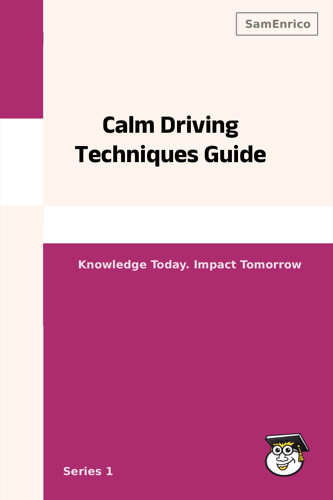
Calm Driving Techniques Guide eBook
Provides defensive driving strategies and cognitiv
Provides defensive driving strategies and cognitive reframing to reduce aggressive reactions in traffic.
Formats
Free sample
Chapter 1: Beyond the Wheel--–- The car ahead of you brakes unexpectedly. Your foot hits the pedal—not too hard, not too soft, just right. You stop with plenty of room to spare. No harm done. But something has shifted inside you.
Your jaw tightens. Your shoulders creep up toward your ears. Your grip on the steering wheel hardens from a hold to a clamp. You didn't choose any of this. It just happened.
And now, for the next several minutes—maybe longer—you will carry this tension with you like a passenger who refuses to get out.This is where every conversation about calm driving must begin: not with techniques or tips, but with the raw, unfiltered reality of what happens inside a human being when they sit behind the wheel. Driving is one of the most peculiar activities in modern life. We strap ourselves into a metal box, hurtle alongside strangers at lethal speeds, and expect ourselves to remain perfectly composed when those strangers do things we would never tolerate in any other context. If someone cut in front of you in a grocery store line, you would feel annoyed. If someone cut in front of you on the highway, your life could end.
The stakes are incomparably higher. And yet we treat driving anger as a character flaw rather than a predictable response to an inherently stressful environment.This book is not here to shame you for getting angry. Shame is a terrible teacher. It makes people defensive, secretive, and resistant to change. This book is here to help you understand your anger so well that you can see it coming, name it, and choose a different response before it chooses for you.
The calm driver is not the driver who never feels anger. The calm driver is the driver who feels anger and has twenty different ways to disarm it before it causes harm.The Architecture of a Trigger Let us examine what actually happens in the moment a driving trigger occurs. The word "trigger" is overused in popular psychology, but it has a specific and useful meaning here: an event that activates your body's threat response, regardless of whether an actual threat exists.Imagine you are driving home from work. It has been a long day. You are tired, though you may not fully register the tiredness.
You are also what psychologists call "cognitively depleted"—your brain has been making decisions for eight or nine hours, and your reservoir of self-control is lower than it was this morning. You are not at your best. Most drivers never are. We drive when we are tired, hungry, stressed, rushed, distracted, or some combination of all four.Now a car merges into your lane without signaling. The gap between you shrinks from a comfortable four seconds to a jarring two seconds.
Your brain processes this information in a fraction of a second. But it does not process it neutrally. Your brain asks, implicitly, a series of questions:Is this event relevant to my goals? Yes. Your goal is to arrive safely.
This event threatens that goal.Is this event caused by something intentional or accidental? Your brain defaults to intentional. It is faster and safer to assume malice than to assume incompetence. On the savanna, assuming the rustling grass was a lion when it was only the wind meant you were occasionally embarrassed. Assuming the rustling grass was the wind when it was a lion meant you were dead.
Your brain is still wired for that trade-off.Is this event directed at me personally? Your brain says yes again. The car merged into your lane, not someone else's. You are the target.Can I cope with this event? Your tired, depleted brain assesses your resources and concludes: barely.
You are already running low on patience. This feels like the final straw.Within one second, your brain has constructed a story: someone has intentionally threatened your safety, targeted you personally, and pushed you past your ability to cope. That story is almost certainly wrong—the merging driver probably did not see you, or misjudged the distance, or was distracted by a crying child in the back seat—but your brain does not care about accuracy. It cares about speed. And the story it tells determines how you feel.Why Your Brain Lies to You (And Why You Believe It)The story your brain tells in that first second is not designed to be true.
It is designed to keep you alive. But on the road, the difference between these two goals is enormous. What keeps you alive in a physical confrontation—heightened arousal, narrowed focus, rapid threat assessment—is exactly what gets you killed on the highway.Psychologists call this pattern the fundamental attribution error. It is one of the most robust findings in social psychology. When we explain our own behavior, we look to the situation: "I swerved because there was a pothole." "I am driving fast because I am late for an appointment." "I didn't see that pedestrian because the sun was in my eyes." When we explain the behavior of others, we look to their character: "They swerved because they are reckless." "They are driving fast because they are selfish." "They didn't see that pedestrian because they are stupid."The fundamental attribution error is not a sign that you are a bad person.
It is a sign that you have a normal human brain. The error saves cognitive energy. It is much easier to label someone "an idiot" than to imagine the complex, unknowable circumstances that led to their behavior. But on the road, this cognitive shortcut is a direct path to rage. Every time you label another driver as fundamentally bad, you give yourself permission to punish them.
And once you have permission, restraint becomes a choice rather than an instinct.Consider a study conducted by researchers at the University of Hawaii. They asked drivers to watch dashcam footage of traffic incidents and rate their anger levels. Half the participants were told nothing about the other drivers. The other half were given brief backstories: the driver who cut someone off was rushing to the hospital because his wife was in labor; the driver who ran a red light was a new immigrant unfamiliar with local traffic patterns; the driver who was driving slowly was an elderly man with poor night vision. The participants who received these backstories reported significantly lower anger levels than the control group.
The same behavior, the same footage, the same provocation—but a different story produced a different emotion.You cannot know the backstory of every driver who provokes you. But you can learn to supply a plausible alternative story in the moment. This is not naivety. This is not pretending that bad drivers do not exist. This is a strategic choice to protect your own peace by refusing to assume the worst.
The driver who cut you off may indeed be a reckless idiot. But they may also be a parent rushing to a sick child, a person fleeing domestic violence, or simply a tired human being who made a mistake. You will never know which story is true. So…
This is the end of the free sample. Get the eBook to keep going. Buy now
About this book
Details
- Author
- Jaynes Shakia
- Publisher
- SamEnrico
- Language
- English
- Genre
- Non-Fiction, Self-Help, Defensive Driving
- Released
- 2026-06-09
- Pages (approx.)
- 137
- Available as
- eBook, Audiobook

Read better in the ZLOADR app
Your eBooks on your phone or tablet. Sign in with your SamEnrico account and start reading.
More by Jaynes Shakia
 TM and Relationships GuideJaynes Shakia$11.99
 The Negative Assertion GuideJaynes Shakia$11.99
 Core Strengthening for Back PainJaynes Shakia$11.99
 The Sky Splitter: The Tunguska Event’s Forgotten WitnessesJaynes Shakia$11.99
 Understanding Peripheral T-cell LymphomaJaynes Shakia$17.99
 How to Start a Tobacco Stemming and Redrying BusinessJaynes Shakia$11.99
 Stripe Dispute Management GuideJaynes Shakia$12.99
 Tech Pop Up in NYC GuideJaynes Shakia$12.99
 Sprint Review HostJaynes Shakia$11.99
You may also like
 Hong Kong Handover 1997Dunn Johnnie$11.99
 Zumba For Postnatal Recovery CourseNeal Christian$11.99
 Zumba for BeginnersLadner Nikia$11.99
 YouTube Comment Mining GuideHumes Pandora$12.99
 Worry Box MeditationCarlin Rudy$11.99
 Workplace Stress MeditationNguyen Lynn$11.99
 Workplace Stress and Sleep RepairHawley Ivory$11.99
 Workplace Perfectionism CureDelaney Jeffry$11.99
 Workplace Injustice Anger GuideWallen Isabelle$11.99
 Work Addiction and Burnout LinkGreenwood Ester$11.99
 Women in Yoga and WellnessBeattie Galina$11.99
 Women in Stand Up ComedyChun Evangeline$11.99