
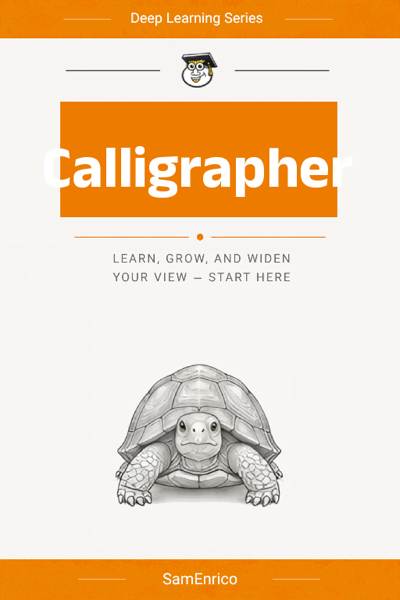
Non-FictionInformativeEducational
Calligrapher eBook
A Coursebook on Calligrapher
A Coursebook on Calligrapher
Formats
Free sample
Chapter 1: The Quiet Ritual...--There is a moment just before the nib touches the paper that separates those who merely write from those who truly practice calligraphy. It is a breath held, a shoulder lowered, a spine straightened. In that fraction of a second, the world outside – the ping of notifications, the hum of appliances, the endless scroll of digital demands – falls away. What remains is you, a simple tool, and a blank page glowing with possibility. That moment is not magic.
It is preparation. And like everything else in this book, it can be learned.Most people believe that calligraphy is about talent – a mysterious gift bestowed at birth upon a lucky few who then produce effortless loops and swoops. This belief is wrong, and it has stopped more aspiring calligraphers than any technical difficulty ever could. Calligraphy is not a talent. It is a trainable skill, as methodical as learning to type or as physical as learning to swim.
The difference is that calligraphy rewards patience with beauty, and beauty, as you will discover, has a way of changing how you see everything.This chapter is the foundation upon which every letter, every project, and every professional opportunity in this book is built. You will learn not just what tools to buy, but why each tool matters. You will learn not just how to sit, but how to breathe. And most importantly, you will learn that for left-handed and right-handed writers alike, the path to beautiful writing begins with the same small, deliberate actions performed consistently over time.Before you write a single letter, you must understand your instrument. Before you understand your instrument, you must understand your own body.
And before you understand your body, you must release the idea that some people “have it” and others do not. Everyone starts somewhere. This is your somewhere.The Three Families of Pens Walk into any art supply store, and the calligraphy aisle can feel like a foreign country. Rows of nibs with unfamiliar names, handles bent at odd angles, bottles of ink promising colors you have never seen on paper. Do not be intimidated.
Every tool in that aisle belongs to one of three families, and once you understand the families, the individual tools become legible.The Broad-Edge Pen is the oldest of the three, the tool of medieval scribes who illuminated manuscripts by candlelight. Its nib is flat, like a small spatula, and it creates thick lines when drawn at certain angles and thin lines when drawn at others. This contrast produces the majestic, rhythmic scripts you see in historical documents – Uncial, Italic, Gothic, Foundational Hand. The broad-edge pen rewards consistency: the same angle, the same pressure, stroke after stroke. It is the ideal starting tool for many calligraphers because it teaches discipline without demanding the nuanced pressure control of other pens.The Pointed Pen is the opposite.
Its nib is sharp and flexible, splitting into two tines under pressure. When you press down, the tines open and release more ink, creating a thick line. When you lift up, the tines close, and the line becomes thin. This thick-thin contrast allows for the elegant, flowing scripts of the 18th and 19th centuries – Copperplate, Spencerian, and the ornamental styles used on wedding invitations today. The pointed pen rewards sensitivity.
It will punish a heavy hand and reward a light touch. Many beginners find it more difficult at first, but the results it can produce are extraordinary.The Brush Pen is the newcomer, a modern tool that combines the flexibility of a brush with the convenience of a pen. Its tip is made of porous fiber or synthetic bristles that mimic the action of a paintbrush. Brush pens are forgiving, portable, and ideal for the looser, more expressive styles collectively known as modern calligraphy. They require no dipping in ink, no cleaning of nibs, and no complicated setup.
For this reason, many beginners start with brush pens. But there is a trade-off: brush pens cannot achieve the same precision as metal nibs, and they encourage a freer style that sometimes bypasses the discipline of traditional scripts.Which family should you choose? The honest answer is all three, but not at once. For the first half of this coursebook, you will work primarily with a broad-edge pen. Why?
Because the broad-edge teaches the fundamentals of angle, spacing, and rhythm without the added variable of variable pressure. Once you have mastered broad-edge scripts, you will move to pointed pen. Brush pens appear throughout as a tool for specific projects, but they are not the primary instrument of this book. If you already own a brush pen, keep it nearby. But for now, set it aside.Anatomy of a Nib Whether broad-edge or pointed, every nib shares common anatomy.
Understanding these parts will save you hours of frustration and prevent the most common beginner mistakes.The slit is the thin cut running from the breather hole (a small circle or teardrop shape) down to the tip of the nib. Ink flows through this slit by capillary action. If the slit is too wide, ink gushes; too narrow, nothing comes out. Most new nibs arrive coated in a thin layer of oil to prevent rust during shipping. This oil must be removed before use, or the ink will bead up and refuse to flow.
You can remove it by wiping the nib with rubbing alcohol, passing it briefly through a flame (carefully), or scrubbing it with a soft toothbrush and dish soap. This is not optional. A new nib straight from the box will not write.The reservoir is a small metal or plastic piece attached to the top of the nib that holds extra ink. On broad-edge nibs, reservoirs are often removable. On pointed nibs, they are usually integrated into the shape of the nib itself.
The reservoir allows you to write several letters before redipping. Without it, you would need to dip after every stroke.The shoulders are the widest part of the nib, and their shape determines how much flex the nib has. Wide shoulders and long tines mean more flex. Narrow shoulders and short tines mean a firmer, less responsive nib. For beginners, a nib with moderate flex (not too soft, not too hard) is ideal.
Extremely flexible nibs, like the famous Gillott 303, are difficult to control and best left for later.The size of a nib corresponds roughly to the x-height (the height of lowercase letters like a, c, and e) you can comfortably write. A larger nib produces larger letters. As a rule of thumb, your x-height should be roughly the same as the width of the nib. A 1mm nib writes an x-height of approximately 1mm. A 2mm nib writes 2mm.
This ratio is not a law, but it is a reliable starting point. For practice, a 1.5mm or 2mm broad-edge nib is excellent. For pointed pen, a medium-flex nib like the Nikko G or Zebra G is the standard recommendation.Ink: What It Is and What It Does Not all ink is calligraphy ink. This may seem obvious, but the number of beginners who ruin their nibs with India ink meant for dip pens designed for…
This is the end of the free sample. Get the eBook to keep going. Buy now
About this book
Details
- Author
- Hollingsworth Silas
- Publisher
- SamEnrico
- Language
- English
- Genre
- Non-Fiction, Informative, Educational
- Released
- 2026-05-06
- Pages (approx.)
- 150
- Available as
- eBook, Audiobook

Read better in the ZLOADR app
Your eBooks on your phone or tablet. Sign in with your SamEnrico account and start reading.
More by Hollingsworth Silas
 Loneliness Thought ReframingHollingsworth Silas$11.99
 Teen Appearance Pressure GuideHollingsworth Silas$11.99
 Spin Class Heart Rate Training ManualHollingsworth Silas$11.99
 Cyberstalking Mental Health Victim CasesHollingsworth Silas$11.99
 Antwerp Diamond Heist Motive AnalysisHollingsworth Silas$11.99
 The Pacific Pioneers: How the Apollo Program Relied on a Forgotten OceanHollingsworth Silas$11.99
 The Last Shot: The Miracle of the 1992 Dream Team's Final GameHollingsworth Silas$11.99
 How to Become a Case Packer And SealerHollingsworth Silas$11.99
 AI Inventory Management GuideHollingsworth Silas$12.99
 Cross Border Union SolidarityHollingsworth Silas$12.99
 Understanding Double DiscordiaHollingsworth Silas$17.99
You may also like
 Hong Kong Handover 1997Dunn Johnnie$11.99
 Zumba For Postnatal Recovery CourseNeal Christian$11.99
 Zumba for BeginnersLadner Nikia$11.99
 YouTube Comment Mining GuideHumes Pandora$12.99
 Worry Box MeditationCarlin Rudy$11.99
 Workplace Stress MeditationNguyen Lynn$11.99
 Workplace Stress and Sleep RepairHawley Ivory$11.99
 Workplace Perfectionism CureDelaney Jeffry$11.99
 Workplace Injustice Anger GuideWallen Isabelle$11.99
 Work Addiction and Burnout LinkGreenwood Ester$11.99
 Women in Yoga and WellnessBeattie Galina$11.99
 Women in Stand Up ComedyChun Evangeline$11.99