
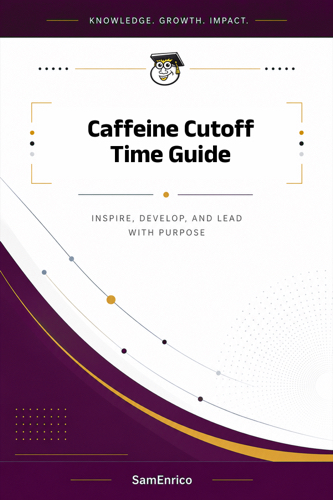
Non-FictionHealth & WellnessCaffeine
Caffeine Cutoff Time Guide eBook
Stop coffee and tea by 2 PM for restful sleep.
Stop coffee and tea by 2 PM for restful sleep.
Formats
Free sample
Chapter 1: The 3 AM Lie--–- The first time Sarah cried at 3:17 AM, she blamed her job. The second time, she blamed her marriage. The third time, she blamed herself.She lay in the dark, husband breathing softly beside her, ceiling fan ticking its endless loop. Her mind wasn't racing. That was the strange part.
She wasn't anxious about tomorrow's presentation or replaying an awkward conversation from 2014. She was just... awake. Wide, humming, chemically alert at the hour when humans are supposed to be drowning in slow waves and dreams.Sarah was thirty-four years old. She ran three miles three times a week.
She ate kale. She meditated using an app with a calm British voice. Her room was dark, cool, and silent—the trifecta of sleep hygiene perfection. She had spent $400 on a weighted blanket, $200 on blackout curtains, and $80 on magnesium lotion that promised "deep sleep in minutes."None of it worked.Every night, the same pattern: fall asleep easily around 10:30 PM, then snap awake between 2:45 and 3:30 AM like a switch had been flipped. Not gasping.
Not panicking. Just... on. Awake enough to check the clock. Awake enough to know she had four more hours until her alarm.
Awake enough to cry silent, frustrated tears while her husband slept like a man who had never heard of insomnia.She told herself it was stress. She told herself it was perimenopause (even though her doctor laughed at that). She told herself she was broken.What she never told herself—because she didn't know—was that the answer was sitting on her desk at 2:00 PM every single day. The latte she bought from the café downstairs. The one that got her through the afternoon slump.
The one she thought was helping her survive.It was destroying her. And she had no idea.The Paradox of the Sleepless Wellness Junkie Sarah is not an outlier. She is the archetype of a strange and terrible paradox: the more we learn about sleep hygiene, the more money we spend on sleep aids, and the more apps we download to track our rest, the more exhausted we become as a population.Consider the numbers. In 2010, the global sleep aid market was worth approximately $35 billion. By 2024, that number had ballooned past $80 billion.
We are buying more weighted blankets, more white noise machines, more blue-light-blocking glasses, more melatonin gummies, more CBD tinctures, and more $5,000 mattresses than any civilization in human history. And yet, according to the Centers for Disease Control and Prevention, one in three American adults sleeps less than the recommended seven hours per night. Insomnia complaints have risen 300% in the last two decades.Something is not adding up.We have perfected the theater of sleep hygiene. We dim the lights at 8 PM. We put our phones on night mode.
We drink chamomile tea. We do our breathing exercises. We climb into our perfect, cool, dark caves—and then we lie there, wide awake, wondering what's wrong with us.The standard answer from the wellness industry is that we aren't trying hard enough. Buy better blackout curtains. Meditate longer.
Try this magnesium spray. The implication is always the same: your sleep problems are your fault. You are not disciplined enough. You are too stressed. You are too anxious.
You are too broken.But what if the wellness industry has it exactly backwards? What if your inability to sleep has almost nothing to do with your bedtime routine and almost everything to do with what you consumed twelve hours earlier?What if the very substance you rely on to get through the afternoon is the same substance that is stealing your night?The Invention of "Sleep Drunkenness"Before we identify the culprit, we need a vocabulary for the problem. Most people who struggle with sleep don't have insomnia in the clinical sense—the inability to fall asleep initially. Instead, they suffer from a constellation of symptoms that have only recently been named and understood.Sleep drunkenness is the first of these. It describes the groggy, disoriented, cognitively impaired state upon waking that many people misattribute to "not being a morning person." You wake up.
You hit snooze. You feel like you were hit by a truck. Your first thought is not "good morning" but "I need coffee immediately."Sleep drunkenness is not a personality flaw. It is a clinical sign that your deep sleep—the restorative stage N3 sleep—has been fragmented. When you don't get enough deep sleep, your brain doesn't complete the overnight cleanup process that clears metabolic waste (including adenosine, which we will discuss in Chapter 2).
You wake up with a brain that is still full of the chemical debris of yesterday.The second symptom is reactive insomnia—not the inability to fall asleep, but the inability to stay asleep or to fall back asleep after waking. This is Sarah's 3:17 AM problem. Reactive insomnia feels like your brain has been plugged into a low-voltage electrical outlet. You're tired. You want to sleep.
But some invisible force is keeping your arousal system engaged, humming at a frequency just high enough to prevent the deep, continuous rest you crave.Here is what most people don't know: reactive insomnia is not primarily a psychological condition. It is a neurochemical condition. And the most common cause is a substance that keeps your brain's arousal system artificially stimulated for ten to twelve hours after you consume it.You have probably already guessed the substance.But the full story of how it works—and why the standard advice about it is dangerously wrong—requires us to unlearn almost everything we think we know.The Culprit You Never Suspected Caffeine is the most widely consumed psychoactive substance on earth. Ninety percent of adults in North America consume it daily. It is socially sanctioned, culturally celebrated, and economically essential.
We have built entire industries around it. We have invented dozens of creative delivery systems: cold brew, nitro brew, espresso, lattes, cappuccinos, americanos, macchiatos, frappuccinos, energy shots, energy drinks, energy chews, caffeinated gum, caffeinated water, caffeinated protein bars, caffeinated jelly beans, and even caffeinated toothpaste.We are, as a species, marinated in caffeine.And here is the strange part: we are also, as a species, exhausted. The two facts are not unrelated. But the connection is subtle, delayed, and counterintuitive. Caffeine makes you feel alert in the short term.
It improves reaction time, mood, and cognitive performance for one to three hours after consumption. These effects are real. They are measurable. They are the reason you reach for your afternoon cup.But those same effects—the ones you feel—are only half the story. The other half happens while you sleep.
Or rather, while you try to sleep. Caffeine does not disappear from your body after a few hours. It lingers. It works in the background. And its primary mechanism of action—blocking the brain's natural sleep signals—is directly opposed to everything your body is trying to accomplish between 10 PM and 6 AM.This is not a matter of opinion.
It is a matter of pharmacokinetics. And the numbers are damning.The 12-Hour Shadow Let us perform a simple thought experiment. Imagine you drink a standard 12-ounce cup of brewed coffee at 2:00 PM. That…
This is the end of the free sample. Get the eBook to keep going. Buy now
About this book
Details
- Author
- Robertson Manuel
- Publisher
- SamEnrico
- Language
- English
- Genre
- Non-Fiction, Health & Wellness, Caffeine
- Released
- 2026-06-06
- Pages (approx.)
- 142
- Available as
- eBook, Audiobook

Read better in the ZLOADR app
Your eBooks on your phone or tablet. Sign in with your SamEnrico account and start reading.
More by Robertson Manuel
 My Life As Cartoon DogRobertson Manuel$11.99
 Micro Flow TechniquesRobertson Manuel$11.99
 Small Talk for TravelersRobertson Manuel$11.99
 The Batch Cooking Protein GuideRobertson Manuel$11.99
 The Swiss Guard at Rome: Blood and Faith in the Papal Wars (1527)Robertson Manuel$11.99
 Understanding Wilkes–stevenson SyndromeRobertson Manuel$17.99
 How to Start a Hobby in 3D PrintingRobertson Manuel$11.99
 Founder Imposter Syndrome DepressionRobertson Manuel$12.99
 Ghana Angel Investors GuideRobertson Manuel$12.99
 Visual Presentation ManagerRobertson Manuel$11.99
You may also like
 Hong Kong Handover 1997Dunn Johnnie$11.99
 Zumba For Postnatal Recovery CourseNeal Christian$11.99
 Zumba for BeginnersLadner Nikia$11.99
 YouTube Comment Mining GuideHumes Pandora$12.99
 Worry Box MeditationCarlin Rudy$11.99
 Workplace Stress MeditationNguyen Lynn$11.99
 Workplace Stress and Sleep RepairHawley Ivory$11.99
 Workplace Perfectionism CureDelaney Jeffry$11.99
 Workplace Injustice Anger GuideWallen Isabelle$11.99
 Work Addiction and Burnout LinkGreenwood Ester$11.99
 Women in Yoga and WellnessBeattie Galina$11.99
 Women in Stand Up ComedyChun Evangeline$11.99