
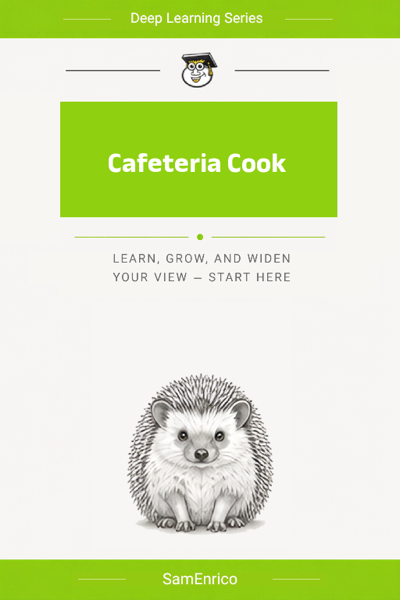
Non-FictionInformativeEducational
Cafeteria Cook eBook
A Coursebook on Cafeteria Cook
A Coursebook on Cafeteria Cook
Formats
Free sample
Chapter 1: Beyond the Steam Table...--If you have ever walked into a cafeteria kitchen for the first time, you probably expected noise. You got that right—the clatter of sheet pans, the hiss of steam kettles, the low rumble of dishwashers that sound like freight trains. You expected heat. You got that too—waves rolling off tilt skillets and convection ovens that can crisp your eyebrows if you lean too close. But what you probably did not expect was the math.
Not the simple counting of portions, but the logistics. The timing. The strange, relentless pressure of cooking food that will not be eaten for another two hours.That is the first and most important truth of cafeteria cooking: you are not cooking for the moment. You are cooking for a moment that has not arrived yet.In a restaurant kitchen, the dance is immediate. The ticket prints, the fire jumps, the plate flies to the window, and within minutes—sometimes seconds—the food lands in front of a customer.
Cause and effect are tightly coupled. If something goes wrong, you adjust on the next ticket. The feedback loop is short and sharp.In a cafeteria kitchen, the feedback loop stretches like taffy. You might cook four hundred portions of green beans at nine in the morning, but no one will taste them until noon. By then, the cook who made them might be on a break or already prepping for tomorrow.
You cannot taste your way through service the way a line cook does. You have to predict, prepare, and trust.This book is about learning to trust your preparation. It is about mastering the unique discipline of high-volume, extended-hold cooking—what we call the cafeteria craft. And it begins with understanding the landscape you are about to enter.The Hidden Complexity of "Simple" Food Walk into almost any cafeteria and you will see what appears to be simple food. Meatloaf.
Mashed potatoes. Green beans. Macaroni and cheese. A salad bar. Soup.
These are not complex dishes by restaurant standards. They do not require tweezers for plating or foams for garnish. They do not demand a dozen obscure ingredients or a circulator bath for forty-eight hours.But simplicity on the plate is deception. Behind that humble scoop of mashed potatoes is a chain of decisions that would make a logistics planner weep.When do you peel the potatoes? If you peel them too early, they oxidize and turn gray.
If you peel them too late, you will be rushing to get them on the steam table by noon. How do you cook two hundred pounds of potatoes at once? Do you boil them in a steam kettle, steam them in a compartment steamer, or roast them in the oven? Each method produces a different texture, and each texture holds differently under heat lamps.How do you hold them? Do you leave them in the steam table pan uncovered, letting the surface dry into a leathery crust?
Do you cover them and risk condensation that turns the bottom into soup? Do you add butter or cream to the recipe to help them hold moisture, or is that an unnecessary cost?And that is just the potatoes. Now do the same mental exercise for every item on the line.This is the hidden complexity of cafeteria cooking. It is not about making food taste good at the moment of cooking. It is about making food taste good two hours after cooking, after sitting under heat lamps, after being stirred and scooped and served by people who are not you.
It is about engineering flavor and texture to survive time.The Seven-Station March Every cafeteria kitchen follows the same basic rhythm, whether it is in a high school, a hospital, a corporate campus, or an army base. That rhythm is a seven-station march, and you will walk it every single day.Station one: receiving. The trucks arrive. Produce. Meat.
Dairy. Dry goods. Frozen cases. Everything must be checked, counted, and inspected. The delivery driver is in a hurry.
You are in a hurry. But shortcuts here create problems that will haunt you for days. A case of tomatoes with mold on the bottom layer. A box of frozen chicken that has partially thawed and refrozen into a solid block of ice and meat. A bag of flour split open and crawling with something that moves.
The receiving station is your first line of defense, and it is not glamorous. It is a clipboard, a thermometer, and the willingness to say "no" to a driver who wants you to sign for damaged goods.Station two: storage. Once the food passes inspection, it must go somewhere. Into the walk-in cooler. Into the freezer.
Onto the dry storage shelves. But not just anywhere—into the right place, in the right order. This is where FIFO lives. First In, First Out. The oldest products go in front.
The newest go in back. The goal is to use food before it spoils and to know exactly where everything is when you need it. A disorganized cooler is a time bomb. You will waste minutes—sometimes hours—hunting for ingredients. You will discover a case of bell peppers buried behind a pallet of potatoes, now wrinkled and soft.
You will find a container of leftover chili from last week that someone forgot to label, and you will have no idea whether it is still safe to serve. Organization is not a personality trait in a cafeteria kitchen. It is a survival skill.Station three: preparation. This is where the knife work happens. Dicing onions.
Chopping celery. Peeling carrots. Portioning chicken breasts. Weighing flour for tomorrow's biscuit dough. In a restaurant, prep is often done throughout the day as needed.
In a cafeteria, almost all prep happens in a concentrated window before service begins. You might have two or three hours to transform cases of raw ingredients into bins of ready-to-cook components. This is assembly-line work, and it demands speed, consistency, and ruthless attention to detail. If you chop onions unevenly, some pieces will burn while others remain raw. If you cut carrot sizes inconsistently, some will be mush while others crunch.
The prep station is where quality is built—or destroyed—before the first pan hits the stove.Station four: cooking. Finally, the fire. But this is not restaurant cooking, where you finish each plate individually. This is batch cooking on an industrial scale. You might sear forty pounds of beef cubes for stew in a tilt skillet that spans three feet across.
You might steam a hundred portions of rice in a compartment steamer the size of a closet. You might roast twenty sheet pans of chicken thighs at once in a convection oven that could double as a sauna. The cooking station is about managing time, temperature, and volume. It is about knowing that your braised beef needs two hours in the steam kettle, but your green beans need only twelve minutes in the steamer. It is about sequencing—starting the long-cooking items first, then layering in the faster items so that everything finishes around the same time.Station five: holding.
This is the station that does not exist in most restaurants, and it is the one that separates cafeteria cooks…
This is the end of the free sample. Get the eBook to keep going. Buy now
About this book
Details
- Author
- Nadeau Donald
- Publisher
- SamEnrico
- Language
- English
- Genre
- Non-Fiction, Informative, Educational
- Released
- 2026-05-11
- Pages (approx.)
- 134
- Available as
- eBook, Audiobook

Read better in the ZLOADR app
Your eBooks on your phone or tablet. Sign in with your SamEnrico account and start reading.
More by Nadeau Donald
 Hair Loss Medication ComparisonNadeau Donald$11.99
 Growth Index Fund StrategyNadeau Donald$11.99
 The Remote Career GrowthNadeau Donald$11.99
 Stress Management for Empty NestersNadeau Donald$11.99
 Frostbound: The Hidden Truth of the Troll Women of DovreNadeau Donald$11.99
 Software i18n AutomationNadeau Donald$12.99
 How to Produce Body MakeupNadeau Donald$11.99
 How to Start a Oil Platform Operation Business (Beginners Guide)Nadeau Donald$11.99
You may also like
 Hong Kong Handover 1997Dunn Johnnie$11.99
 Zumba For Postnatal Recovery CourseNeal Christian$11.99
 Zumba for BeginnersLadner Nikia$11.99
 YouTube Comment Mining GuideHumes Pandora$12.99
 Worry Box MeditationCarlin Rudy$11.99
 Workplace Stress MeditationNguyen Lynn$11.99
 Workplace Stress and Sleep RepairHawley Ivory$11.99
 Workplace Perfectionism CureDelaney Jeffry$11.99
 Workplace Injustice Anger GuideWallen Isabelle$11.99
 Work Addiction and Burnout LinkGreenwood Ester$11.99
 Women in Yoga and WellnessBeattie Galina$11.99
 Women in Stand Up ComedyChun Evangeline$11.99