
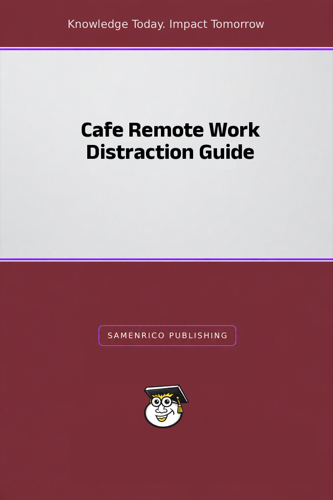
Non-FictionSelf-HelpRemote Work
Cafe Remote Work Distraction Guide eBook
Productively works from coffee shops.
by Emery Yong
Productively works from coffee shops.
Formats
Free sample
Chapter 1: The Hiss of Productivity--–- The first time Sarah brought her laptop to a coffee shop, she lasted eleven minutes. She spent four of those minutes deciding between a latte and a cold brew, three minutes finding an outlet that actually worked, two minutes fighting the glare from a window, and the final two minutes staring at a blank document while a man behind her discussed quarterly earnings at the volume of a stadium announcer. She packed up, went home, and worked from her kitchen table in silence. She told herself the coffee shop was a distraction. She told herself she needed quiet to focus.
She told herself that anyone who could work in a public place must have a superpower she lacked.She was wrong about all of it.The problem wasn't that Sarah couldn't work in coffee shops. The problem was that she didn't understand how her own brain worked in noisy environments. She had been trained—by years of conventional wisdom, by the design of libraries and home offices, by the cult of absolute silence—to believe that focus required the absence of distraction. But the research tells a different story, and it is one of the most counterintuitive and liberating findings in all of cognitive science: for many types of creative and analytical work, a moderately noisy environment is not something to tolerate. It is something to seek out.The Goldilocks Zone of Distraction Let us begin with a number: 65.
And another: 75. Between these two numbers lies what environmental psychologists call the Goldilocks Zone of Distraction—the decibel range where human beings perform at their cognitive peak for tasks requiring creativity, problem-solving, and abstract thinking.To understand why, we have to understand what happens in the brain at different volume levels. In near-silence—a library, a home office at 2:00 AM, a dedicated quiet room—the brain's attentional system operates in what researchers call hyper-focus mode. This sounds like a good thing, and for certain tasks it is. If you are proofreading a legal document, reconciling a spreadsheet, or performing any task that requires error-free precision, silence is your friend.
But here is the problem that most remote workers never consider: hyper-focus comes with a hidden cost. When the brain locks onto a single stream of information with perfect intensity, it also locks out the kind of loose, associative, "diffuse" thinking that generates novel ideas and creative solutions. The neural pathways that connect disparate concepts—the ones that produce the "aha!" moment—require a certain amount of ambient noise to activate. Silence, it turns out, can make your thinking rigid.At the other end of the spectrum, above 85 decibels—the volume of a vacuum cleaner, a busy street, a crowded bar—the brain enters a stress response. Cortisol levels rise.
The amygdala, the brain's threat-detection center, begins to flag environmental stimuli as potential dangers. Focus doesn't just degrade; it fragments. The body prepares for fight or flight, which is excellent if you are being chased by a predator but catastrophic if you are trying to write a proposal or debug a piece of code.Somewhere between these two extremes—between the rigidity of perfect silence and the chaos of overwhelming noise—lies the sweet spot. At 65 to 75 decibels, the ambient sound of a busy coffee shop, the brain experiences a mild but meaningful cognitive challenge. It has to work just hard enough to filter out irrelevant stimuli, and that mild effort has a paradoxical effect: it narrows your attention just enough to block out internal distractions (the voice in your head that says "check email," the nagging worry about tomorrow's meeting) while leaving your perceptual field open enough to maintain creativity.
The result is a state that some researchers call "distracted focus"—a seemingly contradictory condition in which background noise actually improves your ability to concentrate on foreground tasks.The data is striking. In a landmark study published in the Journal of Consumer Research, participants were asked to complete a series of creative problem-solving tasks while exposed to varying levels of ambient noise. Those in the 70-decibel condition—the equivalent of a moderately busy cafe—significantly outperformed both the silent-condition group and the high-noise group. They generated more ideas, rated their own ideas as more creative, and produced solutions that independent judges scored higher on originality. The researchers concluded that a "moderate level of ambient noise is sufficient to induce processing disfluency, which activates abstract cognition and leads to higher creativity."Translated from academic language: a little bit of chaos makes your brain work better.The Diner Effect: Why Boredom Is the Enemy of Productivity There is a second psychological mechanism at work in coffee shops, one that has nothing to do with decibel levels and everything to do with the texture of human environment.
Let us call it the Diner Effect.Imagine you are working from home. You are alone. Your desk is clean. Your phone is on Do Not Disturb. The conditions are, by every objective measure, ideal.
And yet you cannot start. You open your document. You close it. You open your browser. You check the news.
You open the document again. You write a sentence, delete it, write a different sentence, decide it is worse, delete that too. Forty-five minutes pass. You have accomplished nothing. You feel lazy, unfocused, vaguely ashamed.This experience is so common among remote workers that it has acquired a name: task paralysis.
And the strange truth is that task paralysis often has nothing to do with external distraction and everything to do with an absence of it. When the environment is too controlled, too predictable, too silent, the brain can sink into a state of understimulation that feels remarkably like boredom. And boredom, for most people, is a more powerful demotivator than distraction. Distraction at least provides stimulation—a notification, a sound, a movement—that the bored brain craves. Boredom provides nothing.
It is a vacuum, and nature abhors a vacuum. So the brain fills the void with its own distractions: rumination, anxiety, the endless scroll of social media.Now imagine the same task in a coffee shop. The door opens with a jingle. A conversation starts two tables over. The espresso machine hisses.
Someone laughs. None of these sounds are directed at you. None of them require a response. But they provide something that your home office cannot: a gentle, continuous, low-stakes stimulation that keeps your brain from sliding into the void of boredom. Your attentional system remains engaged not because you are forcing it to be engaged but because the environment is doing the work for you.This is the Diner Effect, named for the classic American diner—that noisy, clattery, slightly chaotic environment where people have written everything from term papers to novels.
The diner (or the coffee shop) provides what psychologists call "optimal ambient stimulation": enough novelty to keep the brain alert, not enough to demand a response. The result is a state of flow that feels almost effortless, as if the work is doing itself while you just sit there drinking coffee.The Diner Effect also explains why many remote workers find themselves more productive in a coffee shop than in a dedicated…
This is the end of the free sample. Get the eBook to keep going. Buy now
About this book
Details
- Author
- Emery Yong
- Publisher
- SamEnrico
- Language
- English
- Genre
- Non-Fiction, Self-Help, Remote Work
- Released
- 2026-06-08
- Pages (approx.)
- 138
- Available as
- eBook, Audiobook

Read better in the ZLOADR app
Your eBooks on your phone or tablet. Sign in with your SamEnrico account and start reading.
More by Emery Yong
 Study Journal PromptsEmery Yong$11.99
 Parent Loss and Milestone EventsEmery Yong$11.99
 Bipolar Antidepressant RisksEmery Yong$11.99
 Spin Motivation SecretsEmery Yong$11.99
 Bipolar And Migraine LinkEmery Yong$11.99
 Quizlet Reminder GuideEmery Yong$11.99
 Customer Service EQ HandbookEmery Yong$11.99
 Letters Across the BorderEmery Yong$11.99
 The Lost Colony That Time Forgot: Roanoke's Vanishing ActEmery Yong$11.99
 The Silk Road Illuminator: Al-Idrisi and the Lost Maps of ParadiseEmery Yong$11.99
 The Battle of Diu: Portugal's Naval Dominion in the Indian Ocean (1509)Emery Yong$11.99
 Volume Discounts From China For Both MarketsEmery Yong$12.99
You may also like
 Hong Kong Handover 1997Dunn Johnnie$11.99
 Zumba For Postnatal Recovery CourseNeal Christian$11.99
 Zumba for BeginnersLadner Nikia$11.99
 YouTube Comment Mining GuideHumes Pandora$12.99
 Worry Box MeditationCarlin Rudy$11.99
 Workplace Stress MeditationNguyen Lynn$11.99
 Workplace Stress and Sleep RepairHawley Ivory$11.99
 Workplace Perfectionism CureDelaney Jeffry$11.99
 Workplace Injustice Anger GuideWallen Isabelle$11.99
 Work Addiction and Burnout LinkGreenwood Ester$11.99
 Women in Yoga and WellnessBeattie Galina$11.99
 Women in Stand Up ComedyChun Evangeline$11.99