
Non-FictionSelf-HelpSelf-Compassion
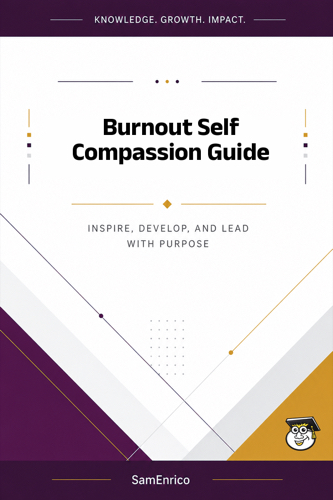
Burnout Self Compassion Guide eBook
Treat yourself with kindness rather than criticism
Treat yourself with kindness rather than criticism when you cannot do it all.
Formats
Free sample
Chapter 1: The Cup Is Not Empty--–- The first thing you need to know about burnout is that you did not cause it by being weak. The second thing you need to know is that the solution is not trying harder. These two truths, simple as they sound, run directly counter to almost everything our culture has taught you about success, productivity, and personal responsibility. If you are reading this book, you have likely spent months or years telling yourself a very different story. The story goes something like this: "Everyone else is managing.
I should be able to manage too. The fact that I am exhausted, cynical, and ineffective means there is something wrong with me. I am not trying hard enough. I am not disciplined enough. I am not good enough." That story is a lie.
And before we can teach you a single self-compassion practice, you must fully understand why that story is not only false but dangerous.Burnout is not a character flaw. It is not a moral failing. It is not evidence that you lack grit, determination, or ambition. Burnout is a physiological and psychological response to systemic depletion—the natural consequence of a nervous system that has been pushed beyond its capacity to recover. Every animal on this planet has a built-in mechanism for responding to stress.
When a gazelle outruns a lion, its body floods with cortisol and adrenaline, it escapes, and then it shakes off the residual energy and returns to grazing. The gazelle does not spend the next three weeks ruminating on whether it ran fast enough. It does not compare its escape time to other gazelles. It does not work through its lunch break. It recovers.
You, however, have been asked to act like a gazelle that never stops running, never shakes off the stress, and never receives the signal that the lion is gone. And then you have been told that your exhaustion is your fault.This chapter will reorient your entire understanding of burnout. We will explore what burnout actually is—beyond the vague feeling of being tired or overwhelmed. We will examine the three dimensions of burnout that researchers have identified over decades of clinical study. We will distinguish between the kind of stress that energizes you (eustress) and the kind that destroys you (distress).
And crucially, we will introduce a concept that will appear throughout this book: compassionate volition, the alternative to the raw, punitive willpower that has failed you so many times. By the end of this chapter, you will have a new framework for understanding why you feel the way you feel. You will also have permission—real, science-backed permission—to stop blaming yourself.The Three Dimensions of Burnout In the 1970s, psychologist Herbert Freudenberger first used the term "burnout" to describe the gradual extinguishing of motivation and energy he observed in healthcare workers. But it was Christina Maslach, a researcher at the University of California, Berkeley, who gave us the definition that remains the gold standard today. Maslach identified three distinct dimensions of burnout, and understanding each one is essential because burnout is not simply "being really tired." It is a specific syndrome with specific components, and you may experience one, two, or all three.The first dimension is exhaustion.
This is the most recognizable symptom: the feeling of having nothing left to give. But exhaustion in burnout is different from ordinary tiredness. Ordinary tiredness responds to sleep. You stay up too late, you sleep in the next morning, and you feel restored. Burnout-related exhaustion does not respond to sleep because it is not primarily about physical fatigue.
It is about emotional and cognitive depletion. Your nervous system has been in a state of high alert for so long that it has lost the ability to down-regulate. You may sleep eight or nine hours and still wake up feeling as though you have already run a marathon. Your brain feels foggy. Tasks that once took minutes now take hours.
This is not laziness; this is your brain conserving resources in the only way it knows how.The second dimension is cynicism and detachment. This often shows up as irritability, a short temper, or a growing indifference toward work or relationships that once mattered to you. Cynicism is a protective mechanism. When you care deeply about something and that caring is consistently met with obstacles, insufficient resources, or lack of recognition, your brain begins to distance itself. It says, "If I stop caring, I will stop being hurt." Many burned-out individuals mistake this cynicism for personal failure—"I used to be such a compassionate person, and now I don't care about anyone." But this is a misunderstanding.
Cynicism is not evidence that your compassion has died; it is evidence that your compassion has been wounded. It is an adaptation, not a flaw.The third dimension is inefficacy, the feeling that nothing you do matters. Inefficacy is the collapse of self-efficacy—the belief that your actions produce results. When you are burned out, you may complete tasks but feel no sense of accomplishment. You may receive positive feedback but dismiss it as meaningless.
You may look back on a full day of work and feel as though you did nothing at all. This is not humility; this is a distorted perception caused by chronic stress. Your brain's reward circuitry has been dampened. Dopamine, the neurotransmitter associated with motivation and satisfaction, is no longer released in response to achievement. You are not failing; you are failing to feel success.These three dimensions—exhaustion, cynicism, and inefficacy—form a vicious cycle.
Exhaustion makes it harder to perform, which increases cynicism, which reinforces inefficacy, which leads to more exhaustion. Breaking this cycle requires interrupting it at any point, but you cannot interrupt what you cannot name. By recognizing that your experience fits this clinical picture, you take the first step out of shame and into clarity.The Stress That Builds Versus the Stress That Burns Not all stress is bad. In fact, the human body is designed to handle short bursts of intense stress remarkably well. The problem is not stress itself but the chronicity of stress.
To understand why, we need to distinguish between two fundamentally different types of stress: eustress and distress.Eustress (the prefix "eu-" comes from Greek, meaning "good" or "well") is the kind of stress that feels challenging but energizing. You feel eustress when you are working toward a meaningful deadline, learning a new skill, or competing in a sport you enjoy. Eustress has a clear endpoint. The body releases cortisol and adrenaline, but these hormones are balanced by the expectation of recovery. After the presentation is delivered, after the race is finished, after the skill is learned—you rest.
Your heart rate returns to baseline. Your muscles relax. Your brain processes the experience and integrates it. Eustress is not the enemy of health; it is the source of growth. Muscles grow because stress damages them and recovery rebuilds them stronger.
The same is true of psychological resilience.Distress, on the other hand, is the kind of stress that overwhelms your coping resources. Distress has no clear endpoint. It is the boss who sends…
This is the end of the free sample. Get the eBook to keep going. Buy now
About this book
Details
- Author
- Callahan Carli
- Publisher
- SamEnrico
- Language
- English
- Genre
- Non-Fiction, Self-Help, Self-Compassion
- Released
- 2026-06-09
- Pages (approx.)
- 135
- Available as
- eBook, Audiobook

Read better in the ZLOADR app
Your eBooks on your phone or tablet. Sign in with your SamEnrico account and start reading.
More by Callahan Carli
 Group Creative Rhythm And Pace GuideCallahan Carli$11.99
 Tom Watson Duel Life StoryCallahan Carli$11.99
 The Webinar Lead FunnelCallahan Carli$11.99
 Feeling Overburdened Anger LinkCallahan Carli$11.99
 The Unseen Revolution: How a Teenage Hacker Changed the WorldCallahan Carli$11.99
 The Obsidian Codex: Unlocking the Secrets of the Voynich ManuscriptCallahan Carli$11.99
 How to Start a Hobby in Pole dancingCallahan Carli$11.99
 Caraway Seeds HarvestingCallahan Carli$11.99
 Canva Digital Product CreationCallahan Carli$12.99
 Payload CMS Alternative GuideCallahan Carli$12.99
 Understanding Chronic Erosive GastritisCallahan Carli$17.99
You may also like
 Hong Kong Handover 1997Dunn Johnnie$11.99
 Zumba For Postnatal Recovery CourseNeal Christian$11.99
 Zumba for BeginnersLadner Nikia$11.99
 YouTube Comment Mining GuideHumes Pandora$12.99
 Worry Box MeditationCarlin Rudy$11.99
 Workplace Stress MeditationNguyen Lynn$11.99
 Workplace Stress and Sleep RepairHawley Ivory$11.99
 Workplace Perfectionism CureDelaney Jeffry$11.99
 Workplace Injustice Anger GuideWallen Isabelle$11.99
 Work Addiction and Burnout LinkGreenwood Ester$11.99
 Women in Yoga and WellnessBeattie Galina$11.99
 Women in Stand Up ComedyChun Evangeline$11.99