
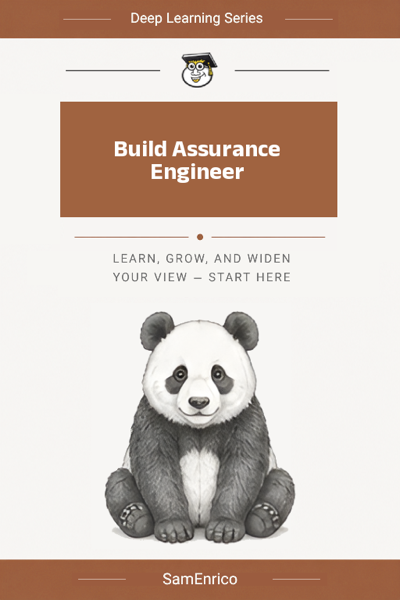
Non-FictionInformativeEducational
Build Assurance Engineer eBook
A Coursebook on Build Assurance Engineer
by Chen Yahaira
A Coursebook on Build Assurance Engineer
Formats
Free sample
Chapter 1: The $300 Billion Blindspot–- The email arrived at 11:47 PM on a Tuesday. Sarah, the lead site reliability engineer at a fast-growing fintech startup, had been asleep for two hours when her phone started buzzing. First, Pager Duty. Then Slack. Then a text from her manager: “We’re down.
All of it.”She stumbled to her laptop, heart already racing. The next three hours would become a case study in what happens when build assurance is an afterthought. By the time the site came back online at 3:15 AM, the company had lost 8millionintransactionfees,12,000usershadsignedupwithcompetitors,andacontractual SLAbreachwouldcostthemanother8 million in transaction fees, 12,000 users had signed up with competitors, and a contractual SLA breach would cost them another 8millionintransactionfees,12,000usershadsignedupwithcompetitors,andacontractual SLAbreachwouldcostthemanother2 million in penalties.The root cause? A single line of code that broke the build – but the build had passed anyway because no one had defined what “passing” actually meant.The unit tests passed. The integration tests passed.
The deployment succeeded. But the build had never checked for database migration reversibility, had never verified that the new cache key format wouldn’t explode with production data volumes, and had never ensured that the artifact deployed to production was byte-for-byte identical to the artifact tested in staging.Sarah’s team hadn’t failed because they were lazy or incompetent. They failed because they didn’t have a build assurance engineer – someone whose entire job was to ensure that a passing build actually meant something.This book is for everyone who has ever been Sarah. And for every engineering leader who never wants to be.The Invisible Crisis on Your Desk Let’s start with a number that will make you uncomfortable: $2.5 trillion. That’s the estimated annual cost of software failures to the global economy, according to a joint study by Cambridge University and the Consortium for Information Systems Quality.
Broken builds, flaky tests, deployment rollbacks, and production incidents that trace back to build-time errors account for a staggering portion of that figure.But here’s the part that should keep you awake at night: most organizations don’t even know how much their build problems cost them. They track server uptime. They track customer support tickets. They track revenue. But they don’t track the cost of a developer who loses 45 minutes of productivity every time a build breaks – a phenomenon documented by the “context switching penalty” research from Microsoft and UC Irvine.Let me make this real for you.Take a team of 50 engineers.
Each engineer, on average, triggers or is affected by three broken builds per week. Each broken build costs 45 minutes of context recovery – the time to stop current work, understand the failure, fix it, and get back to flow. That’s 135 minutes per engineer per week, or 6,750 minutes per week for the team. That’s 112.5 hours per week. At a fully loaded cost of 150perhour(salary,benefits,overhead),that’s∗∗150 per hour (salary, benefits, overhead), that’s **150perhour(salary,benefits,overhead),that’s∗∗16,875 per week** lost to broken builds.
Over a year, that’s nearly $900,000 – and that’s before counting the cost of the broken builds themselves, the incident response, the customer churn, or the team morale damage.Now multiply that across the millions of software engineers worldwide. You begin to understand the $2.5 trillion figure.Here’s what almost no one tells you: broken builds are not a technical problem. They are an assurance problem.A technical problem has a technical solution – better compilers, faster hardware, smarter test frameworks. An assurance problem requires a different approach entirely. Assurance means building confidence, not just functionality.
It means asking not “does this build run?” but “does this build prove that the software is safe, correct, and deployable?”That distinction – between building software and assuring software – is what separates mediocre engineering organizations from elite ones. And it’s why the role of Build Assurance Engineer (BAE) is the most under-hired position in technology today.Why “Build Engineer” Is Not Enough Many organizations have build engineers. These are the people who maintain the Jenkins instances, write the Git Hub Actions workflows, and keep the CI/CD pipeline running. They are essential and often underappreciated. But they are not build assurance engineers.A build engineer answers the question: “Is the pipeline up?”A build assurance engineer answers the question: “Does the pipeline’s green checkmark mean anything?”This is not semantic nitpicking.
It is the difference between a building that has electricity (the lights turn on) and a building that is structurally sound (the lights turning on means you won’t die). Both matter. But only one of them is usually missing.Let me give you concrete examples of what a build engineer does versus what a build assurance engineer does:Build Engineer tasks:Upgrade Jenkins plugins Optimize Docker layer caching Reduce build time from 15 minutes to 12 minutes Fix a broken pipeline step after a Git Hub Actions syntax change Add a new build matrix entry for Node.js version 20Build Assurance Engineer tasks:Define what “build success” actually means across unit tests, integration tests, security scans, and performance gates Implement quality gates that block merging if code coverage drops below 80% – but only for critical modules, and with clear, actionable error messages Establish a flaky test quarantine process with automated detection (flaky test rate >5% triggers notification to the test owner)Design a promotion pipeline where the same binary artifact is tested in staging, signed, and deployed to production without recompilation Create an observability dashboard that shows MTTR for build breaks, build success rate by team, and flakiness index over time Conduct blameless postmortems when a build failure reaches production, identifying the assurance gap rather than blaming the developer who “broke the build”Do you see the difference? The build engineer focuses on the pipeline as a system that needs to run. The build assurance engineer focuses on the pipeline as a process that needs to generate trust.Most organizations have the first.
Almost none have the second. And that is why broken builds are silently draining billions of dollars from the global economy.The Four Pillars of Build Assurance Throughout this book, we will build a complete framework for build assurance. But every framework needs foundations. Here are the four principles that anchor everything that follows. Memorize them.
Return to them when you’re lost. They will guide every decision you make as a build assurance engineer.1. Repeatability A build is repeatable if the same source code, in the same environment, produces the same binary output every time. This sounds obvious, but it is shockingly rare in practice.Consider a typical Node.js build. npm install might pull the latest patch version of a dependency because the package.json says ^1.2.3.
Today that means version 1.2.4. Tomorrow it might mean version 1.2.5 – and that new version could introduce a subtle bug that only appears in production. Your build passed yesterday. Today, with the same code, it passes again. But the artifact is different.
Repeatability is broken.Or consider a Java build that embeds a timestamp in the JAR manifest. The code is identical. The build runs twice. The outputs are different. Repeatability is broken.Or consider a Python build that depends on a system package installed globally…
This is the end of the free sample. Get the eBook to keep going. Buy now
About this book
Details
- Author
- Chen Yahaira
- Publisher
- SamEnrico
- Language
- English
- Genre
- Non-Fiction, Informative, Educational
- Released
- 2026-05-06
- Pages (approx.)
- 158
- Available as
- eBook, Audiobook

Read better in the ZLOADR app
Your eBooks on your phone or tablet. Sign in with your SamEnrico account and start reading.
More by Chen Yahaira
 The Alcohol Testosterone Depletion GuideChen Yahaira$11.99
 Exposure Ladder for PresentationsChen Yahaira$11.99
 Financial Recovery DivorceChen Yahaira$11.99
 Alcohol Withdrawal HallucinationsChen Yahaira$11.99
 Subordinate Anger De escalation GuideChen Yahaira$11.99
 The Poisoned Profits: The Strange Case of Beverley AllittChen Yahaira$11.99
 Understanding Polydactyly Myopia SyndromeChen Yahaira$17.99
 How to Become a Nut SorterChen Yahaira$11.99
 Beach vs Mountain Vacation SpendingChen Yahaira$12.99
 YouTube Brand Safety GuidelinesChen Yahaira$12.99
You may also like
 Hong Kong Handover 1997Dunn Johnnie$11.99
 Zumba For Postnatal Recovery CourseNeal Christian$11.99
 Zumba for BeginnersLadner Nikia$11.99
 YouTube Comment Mining GuideHumes Pandora$12.99
 Worry Box MeditationCarlin Rudy$11.99
 Workplace Stress MeditationNguyen Lynn$11.99
 Workplace Stress and Sleep RepairHawley Ivory$11.99
 Workplace Perfectionism CureDelaney Jeffry$11.99
 Workplace Injustice Anger GuideWallen Isabelle$11.99
 Work Addiction and Burnout LinkGreenwood Ester$11.99
 Women in Yoga and WellnessBeattie Galina$11.99
 Women in Stand Up ComedyChun Evangeline$11.99