
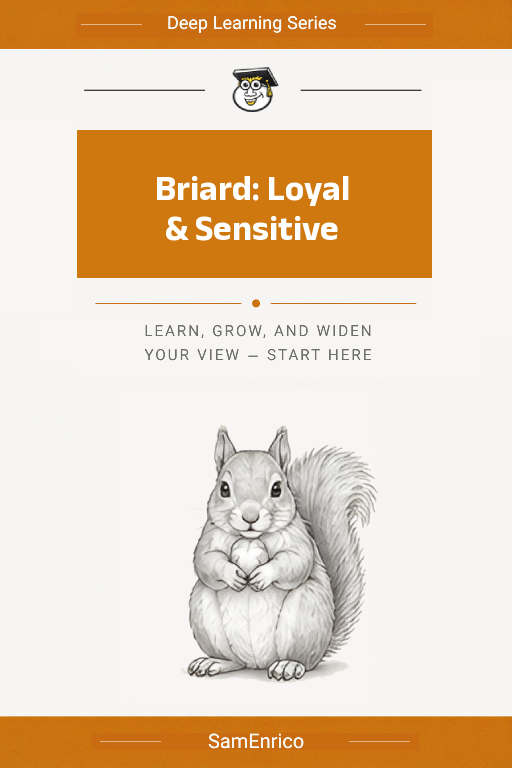
Non-FictionInformativeEducational
Briard: Loyal & Sensitive eBook
This publication, published by SamEnrico, covers B
This publication, published by SamEnrico, covers Briard: Loyal & Sensitive
Formats
Free sample
Chapter 1: The Tapestry Dogs...--– In the dim-lit halls of the Musée de Cluny in Paris, behind a velvet rope and a sheet of protective glass, hangs a fragment of wool and linen that changed everything I thought I knew about dogs. The Lady and the Unicorn tapestries, woven in the 1500s, are famous for their mysterious symbolism and ethereal beauty. But it is not the unicorn that caught my eye during a research trip years before I ever owned a Briard. It was a small, shaggy dog sitting at the feet of a noblewoman, watching. Even in faded thread, even after five centuries, the dog’s expression was unmistakable.
The heavy eyebrows. The beard. The alert, assessing posture of a creature who was not merely a pet but a participant. That dog was looking at something beyond the tapestry’s frame, and it seemed to be thinking.I stood there for a long time, museum pamphlet forgotten in my hand, trying to understand why this particular detail felt so significant. I had seen countless medieval dogs in art—greyhounds curled at the feet of saints, lapdogs perched on ladies’ cushions, hunting dogs tearing after stags.
They were decorative. Symbolic. Adorable. But this dog was different. This dog had a job to do, even if the tapestry did not show it.
This dog was watching the door.That was my first encounter with the Briard, though I did not know its name yet. I would not meet my own Briard, a philosophical rogue I eventually named Beaumont, for another seven years. But the seed was planted. Somewhere in the rolling farmlands of medieval France, a breed had been forged that combined the intelligence of a shepherd, the courage of a soldier, and the emotional attunement of a therapist. The Briard was not designed for lap-sitting or ribbon-winning.
It was designed for vigilance. And vigilance, as I would learn the hard way, is a double-edged sword.The Landscape That Made Them To understand the Briard, you must first understand the country that created it. France, particularly the region of Brie (from which the breed takes its name), was not the romanticized postcard of lavender fields and vineyard cottages that tourists imagine today. Medieval Brie was a harsh, demanding landscape of open pastures, dense forests, and unpredictable weather. Wolves prowled the edges of farmsteads.
Sheep wandered into ravines. Thieves crossed borders with impunity. The farmers of Brie needed a dog that could do everything: herd the flock, guard the homestead, track lost animals, and, if necessary, fight off predators twice its size.This was not a job for a specialist. The Briard had to be a generalist with an extraordinary work ethic. It had to think for itself because its master was often half a field away, unable to see what the dog could see.
It had to be brave because hesitation meant a dead lamb. And it had to be loyal because the bond between farmer and dog was not sentimental—it was survival.The earliest written records of the breed appear in the 12th century, but the Briard’s image appears much earlier. An 8th-century tapestry from the Abbey of Saint-Germain-des-Prés shows a large, bearded dog herding cattle alongside a farmer. The dog’s posture—low to the ground, eyes forward, tail level—is identical to the working stance of modern Briards. For over twelve hundred years, the blueprint has remained largely unchanged.
That is not an accident. When you get a working dog right, you do not tinker with success.But the Briard was not merely a farm dog. Its reputation for intelligence and courage spread beyond the fields of Brie. By the 14th century, the breed was being used by French nobility as estate guardians. A Briard did not just bark at intruders; it assessed them.
It watched from a distance, noted their behavior, and decided whether to raise an alarm. This habit of assessment—the famous “Briard Glare” that I will explore in depth later—is not suspicion for its own sake. It is the legacy of a dog that was bred to distinguish between a wandering traveler and a genuine threat. The Briard does not fear strangers. It evaluates them.
And that evaluation takes time.The Philosopher of the French Revolution The Briard’s most dramatic historical chapter unfolded during the French Revolution. When the peasants of France rose against the aristocracy, they did not merely topple a political system—they set loose waves of chaos, violence, and paranoia that swept through every village and farm. In this environment, loyalty became a life-or-death calculation. Many dogs abandoned their masters to join roaming packs of strays, reverting to feral survival. The Briard did not.Historical accounts from the late 1700s describe Briards standing guard over their families as mobs passed by.
They did not attack indiscriminately—that would have been suicidal. Instead, they positioned themselves between their people and the door, watching, waiting, assessing. If a threat became real, the Briard would give its life without hesitation. Multiple memoirs from the period mention Briards found dead beside their masters after farmhouses were ransacked. They did not flee.
They did not hide. They stood their ground.One story, perhaps apocryphal but widely repeated in French canine literature, tells of a Briard named Gorlois who belonged to a minor nobleman near Chartres. When revolutionary forces came to arrest the nobleman, Gorlois refused to let them enter the home. The soldiers attempted to bribe the dog with food. Gorlois ignored them.
They attempted to distract him with a female dog in heat. Gorlois did not move. Finally, they threatened to shoot the dog, and the nobleman—unwilling to see his companion killed—surrendered peacefully. As he was led away in chains, the account says, Gorlois followed the soldiers, staying close to his master’s side, growling softly at anyone who came too close. The nobleman was executed three weeks later.
Gorlois was found lying across his grave, refusing food or water, and died there within days.Whether this story is literally true matters less than what it reveals about the breed’s cultural reputation. By the end of the 18th century, the Briard was known throughout France as the dog that would not abandon its people. That reputation would soon attract the attention of the most powerful man in Europe.Napoleon’s Shadow Napoleon Bonaparte was many things—military genius, tyrant, reformer—but he was also a keen observer of useful creatures. He understood that wars were won not just by soldiers and cannons but by horses, mules, pigeons, and dogs. During his Italian and Egyptian campaigns, Napoleon employed dogs as messengers and sentinels.
But it was a Briard that allegedly saved his life.The story, preserved in the memoirs of Napoleon’s valet, Louis Constant Wairy, goes like this: During a nighttime stop in a small Italian village, Napoleon’s party was ambushed by enemy scouts. In the chaos, Napoleon was thrown from his horse and knocked unconscious. His bodyguards scattered. A Briard belonging to a local farmer, who had been following the French column out of curiosity, positioned itself over Napoleon’s prone body and refused to let anyone approach.…
This is the end of the free sample. Get the eBook to keep going. Buy now
About this book
Details
- Author
- Whitmore Octavio
- Publisher
- SamEnrico
- Language
- English
- Genre
- Non-Fiction, Informative, Educational
- Released
- 2026-05-18
- Pages (approx.)
- 152
- Available as
- eBook, Audiobook

Read better in the ZLOADR app
Your eBooks on your phone or tablet. Sign in with your SamEnrico account and start reading.
More by Whitmore Octavio
 Follower Count Self WorthWhitmore Octavio$11.99
 Affirmation Morning RoutineWhitmore Octavio$11.99
 Teacher Burnout TriggersWhitmore Octavio$11.99
 Rowing Machine HIIT PlanWhitmore Octavio$11.99
 Marathon Mental Training HypnosisWhitmore Octavio$11.99
 Consultant Imposter GuideWhitmore Octavio$11.99
 Scarcity Influence ModelWhitmore Octavio$11.99
 Burn Center ReferralWhitmore Octavio$11.99
 The Sultan's Bridge: How a Forgotten Engineer Defied the ImpossibleWhitmore Octavio$11.99
 Ottoman Brushstrokes: The Royal Portraits That Shaped an EmpireWhitmore Octavio$11.99
 How to Produce Fishing ReelsWhitmore Octavio$11.99
 Cooperative Tax Benefits GuideWhitmore Octavio$12.99
You may also like
 Hong Kong Handover 1997Dunn Johnnie$11.99
 Zumba For Postnatal Recovery CourseNeal Christian$11.99
 Zumba for BeginnersLadner Nikia$11.99
 YouTube Comment Mining GuideHumes Pandora$12.99
 Worry Box MeditationCarlin Rudy$11.99
 Workplace Stress MeditationNguyen Lynn$11.99
 Workplace Stress and Sleep RepairHawley Ivory$11.99
 Workplace Perfectionism CureDelaney Jeffry$11.99
 Workplace Injustice Anger GuideWallen Isabelle$11.99
 Work Addiction and Burnout LinkGreenwood Ester$11.99
 Women in Yoga and WellnessBeattie Galina$11.99
 Women in Stand Up ComedyChun Evangeline$11.99