
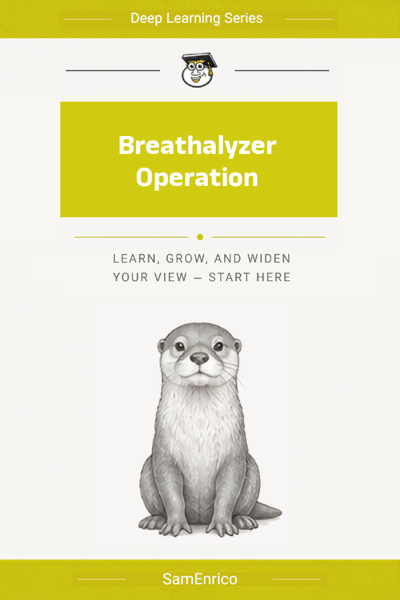
Non-FictionInformativeEducational
Breathalyzer Operation eBook
A Coursebook on Breathalyzer Operation
A Coursebook on Breathalyzer Operation
Formats
Free sample
Chapter 1: The Machine On Trial–- On a humid August night in 1983, a Florida highway patrolman named Steve Riddle stopped a green sedan weaving between lanes on Interstate 4. The driver, a 47-year-old accountant named Michael Mc Manus, smelled faintly of beer and admitted to “a couple” at a company picnic. Riddle administered field sobriety tests—the walk-and-turn, the one-leg stand, the horizontal gaze nystagmus. Mc Manus passed them all. But Riddle had just received a new toy: a portable Alcosensor, one of the first fuel-cell devices issued to Florida troopers.
He asked Mc Manus to blow. The digital display read 0.12—well over Florida’s 0.10 legal limit at the time. Mc Manus was arrested, handcuffed, and taken to the county jail, where he spent the night in a holding cell.Ninety days later, Mc Manus sat in a courtroom, his career and reputation on the line. His attorney, a public defender named Janice Crowley who had never cross-examined a breathalyzer operator in her life, had one slim argument: the Alcosensor had not been approved by Florida’s Department of Law Enforcement. There was no chain-of-custody log for the device.
The officer had not been formally trained on the fuel cell’s temperature sensitivity. The judge, frustrated by what he called “technical nitpicking,” admitted the result anyway. Mc Manus pleaded no contest, lost his license for six months, paid $1,200 in fines, and was fired from his accounting firm when his DUI conviction appeared on a routine background check.Michael Mc Manus was stone sober the night he was arrested. Two years later, a University of Florida forensic science graduate student named Elena Vasquez tested the same model of Alcosensor under controlled conditions. She found that when the device was exposed to direct sunlight for more than twenty minutes—as Riddle’s unit had been, sitting on his dashboard during the afternoon before the night shift—internal temperature fluctuations produced false positives as high as 0.08 on completely alcohol-free subjects.
Vasquez published her findings in the Journal of Forensic Sciences. The Florida Department of Law Enforcement quietly withdrew the device from service. Michael Mc Manus never received an apology, a refund, or a pardon.This is the story of the breathalyzer. Not the neat, clean, scientific story told in training manuals and police academy lectures. The messy story.
The story of machines that lie, operators who cut corners, and a legal system that has spent half a century trying to decide whether a breath sample is evidence or opinion. If you are reading this book because you want to learn how to push the buttons and read the display, you have picked up the wrong volume. If you are reading because you want to understand what the machine actually measures, why it fails, how its failures are hidden, and how to stand in a courtroom and tell the truth—the whole truth—about what happened on the night of the test, then turn the page.The Ghost of Drunkometers Past Before there was a breathalyzer, there was a cop’s nose, a pair of eyes, and a deeply unreliable set of subjective judgments. For most of human history, proving that someone was “drunk” was a matter of watching them stumble, slur, or vomit. In 1874, a British physiologist named Francis Anstie made an obscure observation: alcohol consumed by a subject reappeared in measurable quantities in their breath.
Anstie was not interested in law enforcement; he was interested in metabolism. His discovery sat in academic journals for fifty-seven years, untouched by police work.Then came Prohibition. The Eighteenth Amendment, ratified in 1919, made the manufacture, sale, and transportation of intoxicating liquors illegal in the United States. Enforcement was a nightmare. How did an officer prove that a driver had been drinking when the driver could simply claim the smell was from a passenger, a spilled bottle, or last night’s party?
The need for objective, chemical evidence became urgent.In 1931, a Northwestern University biochemist named Rolla Harger built the first practical device: the Drunkometer. The subject blew into a balloon. The air sample was then released through a chemical solution of potassium permanganate. Alcohol in the breath reacted with the solution, changing its color. The deeper the color change, the more alcohol present.
The Drunkometer was a marvel of its era—portable (barely), repeatable (mostly), and scientific (sort of). Harger’s invention was adopted by police departments in Indiana, Illinois, and New York. For the first time, a machine could testify against a driver.But the Drunkometer had problems. The chemical solution had to be mixed fresh each day. The color change was judged by eye, not by instrument.
Different officers saw different shades of purple. The machine was also vulnerable to interference from acetone, gasoline vapors, and cigarette smoke—all common in the enclosed spaces where tests were administered. In 1938, a New Jersey court became the first to exclude Drunkometer evidence, ruling that the device had not achieved “general acceptance” in the scientific community. That phrase—“general acceptance”—would echo for decades.The modern breathalyzer was born in 1954, when Indiana State Police captain Robert Borkenstein (a former camera repairman with no formal scientific training) invented the Breathalyzer Model 900. Borkenstein replaced Harger’s permanganate solution with potassium dichromate, a more stable chemical reagent.
He added a spectrophotometer to measure color change precisely rather than relying on human eyes. The Model 900 became the gold standard for twenty years. Thousands were sold to police departments across America.Borkenstein’s genius was not just technical; it was legal. He understood that a machine’s output was only as reliable as the operator’s training. He designed a certification course that remains the template for modern breathalyzer training: classroom instruction, written examination, supervised practice, and a final proficiency test.
The Borkenstein course, now administered by the National Highway Traffic Safety Administration (NHTSA), has certified hundreds of thousands of officers. But Borkenstein also understood something darker: the machine could be made to say whatever the operator wanted, if the operator knew how to manipulate the conditions. He never wrote that down. But every experienced breathalyzer operator knows it.Implied Consent: The Legal Trap Door You have the right to remain silent. You have the right to an attorney.
You do not have the right to refuse a breath test. This is the fundamental shock that every DUI suspect experiences, usually in the back of a patrol car after blowing into a PBT and watching the numbers climb. The legal doctrine that strips away the Fourth Amendment’s protection against unreasonable searches is called implied consent.Here is how it works. Every state in the United States has enacted an implied consent law, beginning with New York in 1953 and ending with Rhode Island in 1995. The law says that any person who operates a motor vehicle on public roads is deemed to have given advance consent to chemical testing of their breath, blood, or urine if lawfully arrested for driving under the influence.
You do not sign a form. You do not check a box on your driver’s license application. The consent is implied by the act of driving.The penalty for refusing a test is not criminal—it is administrative. Your license will be suspended…
This is the end of the free sample. Get the eBook to keep going. Buy now
About this book
Details
- Author
- Flemming Mallory
- Publisher
- SamEnrico
- Language
- English
- Genre
- Non-Fiction, Informative, Educational
- Released
- 2026-06-02
- Pages (approx.)
- 149
- Available as
- eBook, Audiobook

Read better in the ZLOADR app
Your eBooks on your phone or tablet. Sign in with your SamEnrico account and start reading.
More by Flemming Mallory
 The Language Lab FearFlemming Mallory$11.99
 First Person Shooter AddictionFlemming Mallory$11.99
 Evening Eating Circadian ImpactFlemming Mallory$11.99
 Embodied Cognition BasicsFlemming Mallory$11.99
 Legal Planning for CaregiversFlemming Mallory$11.99
 Step Five Self Forgiveness GuideFlemming Mallory$11.99
 Overeaters Anonymous IntegrationFlemming Mallory$11.99
 From Al Hol Camp To ParisFlemming Mallory$11.99
 Growth Hormone Decline DecodedFlemming Mallory$11.99
 The Verdict of the Oracle: How a Divine Trial Toppled a TyrantFlemming Mallory$11.99
 The Last Flight of the Hindenburg: A Balloon’s Bold DreamFlemming Mallory$11.99
 The Algorithm Whisperer: How a Teen Coder Built the First Viral AppFlemming Mallory$11.99
You may also like
 Hong Kong Handover 1997Dunn Johnnie$11.99
 Zumba For Postnatal Recovery CourseNeal Christian$11.99
 Zumba for BeginnersLadner Nikia$11.99
 YouTube Comment Mining GuideHumes Pandora$12.99
 Worry Box MeditationCarlin Rudy$11.99
 Workplace Stress MeditationNguyen Lynn$11.99
 Workplace Stress and Sleep RepairHawley Ivory$11.99
 Workplace Perfectionism CureDelaney Jeffry$11.99
 Workplace Injustice Anger GuideWallen Isabelle$11.99
 Work Addiction and Burnout LinkGreenwood Ester$11.99
 Women in Yoga and WellnessBeattie Galina$11.99
 Women in Stand Up ComedyChun Evangeline$11.99