
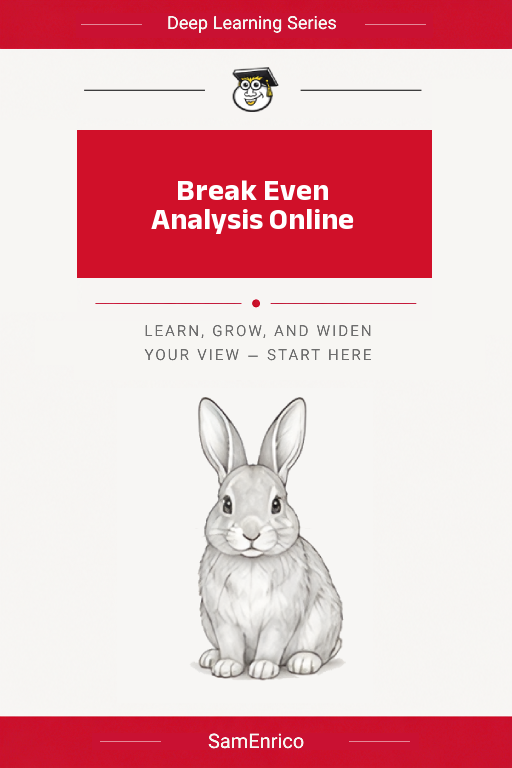
Non-FictionStartup GuideStrategic Planning
Break Even Analysis Online eBook
Calculate break-even point for business plan using
by Doty Tracey
Calculate break-even point for business plan using free online calculators. Google Sheets method.
Formats
Free sample
Chapter 1: The Profit Launchpad--–- Most entrepreneurs believe break-even analysis is a dull, back-of-the-napkin calculation they can postpone until “later.” Later never comes. And neither does profitability.You have probably heard someone say, “We just need to break even first, then we can worry about profit.” That single sentence reveals a dangerous misunderstanding. Break-even is not the finish line of survival. It is the starting line of wealth creation. The difference between those two mental models is the difference between a business that limps along for years and one that scales aggressively from day one.This chapter will fundamentally reshape how you think about the break-even point (BEP).
You will learn why it is the single most important number in your business plan, why investors demand it before writing a check, and how a clear understanding of BEP separates thriving companies from the ones that quietly shut their doors after eighteen months. More importantly, you will discover that break-even analysis is not a tedious accounting exercise—it is your strategic compass, your early warning system, and your negotiation weapon all rolled into one.Let us begin by dismantling the most persistent myth in small business finance.The “No-Profit, No-Loss” Trap Ask ten entrepreneurs what break-even means, and nine will tell you: “It is when your revenue equals your costs. You are not making money, but you are not losing money either.” That definition is technically correct but strategically useless.Think of break-even as the moment a rocket lifts off the launchpad. Before that moment, all the fuel burning is just fighting gravity. The rocket is consuming enormous resources but going nowhere.
The instant it breaks free of gravity’s grip, however, every ounce of fuel propels it higher and faster. Break-even is that exact instant—not the destination, but the threshold beyond which every sale generates pure profit.Consider two coffee shop owners, Maria and James. Both open identical shops with 5,000inmonthlyfixedcosts(rent,utilities,oneemployee)andacontributionmarginof5,000 in monthly fixed costs (rent, utilities, one employee) and a contribution margin of 5,000inmonthlyfixedcosts(rent,utilities,oneemployee)andacontributionmarginof2 per coffee (selling price 4minusvariablecostsof4 minus variable costs of 4minusvariablecostsof2 for beans, cup, and labor). Both calculate their break-even at 2,500 cups per month.Maria treats break-even as survival. She says, “I just need to sell 2,500 cups to cover my costs.
Anything above that is a bonus.” She prices her coffee at $4, runs minimal marketing, and watches her daily sales nervously. Most months she sells 2,600 or 2,700 cups. She breaks even, takes home a small paycheck, but never grows.James treats break-even as a launchpad. He asks a different question: “If I already know that my first 2,500 cups pay all my bills, what can I do to maximize every cup after that?” He introduces a loyalty program that increases average customer frequency. He adds premium pastries with a 3contributionmargin.Heraiseshiscoffeepriceto3 contribution margin.
He raises his coffee price to 3contributionmargin.Heraiseshiscoffeepriceto4.50, knowing that his new break-even becomes 2,000 cups (since contribution margin increases to 2.50),andthenhespends2.50), and then he spends 2.50),andthenhespends500 more on marketing because he has room in his fixed cost structure.Within a year, James sells 4,000 cups monthly and nets 5,000inprofit.Mariastillsells2,700cupsandnets5,000 in profit. Maria still sells 2,700 cups and nets 5,000inprofit.Mariastillsells2,700cupsandnets400. Same business, same neighborhood, completely different outcomes—solely because of how they understood break-even.The break-even point is not a wall you hope to bump against. It is a door you walk through. Once you pass through it, every subsequent sale is profit.
That changes everything about how you price, how you market, and how you invest in growth.The Banker’s Question: Why Investors Demand Your BEPIf you ever pitch your business to an angel investor, a venture capitalist, or a bank loan officer, they will ask a series of predictable questions: What is your total addressable market? Who are your competitors? What is your unit economics? But there is one question that acts as a filter, separating serious entrepreneurs from amateurs. That question is: “At what volume do you break even, and how confident are you in that number?”Investors ask this because the break-even point reveals three things they care about more than anything else: risk, capital efficiency, and management competence.First, risk.
A business that breaks even at 1,000 units per month is far less risky than one that needs 10,000 units. The first business can survive a slow season, a supply chain disruption, or a marketing misfire. The second business operates on a knife’s edge. Investors want to know how much runway you have before you run out of money. Your break-even point, combined with your cash burn rate, tells them exactly how many months they have to wait before you become self-sustaining.Second, capital efficiency.
Every dollar invested in a business should eventually return multiple dollars to the investor. The lower your break-even point, the less capital you need to reach profitability. A software company that breaks even at 50,000inmonthlyrecurringrevenuemightneedonly50,000 in monthly recurring revenue might need only 50,000inmonthlyrecurringrevenuemightneedonly200,000 in seed funding. A hardware company that breaks even at 2millioninrevenuemightneed2 million in revenue might need 2millioninrevenuemightneed5 million. Investors will always favor the business that requires less capital to prove its model.Third, management competence.
Investors have heard every optimistic projection imaginable. “We will capture 5 percent of a billion-dollar market.” “Our growth will triple every quarter.” They are numb to these claims. But when an entrepreneur can say, “Our fixed costs are 24,000permonth,ourcontributionmarginis24,000 per month, our contribution margin is 24,000permonth,ourcontributionmarginis12 per unit, so we break even at 2,000 units. Based on our pre-launch waitlist of 500 customers and our current conversion rate, we expect to hit that in month four”—that entrepreneur sounds like someone who understands business fundamentals. That entrepreneur gets funded.Here is a real-world example.
In 2021, two founders pitched competing food delivery startups to the same venture capital firm. Founder A had a slick pitch deck, beautiful mockups, and a vague projection of “millions in revenue within two years.” When asked about break-even, she hesitated and said, “We have not calculated that yet. We are focused on growth.” Founder B had a simpler presentation but immediately answered: “Our fixed costs are 18,000monthly.Ouraverageordervalueis18,000 monthly. Our average order value is 18,000monthly.Ouraverageordervalueis28, variable costs are 16,socontributionmarginis16, so contribution margin is 16,socontributionmarginis12. We break even at 1,500 orders per month.
We are currently at 800 orders and growing 15 percent week over week, so we project break-even in week seven.” Founder B received $500,000. Founder A did not.The banker’s question is not a trap. It is an invitation to demonstrate that you understand the mechanics of your own business. Master your break-even point, and you master that conversation.The Cost of Ignorance: A Case Study in Avoidable Failure Numbers without stories are forgettable. Let us examine a single, detailed case study of a business that failed because its founder misunderstood break-even analysis.
(Note: The e-commerce transaction fee example that some books use has been deliberately placed in Chapter 2, where we systematically break down variable costs. Here, we focus on a different failure mode: the expansion trap.)Meet Sarah. She started a handmade candle business from her kitchen. Her candles were beautiful, her Instagram aesthetic was on point, and within six months she was…
This is the end of the free sample. Get the eBook to keep going. Buy now
About this book
Details
- Author
- Doty Tracey
- Publisher
- SamEnrico
- Language
- English
- Genre
- Non-Fiction, Startup Guide, Strategic Planning
- Released
- 2026-06-01
- Pages (approx.)
- 140
- Available as
- eBook, Audiobook

Read better in the ZLOADR app
Your eBooks on your phone or tablet. Sign in with your SamEnrico account and start reading.
More by Doty Tracey
 Values And Mission Alignment Remote Team Cultural Rituals CourseDoty Tracey$11.99
 The Criticism Rebranding GuideDoty Tracey$11.99
 The Shift Work Stress GuideDoty Tracey$11.99
 Forgiving Your Bully GuideDoty Tracey$11.99
 The Child Loss Complicated GriefDoty Tracey$11.99
 The Bronze Alchemists: Benin's Lost Masters of the CastDoty Tracey$11.99
 Understanding Trigonocephaly Ptosis ColobomaDoty Tracey$17.99
 Franchising into Brazil GuideDoty Tracey$12.99
 Campfire Cooking InstructorDoty Tracey$11.99
 How to Start a Camshaft (not for Motor Vehicle) Business (Beginners Guide)Doty Tracey$11.99
You may also like
 Hong Kong Handover 1997Dunn Johnnie$11.99
 Zumba For Postnatal Recovery CourseNeal Christian$11.99
 Zumba for BeginnersLadner Nikia$11.99
 YouTube Comment Mining GuideHumes Pandora$12.99
 Worry Box MeditationCarlin Rudy$11.99
 Workplace Stress MeditationNguyen Lynn$11.99
 Workplace Stress and Sleep RepairHawley Ivory$11.99
 Workplace Perfectionism CureDelaney Jeffry$11.99
 Workplace Injustice Anger GuideWallen Isabelle$11.99
 Work Addiction and Burnout LinkGreenwood Ester$11.99
 Women in Yoga and WellnessBeattie Galina$11.99
 Women in Stand Up ComedyChun Evangeline$11.99