
Non-FictionSelf-HelpBrainstorming
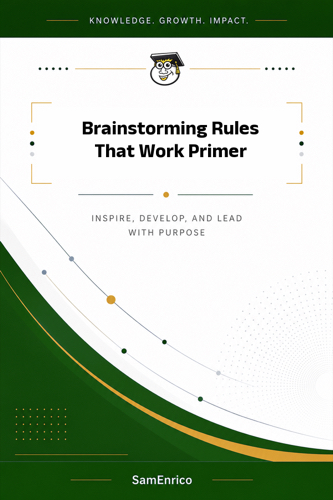
Brainstorming Rules That Work Primer
Establishes defer judgment, build on ideas, and en
Establishes defer judgment, build on ideas, and encourage wild concepts for effective group sessions.
Formats
About this book
Free sample
Chapter 1: The Silent Killer--–- It begins in silence. Not the productive silence of deep thought, but the heavy silence of a room where an idea has just been murdered. Someone—usually the youngest person in the room, or the newest hire, or the one who hasn't yet learned to keep their mouth shut—offers a half-formed thought. It's rough. It's weird.
It doesn't quite make sense yet. And before the sentence is even finished, a senior leader shifts in their chair and says, almost kindly, "That's not how we do things here." Or "We tried that in 2017." Or simply, "No."The room exhales. The tension breaks. Everyone laughs nervously. And the idea dies.Nobody will remember that moment tomorrow.
Nobody will log it in a meeting minutes document. But something irreversible just happened. A statistical probability—the chance that this group would stumble upon a breakthrough—just dropped by a measurable amount. And the killer? It wasn't malice.
It wasn't incompetence. It was the most natural, automatic, socially rewarded behavior in any organization: judgment.This book is the autopsy of that moment. And the resurrection of what comes after.The Anatomy of a Murdered Idea Let's slow down time and examine what actually happens in the 2.3 seconds between a person speaking a raw idea and a colleague judging it.The speaker's brain is in a vulnerable state. Neuroimaging studies show that when people generate novel ideas, the default mode network—the brain's associative, creative system—is highly active. This is the opposite of the executive control network, which is responsible for analysis, logic, and criticism.
You cannot run both networks at full capacity simultaneously. They are, neurologically speaking, rivals.When the speaker offers an unfinished idea, they are operating in creative mode. Their prefrontal cortex is suppressing the inner critic long enough to get the words out. But the listener? The listener is almost certainly operating in analytical mode.
They hear a gap, a flaw, an implausibility. And their brain—trained by decades of schooling, performance reviews, and corporate culture—immediately flags the error. The listener's executive control network lights up.…
This is the end of the free sample. Get the eBook to keep going. Buy now
Contents
- Chapter 1
- Chapter 2
- Chapter 3
- Chapter 4
- Chapter 5
- Chapter 6
- Chapter 7
- Chapter 8
- Chapter 9
- Chapter 10
- Chapter 11
- Chapter 12
Details
- Author
- Arsenault Micheal
- Publisher
- SamEnrico
- Language
- English
- Genre
- Non-Fiction, Self-Help, Brainstorming
- Released
- 2026-06-07
- Pages (approx.)
- 129
- Available as
- eBook, Audiobook

Read better in the ZLOADR app
Your eBooks on your phone or tablet. Sign in with your SamEnrico account and start reading.
More by Arsenault Micheal
 Post Weight Loss MaintenanceArsenault Micheal$11.99
 Poland Clean Air Program GuideArsenault Micheal$11.99
 The Restless Leg Child GuideArsenault Micheal$11.99
 Stress Management for Union WorkersArsenault Micheal$11.99
 Silent Wings: The Forgotten Drones of the Cold WarArsenault Micheal$11.99
 Marketing Operations AssociateArsenault Micheal$11.99
 Understanding Chromosome 3, Trisomy 3p25Arsenault Micheal$17.99
 How to Become a Buzzsaw OperatorArsenault Micheal$11.99
 Partnership Agreement for Co FoundersArsenault Micheal$12.99
 No Code MVP Building GuideArsenault Micheal$12.99
You may also like
 Hong Kong Handover 1997Dunn Johnnie$11.99
 Zumba For Postnatal Recovery CourseNeal Christian$11.99
 Zumba for BeginnersLadner Nikia$11.99
 YouTube Comment Mining GuideHumes Pandora$12.99
 Worry Box MeditationCarlin Rudy$11.99
 Workplace Stress MeditationNguyen Lynn$11.99
 Workplace Stress and Sleep RepairHawley Ivory$11.99
 Workplace Perfectionism CureDelaney Jeffry$11.99
 Workplace Injustice Anger GuideWallen Isabelle$11.99
 Work Addiction and Burnout LinkGreenwood Ester$11.99
 Women in Yoga and WellnessBeattie Galina$11.99
 Women in Stand Up ComedyChun Evangeline$11.99