
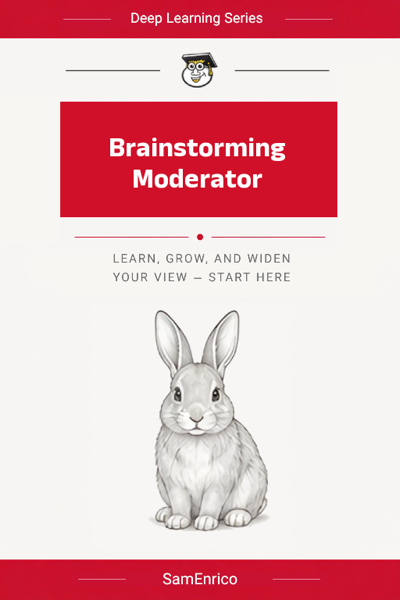
Non-FictionInformativeEducational
Brainstorming Moderator eBook
A Coursebook on Brainstorming Moderator
A Coursebook on Brainstorming Moderator
Formats
Free sample
Chapter 1: The Alchemist’s Choice...--–- The first time I watched a brainstorming session collapse, it took less than eleven minutes. The manager, well-intentioned and energetic, stood at a whiteboard with a marker poised like a weapon. “No bad ideas!” he announced, then asked, “How might we increase revenue by 30% this quarter?” The room froze. One junior analyst whispered something about pricing. The manager wrote it down.
A director immediately said, “That won’t work—legal would never approve.” The junior analyst did not speak again for the remaining forty-nine minutes. By the end, the group had generated exactly seven ideas, three of which were variations of “work harder,” one of which was “cancel all vacations,” and two of which had been proposed in the previous quarter’s failed brainstorming session. The manager thanked everyone, typed up the whiteboard photo, and emailed it with the subject line “Great session team!” Nothing changed.That manager was not incompetent. He was not lazy. He was acting on a deeply flawed assumption: that creativity emerges spontaneously if you remove obvious criticism and provide a marker.
This assumption has been disproven by decades of research—from Alex Osborn’s original work in the 1950s to Keith Sawyer’s Group Genius to Teresa Amabile’s studies on organizational creativity—yet it persists in conference rooms and Zoom calls around the world. The evidence is clear: unstructured brainstorming does not work. But structured brainstorming, led by a skilled moderator, works remarkably well. The difference between the two is not the intelligence of the participants, not the quality of the coffee, not even the nature of the problem. The difference is the person holding the pen.This book is about becoming that person.
Not an idea collector—someone who passively records whatever happens to emerge from the mouths of the loudest people in the room—but an idea catalyst: someone who designs the conditions, sequences the activities, and modulates the energy that transforms a group of individuals into a genuinely creative collective. The distinction between collector and catalyst is the central organizing principle of everything that follows. A collector asks “What ideas do you have?” and writes down the answers. A catalyst asks “What conditions would allow our best ideas to surface?” and then builds those conditions, minute by minute, from the invitation email to the post-session follow-through.The Paradox That Demands a New Kind of Facilitator Brainstorming suffers from a strange and painful paradox: it is both the most widely used creative technique in business and the most frequently botched. Studies consistently show that traditional, unfacilitated brainstorming groups produce fewer high-quality ideas than the same number of individuals working alone and then pooling their results.
This finding, first documented by Michael Diehl and Wolfgang Stroebe in 1987 and replicated dozens of times since, has led many to declare brainstorming dead. But that conclusion mistakes the tool for its misuse. What fails is not brainstorming but the absence of skilled moderation. Diehl and Stroebe identified three killers: production blocking (people cannot speak while someone else is speaking), evaluation apprehension (fear of looking foolish), and social loafing (hiding in the crowd). Every single one of these killers is a failure of moderation, not a failure of the method.A skilled moderator eliminates production blocking by alternating between silent generation and structured sharing.
She eliminates evaluation apprehension by enforcing temporal separation between idea generation and idea judgment. She eliminates social loafing by making every participant’s contribution visible and attributed. The moderator does not need to be the smartest person in the room, the most creative, or the most experienced in the domain. She needs to be the most intentional. That intentionality is what this chapter—and this entire book—will build.Mindset Over Technique: Why 80% of Moderation Is How You Show Up Let me state a claim that may sound provocative but is supported by every master facilitator I have studied across the top ten books on creativity and group dynamics: effective moderation is approximately twenty percent technique and eighty percent mindset.
You can memorize every tool in this book—brainwriting, SCAMPER, affinity clustering, dot voting, negative brainstorming, pre-mortems, all of it—and still fail as a moderator if you bring the wrong internal orientation to the room. Conversely, a moderator with the right mindset but only a handful of techniques will consistently outperform a technique-rich, mindset-poor colleague.What is this mysterious mindset? It consists of three core competencies, each of which can be learned, practiced, and improved. None of them are innate personality traits, though some people have head starts. The three competencies are neutrality, curiosity, and adaptive energy.
Let me define each with precision.Neutrality does not mean having no opinions. It means having a disciplined practice of withholding your opinions from the group’s creative process. The neutral moderator does not nod more enthusiastically at her favorite idea. She does not say “That’s interesting” in a tone that signals “That’s stupid.” She does not use her body language, facial expressions, or vocal inflections to steer the group toward her preferred outcome. This is harder than it sounds.
The moment someone proposes an idea that you believe is obviously wrong, your face wants to telegraph that belief. The moment someone proposes an idea that you secretly had yourself, your face wants to glow with validation. The neutral moderator trains herself to become a poker player—not in the sense of deception, but in the sense of consistent, unreadable presentation regardless of internal state. A useful practice: before any session, write down your own three best answers to the challenge question on a private sticky note. Then commit to never sharing them unless the group explicitly requests them as a last resort.
This small ritual externalizes your bias and makes it easier to set aside.Curiosity is the antidote to premature judgment. When a participant says something that sounds confusing, off-topic, or even stupid, the curious moderator does not dismiss or ignore. She asks a genuine question: “What led you to that?” or “Can you say more about what you mean by that word?” or “What problem would that solve?” These questions are not rhetorical devices for gently killing ideas. They are genuine attempts to understand. Many of the best ideas in history began as half-formed, poorly articulated, or counterintuitive fragments.
The curious moderator treats every contribution as a clue, not a conclusion. This orientation transforms the moderator’s role from quality control officer to detective. You are not there to judge whether ideas are good. You are there to uncover what the group collectively knows but has not yet articulated.Adaptive energy is the capacity to read the room in real time and shift tactics without hesitation. A low-energy session needs a physical warm-up.
A high-conflict session needs a reset. A session that has generated fifty similar ideas needs a provocative stimulus. The moderator with adaptive energy does not cling to a pre-written agenda like a script. She treats the agenda as a hypothesis, not a commitment. She watches faces, listens to tone, and notices who has not spoken recently.
She has a mental menu of twenty possible next moves and can select one in three seconds. This competency is…
This is the end of the free sample. Get the eBook to keep going. Buy now
About this book
Details
- Author
- Hilton Tamatha
- Publisher
- SamEnrico
- Language
- English
- Genre
- Non-Fiction, Informative, Educational
- Released
- 2026-05-04
- Pages (approx.)
- 155
- Available as
- eBook, Audiobook

Read better in the ZLOADR app
Your eBooks on your phone or tablet. Sign in with your SamEnrico account and start reading.
More by Hilton Tamatha
 Jamaican BPO Startup GuideHilton Tamatha$11.99
 Physical Symptoms Presentation AnxietyHilton Tamatha$11.99
 Beating the Inner CriticHilton Tamatha$11.99
 The Erectile Dysfunction Testosterone GuideHilton Tamatha$11.99
 Frostborn: The Troll Queen’s Last StandHilton Tamatha$11.99
 How to Become a Occupational Therapy AssistantHilton Tamatha$11.99
 YouTube for Ecommerce BrandsHilton Tamatha$12.99
 Airline Spending Recovery PatternsHilton Tamatha$12.99
 Understanding Polycystic Kidney Disease, Type 2Hilton Tamatha$17.99
You may also like
 Hong Kong Handover 1997Dunn Johnnie$11.99
 Zumba For Postnatal Recovery CourseNeal Christian$11.99
 Zumba for BeginnersLadner Nikia$11.99
 YouTube Comment Mining GuideHumes Pandora$12.99
 Worry Box MeditationCarlin Rudy$11.99
 Workplace Stress MeditationNguyen Lynn$11.99
 Workplace Stress and Sleep RepairHawley Ivory$11.99
 Workplace Perfectionism CureDelaney Jeffry$11.99
 Workplace Injustice Anger GuideWallen Isabelle$11.99
 Work Addiction and Burnout LinkGreenwood Ester$11.99
 Women in Yoga and WellnessBeattie Galina$11.99
 Women in Stand Up ComedyChun Evangeline$11.99