
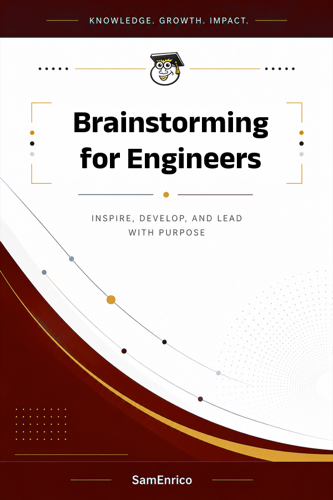
Free sample
Chapter 1: Cognitive Friction...--–- The engineering manager looked exhausted. Across the conference table, the whiteboard was covered in sticky notes—seventy-three of them, to be precise. The team had just spent four hours in what everyone called a "successful brainstorming session." There was pizza, there was energy, and there was definitely no shortage of ideas. One idea in particular had captured everyone's imagination: a passive cooling system that would eliminate the need for fans altogether. The team spent the next three weeks modeling, simulating, and prototyping this elegant solution before discovering what any first-year thermodynamics student could have told them on day one.
The laws of physics had not been suspended for their creativity session. The idea was impossible. Three weeks. Wasted.This scene repeats itself daily in engineering organizations around the world. Well-intentioned teams gather in conference rooms, armed with markers and optimism, believing that the absence of structure is the presence of creativity.
They have been told that brainstorming means saying "yes, and" rather than "no, because." They have been taught that judgment kills ideas and that the goal is quantity over quality. And they are wrong.Traditional brainstorming, as popularized by advertising executive Alex Osborn in the 1950s, was designed for a specific context: generating catchy slogans, marketing angles, and creative copy. It was never designed for torque specifications, thermal gradients, or stress-strain curves. Yet somehow, this method migrated from Madison Avenue to manufacturing floors, from ad agencies to aerospace firms, and from creative writing workshops to mechanical engineering departments. The migration was a mistake.This chapter dismantles the myth that casual, unstructured brainstorming works for technical teams.
Drawing on cognitive psychology research, engineering case studies, and decades of failed "pizza parties," we will identify exactly why traditional brainstorming fails engineers. More importantly, we will introduce the foundational principle that replaces blind agreement with structured conflict: Cognitive Friction. By the end of this chapter, you will understand not only why your past brainstorming sessions have underperformed but also why the solution is not more creativity—it is better constraints.The Three Failure Modes of Traditional Brainstorming Before we can fix a broken process, we must understand exactly how it breaks. Research in cognitive psychology and organizational behavior has identified three specific failure modes that plague traditional brainstorming in engineering contexts. These are not minor inconveniences; they are structural flaws embedded in the method itself.Failure Mode One: Production Blocking Imagine a team of eight engineers sitting around a table.
One person is speaking. The other seven are waiting. In that waiting period, something insidious happens: ideas decay. Cognitive psychology research has demonstrated that the human working memory can hold approximately seven chunks of information for about twenty seconds without active rehearsal. When an engineer has a technical thought—a potential solution involving a specific material, a novel linkage, or an unexpected control algorithm—that thought begins to degrade the moment they cannot express it.This is called production blocking, and it is the single most destructive force in traditional brainstorming.
A study by Diehl and Stroebe (1987) found that individuals in brainstorming groups generated only half as many ideas as the same number of individuals working alone, and their ideas were significantly less creative. The culprit was not social loafing (though that came next) but the simple fact that people forget their thoughts while waiting for others to finish.For engineers, this is particularly devastating. Technical ideas are not marketing slogans. A marketing slogan might be "Faster, stronger, better"—easy to remember while waiting. An engineering idea might be "What if we replaced the aluminum housing with a carbon-fiber composite, changed the cross-section from circular to elliptical to improve moment of inertia, and added a thermoelectric cooler at the interface with the heat sink?" That thought cannot survive a ninety-second wait while a colleague describes their unrelated idea about handle ergonomics.
It simply vanishes.I have witnessed this phenomenon dozens of times in design reviews. An engineer's face lights up with an insight. They lean forward slightly. Their hand reaches for a marker. But someone else is speaking.
So they wait. They nod. They glance at the marker. They look back at the speaker. Their posture changes.
The light in their eyes dims. By the time the floor is theirs, they say, "I had something, but it's gone." And it is.Failure Mode Two: Evaluation Apprehension The second failure mode is more social and, for engineering organizations, more pernicious. Evaluation apprehension is the anxiety people feel when they believe their ideas will be judged by others. In traditional brainstorming, facilitators explicitly instruct participants to withhold criticism. "No idea is a bad idea," they chant.
"Defer judgment." But this instruction conflicts with a deeper reality: engineering is fundamentally about judgment. Engineers are trained to evaluate, to calculate, to validate. Asking an engineer not to judge is like asking a fish not to swim.The result is not a suspension of judgment but a displacement of it. Judgment does not disappear; it goes underground. Junior engineers learn quickly that their "wild ideas" will be remembered, even if not criticized aloud.
The senior engineer who says nothing during the brainstorm may later, in the hallway, mention that the junior's idea was "interesting but impractical." That hallway comment carries more weight than an hour of facilitated positivity.This dynamic creates a chilling effect that is particularly acute in engineering hierarchies. Consider the following scenario: a junior mechanical engineer proposes using a shape-memory alloy actuator instead of a traditional solenoid. The senior electrical engineer raises an eyebrow. The project manager writes something down. The junior engineer spends the rest of the session wondering what they wrote.
The next day, the junior's idea is not mentioned again. Six months later, the junior stops proposing unconventional ideas altogether.Evaluation apprehension does not just reduce the quantity of ideas; it systematically eliminates the most novel ideas. Research has shown that in traditional brainstorming groups, the ideas that get expressed are disproportionately the safest, most conventional, most predictable ideas. The radical insights—the ones that might lead to patents and breakthroughs—are suppressed by the very people who are supposed to generate them.Failure Mode Three: Social Loafing The third failure mode is the most democratic: it affects everyone equally. Social loafing is the tendency for individuals to exert less effort when working in a group than when working alone.
It was first identified in rope-pulling experiments in the late nineteenth century, but it has been replicated in dozens of contexts since. The mechanism is simple: when individual contribution cannot be easily identified, individual effort declines.In a traditional brainstorming session, who owns idea number forty-two? Is it the person who spoke it, the person who wrote it on the sticky note, or the group as a whole? The ambiguity of ownership diffuses accountability. When no one is individually responsible for the output, everyone is collectively less responsible.For engineers, social loafing is particularly problematic because engineering work is typically marked by individual accountability.
Your name goes on the drawing. Your signature approves the calculation. Your license stamps the design. In a brainstorm, suddenly that accountability disappears. The result is a strange hybrid: a process that…
This is the end of the free sample. Get the eBook to keep going. Buy now
About this book
Details
- Author
- Gilbert Sam
- Publisher
- SamEnrico
- Language
- English
- Genre
- Non-Fiction, Self-Help
- Released
- 2026-06-06
- Pages (approx.)
- 160
- Available as
- eBook, Audiobook

Read better in the ZLOADR app
Your eBooks on your phone or tablet. Sign in with your SamEnrico account and start reading.
More by Gilbert Sam
 Growth Mindset In ArtGilbert Sam$11.99
 Multilingual Collaboration GuideGilbert Sam$11.99
 Self Esteem for FreelancersGilbert Sam$11.99
 Drones in Logistics GuideGilbert Sam$11.99
 The SMART for ParentsGilbert Sam$11.99
 Delegation for ResearchersGilbert Sam$11.99
 Mindfulness for FreelancersGilbert Sam$11.99
 The Golden Scrolls of Nubia: Secrets of the Meroitic ScholarsGilbert Sam$11.99
 The Quantum Arches: Gaudi’s Sagrada Família and the Alchemy of LightGilbert Sam$11.99
 The Essential Guide to Christmas: ModernGilbert Sam$11.99
 How to Produce Emergency BlanketsGilbert Sam$11.99
 South Africa Business Loan Qualification GuideGilbert Sam$12.99
You may also like
 Hong Kong Handover 1997Dunn Johnnie$11.99
 Zumba For Postnatal Recovery CourseNeal Christian$11.99
 Zumba for BeginnersLadner Nikia$11.99
 YouTube Comment Mining GuideHumes Pandora$12.99
 Worry Box MeditationCarlin Rudy$11.99
 Workplace Stress MeditationNguyen Lynn$11.99
 Workplace Stress and Sleep RepairHawley Ivory$11.99
 Workplace Perfectionism CureDelaney Jeffry$11.99
 Workplace Injustice Anger GuideWallen Isabelle$11.99
 Work Addiction and Burnout LinkGreenwood Ester$11.99
 Women in Yoga and WellnessBeattie Galina$11.99
 Women in Stand Up ComedyChun Evangeline$11.99