
Non-FictionSelf-HelpHumilitySelf Promotion
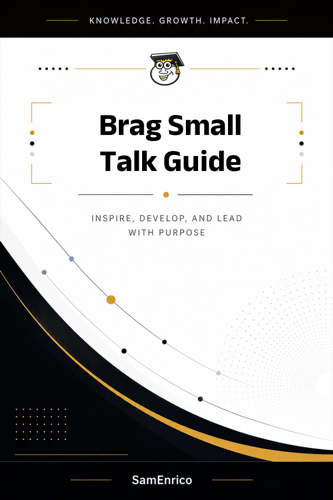
Brag Small Talk Guide eBook
Share accomplishments without sounding arrogant us
Share accomplishments without sounding arrogant using we language and gratitude.
Formats
Free sample
Chapter 1: The Status Thermostat...-- Every time you open your mouth to share a win, you are either heating or cooling the room. Most people walk around with a broken internal thermometer. They believe that louder, bigger, and more frequent self-promotion is the path to respect. They are catastrophically wrong.Let me paint a scene you will recognize. You are at a casual work lunch.
Five colleagues sit around a table. Someone mentions a recent project deadline they crushed. Another person immediately follows with a bigger deadline they crushed faster. A third person tries to humble brag—”I’m so exhausted from winning so many awards”—and the entire table goes silent. Forks stop moving.
Eyes drop. The rest of the lunch feels cold, competitive, and exhausting. No one says what everyone is thinking: That person made the room smaller.That is the status thermostat in action. Every time you speak about yourself, you adjust the emotional temperature of the conversation. Self-focused, credit-hoarding language raises the temperature in a way that makes everyone uncomfortable.
It feels like someone turned up a heater in a tiny room with no windows. Listeners start looking for exits. They stop contributing. They remember you as the person who made them feel small.But here is what most people never learn: the opposite move—shifting credit, using “we,” expressing gratitude—lowers the temperature in a way that makes everyone want to stay. It turns a potentially arrogant moment into a connective one.
You share the same win. You receive the same recognition. But the room feels different. People lean in instead of leaning back.This chapter is about rewiring that internal thermostat. Before you ever speak a single word of a brag, your mindset determines whether the listener hears arrogance or authenticity.
We are going to rebuild your inner script from the ground up, replacing the default “me” with a strategic, sincere “we.” By the end of this chapter, you will never again accidentally heat a room you meant to cool.The Threat Response You Didn’t Know You Were Triggering Let us start with biology, because your mouth is not the problem. Your listener’s brain is the problem.Social comparison theory, first developed by psychologist Leon Festinger in 1954, argues that humans have an innate drive to evaluate themselves in comparison to others. When someone announces a win, your listener’s brain automatically runs a split-second calculation: Is this person better than me? If yes, how much better? And what does that say about my own standing?This calculation is not intellectual.
It is emotional and physiological. Researchers have found that hearing someone else’s success activates the same neural regions associated with physical pain, particularly when the listener perceives the success as undeserved or self-promoting. A study published in Science (2004) showed that social rejection and physical pain share neural circuitry in the anterior cingulate cortex. When you brag in a way that feels arrogant, you are not just annoying the listener. You are causing them a low-grade form of social pain.That sounds dramatic.
But think about your own experience. Have you ever been at a party where someone talked nonstop about their promotion, their new house, their child’s academic achievements, and you felt your chest tighten slightly? That tightening is real. That is the threat response.Here is what makes it worse: the listener does not need to be consciously jealous to feel the threat. Even people who genuinely like you and want you to succeed will experience a micro-dose of comparison-based discomfort when you share a win in an exclusive, self-congratulatory way.
It is not their fault. It is not entirely your fault. It is human wiring.But knowing this wiring exists gives you an enormous advantage. You can stop triggering the threat response before it starts.How “We” Lowers the Threat The solution is deceptively simple: shift from “I” to “we.” But not the fake, performative “we” that people use when they want credit without sounding greedy. A real, substantive “we” that genuinely redistributes acknowledgment.When you say, “Our team achieved X,” instead of “I achieved X,” you accomplish three critical things.
First, you signal that you see yourself as part of a larger ecosystem. That signals safety to the listener because you are not claiming to be above them. Second, you invite the listener to mentally join your “we.” Humans are tribal. When you use inclusive language, listeners unconsciously include themselves in your success narrative. Third, you reduce the comparison threat because the win is now shared across multiple people, diluting any sense of individual superiority.A 2016 study in the Journal of Experimental Social Psychology tested exactly this phenomenon.
Participants listened to recordings of people sharing professional achievements. Half the recordings used “I” language (“I closed the deal,” “I solved the problem”). Half used “we” language even when the achievement was factually solo (“We figured out a solution,” “Our approach worked”). The “we” speakers were rated as more likable, more collaborative, and more leadership-material—even when listeners knew the speaker had worked alone. The mere use of inclusive language changed perceptions.Let me repeat that because it is counterintuitive: Even when you worked alone, saying “we” makes people like you more.
They do not penalize you for sharing credit that is not technically accurate. They reward you for being generous.This is not about lying. You are not claiming that invisible ghosts helped you finish a solo project. You are acknowledging that no achievement exists in a vacuum. The infrastructure that supported you—the clean water you drank, the education you received, the stable internet connection, the colleague who reviewed your work, the family member who gave you quiet time—all of those are legitimate “we” partners.
You are simply making the invisible visible.The Solo Achievement Trap Most people resist “we” language because they believe it diminishes their individual contribution. This is the solo achievement trap, and it is one of the most persistent myths in professional communication.The trap works like this: you work hard on something. You do it mostly alone. You succeed. When you go to share that success, your brain screams, Say “I”!
You earned this! No one else did the work! If you say “we,” people will think you are weak or trying to hide!That voice is lying to you. And it is lying with data from a different era.Research on leadership perception has shifted dramatically in the last decade. Older models of leadership emphasized individual heroism—the lone genius, the solo climber, the singular visionary.
Those models are dying. Contemporary research from organizational psychology shows that leaders who use inclusive language are rated as more effective, more trustworthy, and more promotable than those who use exclusive language. A 2018 analysis of over 1,000 performance reviews found that employees who were described as “collaborative,” “team-oriented,” and “generous with credit” received significantly higher raises and promotions than those described as “independent,” “self-sufficient,” or “driven.” The individualist language was not a compliment. It was a subtle penalty.Here is a concrete example. Two software engineers complete the same project.
Engineer A says: “I refactored the entire codebase. I reduced load time by 40 percent. I’m really proud of my…
This is the end of the free sample. Get the eBook to keep going. Buy now
About this book
Details
- Author
- Farnsworth Yun
- Publisher
- SamEnrico
- Language
- English
- Genre
- Non-Fiction, Self-Help, Humility, Self Promotion
- Released
- 2026-06-08
- Pages (approx.)
- 128
- Available as
- eBook, Audiobook

Read better in the ZLOADR app
Your eBooks on your phone or tablet. Sign in with your SamEnrico account and start reading.
More by Farnsworth Yun
 Walking Meditation for Morning SicknessFarnsworth Yun$11.99
 Sales Habit Formation GuideFarnsworth Yun$11.99
 Loving Kindness For Self Criticism GuideFarnsworth Yun$11.99
 Value Curve Analysis GuideFarnsworth Yun$11.99
 Cosmic Echoes: The First Stargazers of Prehistoric EuropeFarnsworth Yun$11.99
 Trollheim’s Tower: The Hollow Spire of the Frost GiantsFarnsworth Yun$11.99
 Understanding Granulomatosis, LymphomatoidFarnsworth Yun$17.99
 Showroom Team LeadFarnsworth Yun$11.99
 Payment Reverse Charge GuideFarnsworth Yun$12.99
 BPO Contract NegotiationFarnsworth Yun$12.99
 How to Start a Buffet (licensed) Business (Beginners Guide)Farnsworth Yun$11.99
You may also like
 Hong Kong Handover 1997Dunn Johnnie$11.99
 Zumba For Postnatal Recovery CourseNeal Christian$11.99
 Zumba for BeginnersLadner Nikia$11.99
 YouTube Comment Mining GuideHumes Pandora$12.99
 Worry Box MeditationCarlin Rudy$11.99
 Workplace Stress MeditationNguyen Lynn$11.99
 Workplace Stress and Sleep RepairHawley Ivory$11.99
 Workplace Perfectionism CureDelaney Jeffry$11.99
 Workplace Injustice Anger GuideWallen Isabelle$11.99
 Work Addiction and Burnout LinkGreenwood Ester$11.99
 Women in Yoga and WellnessBeattie Galina$11.99
 Women in Stand Up ComedyChun Evangeline$11.99