
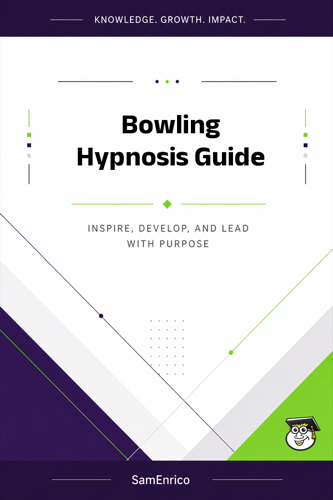
Bowling Hypnosis Guide eBook
Improves release and spare focus.
Improves release and spare focus.
Formats
Free sample
Chapter 1: The Knowing-Doing Chasm–- You already know how to do it. That is the cruelest fact in all of bowling.You have watched the slow-motion videos. You have read the articles about wrist position, axis rotation, and the pendulum swing. You have stood behind your teammate who averages 215 and studied his release frame by frame. You can close your eyes right now and describe, with perfect accuracy, what a flawless release looks like: the relaxed grip, the late thumb exit, the fingers lifting through the back of the ball, the smooth follow-through that ends with the hand shaking hands with the pins.You know.And yet, when you step onto the approach in the tenth frame with a single ten-pin standing between you and a new personal best, your hand does something entirely different.
It squeezes. It yanks. It drops the shoulder. It snatches the ball as if trying to rip the coverstock off. The ball skids past the ten-pin, kisses the gutter, and you walk back to your seat muttering the same four words you have muttered a thousand times: “I know what I did wrong.”That is the paradox.
That is the chasm. And until you understand why knowing is not enough, you will continue to throw 180 games with the physical talent to throw 220s.The Anatomy of a Bowler’s Brain To understand why your body betrays your knowledge, you must first understand that you do not have one brain. You have two. Not literally two separate organs, but two fundamentally different operating systems running on the same neural hardware.The conscious mind—the part you think of as “you”—lives in the prefrontal cortex. It is analytical, verbal, sequential, and painfully slow.
It processes information at roughly 40 to 60 bits per second. That sounds fast until you realize that a single frame of visual information contains millions of bits. The conscious mind is the CEO who takes notes slowly and demands a full report before making a decision.The subconscious mind—the part you rarely hear from until it saves your life or sabotages your release—operates at roughly 11 million bits per second. It handles your heartbeat, your balance, your breathing, and every automatic movement you have ever learned. It is the thousands of employees on the factory floor who do the real work while the CEO sits in an office taking notes.Here is the problem.
When you learned to bowl, you started consciously. Someone told you to keep your wrist straight, so you thought about keeping your wrist straight. You repeated that conscious instruction hundreds of times. Over time, with enough repetition, the motor pattern began to transfer from the conscious mind to the subconscious. That is how all learning works.
First you think about it, then you do it without thinking.But something insidious happens to bowlers who stay in the 160-to-190 average range. They never fully complete the transfer. Instead, they develop what sports psychologists call conscious interference—a toxic habit of pulling motor programs back into conscious control exactly when they should be left on autopilot.The Forty-Bit Delay Consider what happens during a typical release when a 170-average bowler decides to “focus.”The bowler stands on the approach. The conscious mind, trying to be helpful, runs through a checklist: Wrist straight. Thumb out first.
Fingers lift. Don’t pull it. Stay behind the ball. Follow through.Each one of those instructions takes time. Not much time—perhaps a tenth of a second per instruction.
But the bowling release, from the moment the ball passes your ankle to the moment it leaves your hand, takes roughly 0.3 seconds total.You are trying to run a six-item checklist in a 0.3-second window. The math does not work. By the time the conscious mind processes the second instruction, the ball is already gone—but not before the conflicting commands have created muscle freeze, hesitation, or a jerky snatch.This is the Forty-Bit Delay. Your conscious mind processes instructions at forty bits per second. Your release requires subconscious execution at millions of bits per second.
When you force conscious control onto a subconscious process, you introduce a delay that fractures the fluidity of the movement. The result is not a smooth release. It is a stutter-step, a grab, a yank, or a desperate fling.The cruel irony is that you are trying harder. And trying harder is exactly what makes you worse.The Fifty-Frame Barrier Motor learning researchers have identified a phenomenon they call the fifty-frame barrier. The finding is deceptively simple: to imprint a new motor habit through conscious, analytical practice, you need approximately fifty perfect repetitions.
That is for a simple habit like tapping your finger in a specific sequence.Bowling is not simple.The release occurs within a complex chain of movements: the setup, the pushaway, the backswing, the downswing, the release, the follow-through. Each phase interacts with every other phase. Changing one element—say, relaxing your grip pressure—ripples through the entire kinetic chain. Your subconscious is not trying to learn one thing. It is trying to recalibrate a dozen interdependent variables simultaneously.Here is what happens to most bowlers who try to fix their release through conscious practice.
They throw fifty shots while thinking about grip pressure. By shot thirty, fatigue sets in. By shot forty, the conscious mind wanders. By shot fifty, they have reinforced their old bad habit forty times and the new good habit maybe ten times. The math is brutal: the old habit wins because it has had years of repetition, while the new habit has had only minutes.This is why you can practice for hours and see no improvement.
You are not practicing the new release. You are practicing the conflict between the new release and the old release. And that conflict is its own motor habit—one that feels exactly like frustration.The Myth of “Just Concentrate Harder”Every struggling bowler has heard the same useless advice: “Just concentrate.” “Focus.” “Get your head in the game.”This advice is not just unhelpful. It is actively destructive. It assumes that the problem is insufficient conscious effort, when in fact the problem is the presence of conscious effort at all.
Telling a bowler with conscious interference to concentrate harder is like telling someone who is drowning to breathe more water.Let us be precise about what concentration actually is. Concentration is the deliberate direction of attention toward a specific stimulus or task. In bowling, that sounds good. But the devil is in the word “deliberate.” Deliberate attention is conscious attention. Conscious attention is slow attention.
Slow attention destroys timing.The bowlers who throw 300 games are not concentrating harder than you. They are concentrating differently. Or, more accurately, they have learned to stop concentrating on the release entirely. They have moved their attention to something neutral—a spot on the lane, a feeling in their breathing, a simple rhythm—while their subconscious executes the release without interference.That is the secret that no coach ever told you. The best concentration is not concentration at all.
It is the strategic withdrawal of conscious attention from the very thing you want to do well.What Hypnosis Actually Is (And…
This is the end of the free sample. Get the eBook to keep going. Buy now
About this book
Details
- Author
- Sheets Karina
- Publisher
- SamEnrico
- Language
- English
- Genre
- Non-Fiction, Self-Help, Bowling
- Released
- 2026-06-07
- Pages (approx.)
- 126
- Available as
- eBook, Audiobook

Read better in the ZLOADR app
Your eBooks on your phone or tablet. Sign in with your SamEnrico account and start reading.
More by Sheets Karina
 Teen Flow State GuideSheets Karina$11.99
 Quadrant One Crisis ManagementSheets Karina$11.99
 The 90 Minute Focus CycleSheets Karina$11.99
 Morning Dew WalkSheets Karina$11.99
 Stress Libido Sexual HealthSheets Karina$11.99
 Self Talk for WritersSheets Karina$11.99
 Lighthouse Keeper CalmSheets Karina$11.99
 Love, Lies, and a Royal Scandal: The Untold Story of Princess Margaret and Roddy LlewellynSheets Karina$11.99
 The Silent Uprising: How a Librarian Defied the NazisSheets Karina$11.99
 White Tigers: Genetic AnomalySheets Karina$11.99
 Cooperatives Value Addition GuideSheets Karina$12.99
 Chinese Supplier Relationship BlueprintSheets Karina$12.99
You may also like
 Hong Kong Handover 1997Dunn Johnnie$11.99
 Zumba For Postnatal Recovery CourseNeal Christian$11.99
 Zumba for BeginnersLadner Nikia$11.99
 YouTube Comment Mining GuideHumes Pandora$12.99
 Worry Box MeditationCarlin Rudy$11.99
 Workplace Stress MeditationNguyen Lynn$11.99
 Workplace Stress and Sleep RepairHawley Ivory$11.99
 Workplace Perfectionism CureDelaney Jeffry$11.99
 Workplace Injustice Anger GuideWallen Isabelle$11.99
 Work Addiction and Burnout LinkGreenwood Ester$11.99
 Women in Yoga and WellnessBeattie Galina$11.99
 Women in Stand Up ComedyChun Evangeline$11.99