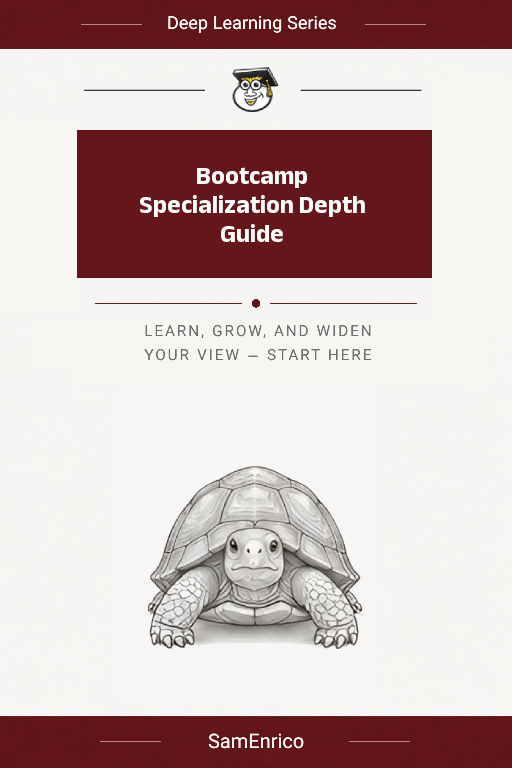
Bootcamp Specialization Depth Guide eBook
Compare bootcamp tracks in frontend, backend, data
Compare bootcamp tracks in frontend, backend, data science, or mobile versus degree breadth.
Formats
Free sample
Chapter 1: The Depth Economy--The email arrived at 11:47 PM on a Tuesday. The subject line read: “Offer Letter – Junior Software Engineer.” The sender was a Series A fintech startup that had just raised twenty million dollars. The recipient was a former high school English teacher named Maya who, nine months earlier, had never written a line of Java Script. Maya did not have a computer science degree. She had never taken a course in algorithms, operating systems, or compiler design.
She could not explain how a garbage collector works or recite the time complexity of quicksort from memory. What Maya had was a twelve-week intensive bootcamp, a deployed e-commerce site with two hundred monthly users, and a Git Hub repository documenting three production bugs she had fixed—complete with error messages, failed hypotheses, and the final pull request that saved the day.The hiring manager later told her, “We interviewed twelve people with CS degrees. Seven of them could reverse a linked list on a whiteboard. Only you could tell me what happens when a Stripe webhook arrives before the database write is committed.”This is not an outlier story. It is a signal of a fundamental shift in how technology work gets done—and how the people who do it get hired.The Thesis of This Book This book argues against the Renaissance developer ideal.
For decades, the software industry worshipped the polymath: the engineer who could write a compiler in C, design a database schema, build a frontend in React, and debug a kernel panic—all before lunch. That ideal was born in an era of scarcity, when computing resources were expensive, tooling was primitive, and every engineer had to understand the full stack because no one else would. That era is over.We have entered what this book calls the Depth Economy. In a Depth Economy, employers pay a premium for demonstrable, applied expertise in a specific, market-relevant stack. They do not pay for knowing a little about many things.
They pay for the ability to walk into a room, look at a problem in your domain, and say: “I have solved this exact thing before. Give me two weeks.”This book is a tactical playbook for career switchers, bootcamp graduates, and self-taught coders who want to survive and thrive in the Depth Economy. It will teach you how to choose a specialization among the four major tracks—frontend, backend, data science, and mobile—and go deep enough to win job interviews, survive AI-driven automation, and build a sustainable career. It will also warn you about the risks of hyper-specialization and show you how to maintain enough adjacent knowledge to pivot when the market shifts.But before we get to the tactics, we need to understand why the rules have changed.The Great Abstraction Twenty years ago, deploying a web application required deep knowledge of physical infrastructure. You needed to understand rack-mounted servers, network switches, load balancers, and firewalls.
You needed to configure Apache or Nginx by hand, manage SSL certificates, and monitor disk usage with command-line tools. A single mistake could bring down the entire application for days.Today, you can deploy a full-stack application to Vercel or Render in ten minutes with a single git push. AWS, Google Cloud, and Azure have abstracted away most infrastructure complexity. Managed databases like Supabase and Mongo DB Atlas handle replication, backups, and failover automatically. CI/CD pipelines run tests and deployments on every commit.
The cloud has democratized deployment, but it has also changed what employers need from entry-level engineers.They no longer need someone who can configure a load balancer. They need someone who can ship features quickly and debug production issues when they arise. These are fundamentally different skills. One is about system administration. The other is about applied problem-solving in a specific codebase.Consider the experience of a typical computer science graduate.
Over four years, they take courses in algorithms, data structures, operating systems, compilers, databases, networking, software engineering, and artificial intelligence. They learn a tremendous amount about the theory of computing. But many graduate without ever deploying a real application to a real server, without handling a production outage, without debugging a race condition caused by concurrent requests, and without writing a unit test that actually caught a bug.This is not a condemnation of computer science education. CS degrees were never designed to produce job-ready web developers. They were designed to produce computer scientists—people who understand the fundamental principles of computation, who can design new algorithms, who can reason about the theoretical limits of what computers can do.
That is valuable. But it is not what most companies need from entry-level hires.What most companies need is someone who can take a feature specification, turn it into working code, deploy it without breaking everything, and fix it when it breaks. These are skills that bootcamps explicitly teach and that many degree programs implicitly neglect.The Depth Economy Defined The Depth Economy is a labor market where specialized, demonstrable expertise commands higher salaries and better job security than broad but shallow knowledge. This is a reversal of the previous era, where generalists were prized for their ability to adapt across different technical domains.Several forces have driven this shift:First, the explosion of framework complexity. In 2010, building a web application meant j Query on the frontend and PHP on the backend.
The surface area was small. One person could realistically master the entire stack. Today, a modern frontend application involves Type Script, React, Next.js, Tailwind CSS, Zustand or Redux for state management, React Query for data fetching, Storybook for component documentation, Jest and React Testing Library for tests, and Webpack or Vite for bundling. A backend application might involve Node.js or Python, Express or Fast API, Postgre SQL, Redis, Prisma or Type ORM for database access, JWT or OAuth for authentication, and AWS or Render for deployment. No single person can master all of this at a deep level.
The surface area is too large.Second, the rise of product engineering. Modern software development is less about building systems from scratch and more about rapidly iterating on features. Companies measure success by velocity: how quickly can you ship, measure, learn, and ship again? This favors deep specialists who can implement features in their domain without constantly looking up documentation. A frontend specialist who knows React hooks, context, and performance optimization by heart will always outpace a generalist who splits their time across five technologies.Third, the data on specialization.
Stack Overflow’s 2024 developer survey found that specialized developers—those who described themselves primarily as frontend, backend, data, or mobile engineers—reported 22% higher job satisfaction and 18% higher salaries than full-stack generalists. The same survey found that employers were 34% more likely to hire a specialist for a junior role than a generalist, contradicting the common belief that “full-stack” is the most employable label.The Comparison: Deep vs. Broad Let us be precise about what depth looks like compared to breadth. The following matrix contrasts the typical outputs of a deep bootcamp-style education versus a broad degree-style education—not to declare one superior in all contexts, but to show where each excels and where each falls…
This is the end of the free sample. Get the eBook to keep going. Buy now
About this book
Details
- Author
- Thorne Hannelore
- Publisher
- SamEnrico
- Language
- English
- Genre
- Non-Fiction, Student's Shortcut, Specialization
- Released
- 2026-06-01
- Pages (approx.)
- 141
- Available as
- eBook, Audiobook

Read better in the ZLOADR app
Your eBooks on your phone or tablet. Sign in with your SamEnrico account and start reading.
More by Thorne Hannelore
 Managing Open Door Policy HandbookThorne Hannelore$11.99
 Female CEOs Corporate RiseThorne Hannelore$11.99
 Delegation for ADHDThorne Hannelore$11.99
 Saving And Debt AttitudesThorne Hannelore$11.99
 Meditation Habit GuideThorne Hannelore$11.99
 Serial Killer Psychopathy PatternsThorne Hannelore$11.99
 Step Four Moral InventoryThorne Hannelore$11.99
 Mindset For Lifelong LearningThorne Hannelore$11.99
 The Shadow Triads: Hong Kong's Underworld War of 1925Thorne Hannelore$11.99
 The Ghost of Fort Jesus: The Witchcraft and Espionage Trial of Mombasa (1875)Thorne Hannelore$11.99
 A Collector's Handbook to the Chevrolet Ad UniversalThorne Hannelore$11.99
 Rubric Based Prompt GuideThorne Hannelore$12.99