
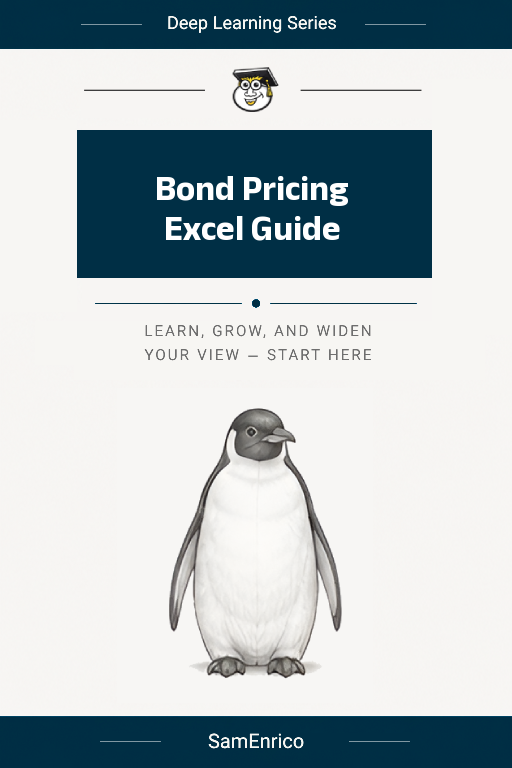
Non-FictionStudent's ShortcutBonds
Bond Pricing Excel Guide eBook
Calculate bond prices, yield to maturity, and curr
Calculate bond prices, yield to maturity, and current yield using Excel for economics exams.
Formats
Free sample
Chapter 1: The Seven Keys--–- Every bond tells a story. That story is written in seven variables, and once you learn to read them, you will never look at a fixed income security the same way again. Most students begin their bond pricing journey by memorizing formulas—price equals coupon times something divided by something else, yield to maturity is that thing you solve for iteratively—and they leave their first economics exam feeling as though they have been asked to translate ancient Greek without a lexicon. This book exists to change that experience, not by handing you more formulas to memorize, but by giving you a tool—Microsoft Excel—that turns bond math from abstract theory into something you can see, touch, and manipulate.The problem with financial calculators is not that they are inaccurate. On the contrary, a $30 Texas Instruments BA II Plus will compute a bond's price faster than most humans can type the inputs.
The problem is that the calculator is a black box. You enter numbers, you press a button, and an answer appears. You have no idea whether that answer is correct or whether you accidentally used the wrong day-count convention. You cannot see the cash flows being discounted. You cannot trace an error back to its source.
In an exam setting—particularly in economics, CFA, and MBA exams that increasingly require students to show their reasoning—this opacity is a致命 weakness.Excel offers the opposite: complete transparency. Every formula is visible. Every assumption is explicit. Every cell can be audited. When you build a bond pricing model in Excel, you are not just calculating an answer; you are constructing an argument.
Your spreadsheet becomes a visual explanation of why a bond trades at a premium or a discount, how sensitive its price is to interest rate changes, and whether its yield to maturity truly reflects its risk.This chapter introduces the foundational language of bonds and the essential Excel setup that will serve you throughout this book. By the end, you will understand the seven variables that define any bond, you will have configured Excel for financial modeling, and you will be ready to build your first pricing model in Chapter 2.The Seven Variables That Define Every Bond Before you can price a bond in Excel, you must understand the variables that describe it. Every bond—whether a US Treasury, a corporate debenture, a municipal note, or a sovereign emerging market issue—can be fully characterized by exactly seven inputs. I call this the Holden Extended 7-Variable System, named after Professor Craig Holden of the Kelley School of Business at Indiana University, whose pioneering work in Excel-based finance education demonstrated that mastering these seven inputs unlocks virtually every bond problem.Let us meet each variable in turn.Variable 1: Settlement Date. This is the date on which the bond actually changes hands—the day the buyer pays and the seller delivers.
In exam problems, the settlement date is typically a specific calendar date (e.g., June 15, 2024). In real markets, settlement usually occurs one or two business days after the trade date (T+1 for Treasuries, T+2 for corporate bonds). The settlement date matters because bond pricing must account for accrued interest: if you buy a bond between coupon payment dates, you owe the seller the interest that has accumulated since the last coupon.Variable 2: Maturity Date. This is the date on which the bond expires. On this day, the issuer makes the final coupon payment (if any) and returns the face value (par value) to the bondholder.
Maturity dates can range from overnight (in the case of some commercial paper) to 30 years or more (for long-term Treasuries). For exam purposes, maturity is usually given as a specific date or as a number of years from the settlement date.Variable 3: Coupon Rate. This is the annual interest rate that the bond pays, stated as a percentage of the bond's face value. For example, a bond with a 5% coupon rate and 1,000facevaluepays1,000 face value pays 1,000facevaluepays50 in interest per year. Crucially, the coupon rate determines the periodic coupon payment amount, but the frequency of those payments matters enormously.
A 5% annual coupon bond pays 50onceperyear.A550 once per year. A 5% semi-annual coupon bond pays 50onceperyear.A525 every six months. The coupon rate is fixed for standard fixed-rate bonds, though later chapters will explore floating-rate notes where the coupon resets periodically.Variable 4: Yield (or Price). Here is where the magic happens. For any bond, yield and price are two sides of the same coin—but you cannot know both simultaneously without additional information.
If you know the bond's price, you can solve for its yield to maturity (the internal rate of return). If you know the yield, you can solve for the price. In exam problems, you will be given one and asked to find the other. Throughout this book, I will refer to this as the yield-price duality, and it is the single most important relationship in fixed income.Variable 5: Redemption Value. This is the amount the bondholder receives at maturity.
For most bonds, the redemption value equals the face value (par), typically 1,000forcorporatebondsand1,000 for corporate bonds and 1,000forcorporatebondsand100 for many government bonds. However, some bonds redeem at a premium (e.g., 105% of par) or a discount (e.g., 98% of par). Callable bonds may have different redemption values depending on when they are called. Always check the bond's indenture for the exact redemption terms.Variable 6: Payment Frequency. How often does the bond pay coupons?
Annual (once per year) is common in European markets. Semi-annual (twice per year) is standard for US Treasuries and most US corporate bonds. Quarterly is sometimes used for certain corporate and municipal bonds. Monthly appears in mortgage-backed securities. In Excel, frequency is represented numerically: 1 for annual, 2 for semi-annual, 4 for quarterly.
Getting this wrong is one of the most common exam errors, and we will return to it repeatedly.Variable 7: Day-Count Basis. This is the least intuitive of the seven variables, but it is also the one that trips up the most students on exams. The day-count basis determines how interest accrues between coupon dates. Different bond markets use different conventions. A 30/360 basis assumes each month has 30 days and each year has 360 days—this simplifies calculations and is common for corporate bonds.
An Actual/Actual basis uses the actual number of days in each month and the actual number of days in the year—this is standard for US Treasuries. Other conventions include Actual/360 (used for money market instruments) and Actual/365 (used for UK gilts). In Excel's bond functions, the basis is represented by a numeric code: 0=30/360 US, 1=Actual/Actual, 2=Actual/360, 3=Actual/365, 4=30/360 European.These seven variables appear in every bond pricing function in Excel. Master them, and you master bond math.Why Terminology Matters: Par, Coupon, Maturity Before we open Excel, let us solidify the core terminology with concrete examples.Par Value (Face Value). This is the nominal amount that the issuer promises to repay at maturity.
It is also the reference amount for calculating coupon payments. A bond with a 6% coupon rate and 1,000parvaluepays1,000 par value pays 1,000parvaluepays60 per year. If the same bond had 5,000parvalue,itwouldpay5,000 par value, it would pay 5,000parvalue,itwouldpay300 per…
This is the end of the free sample. Get the eBook to keep going. Buy now
About this book
Details
- Author
- Devore Tracie
- Publisher
- SamEnrico
- Language
- English
- Genre
- Non-Fiction, Student's Shortcut, Bonds
- Released
- 2026-06-01
- Pages (approx.)
- 160
- Available as
- eBook, Audiobook

Read better in the ZLOADR app
Your eBooks on your phone or tablet. Sign in with your SamEnrico account and start reading.
More by Devore Tracie
 Respite Care Options GuideDevore Tracie$11.99
 Couples Meal PlanningDevore Tracie$11.99
 Scottish Highlands GuideDevore Tracie$11.99
 The Immigrant Turnaround ArtistDevore Tracie$11.99
 Postpartum OCD GuideDevore Tracie$11.99
 Value Based Activation GuideDevore Tracie$11.99
 Pomodoro For Adhd FocusDevore Tracie$11.99
 Fear of Failure for Customer ServiceDevore Tracie$11.99
 The Scholastic Crown of the West: Oxford's Medieval EnlightenmentDevore Tracie$11.99
 The Burning of the SS Mararoa: Fire, Fraud, and Forensic Firsts in Prohibition-Era New ZealandDevore Tracie$11.99
 Service Providers Guide to Correspondence ClubsDevore Tracie$11.99
 Government Contract Debriefing GuideDevore Tracie$12.99
You may also like
 Hong Kong Handover 1997Dunn Johnnie$11.99
 Zumba For Postnatal Recovery CourseNeal Christian$11.99
 Zumba for BeginnersLadner Nikia$11.99
 YouTube Comment Mining GuideHumes Pandora$12.99
 Worry Box MeditationCarlin Rudy$11.99
 Workplace Stress MeditationNguyen Lynn$11.99
 Workplace Stress and Sleep RepairHawley Ivory$11.99
 Workplace Perfectionism CureDelaney Jeffry$11.99
 Workplace Injustice Anger GuideWallen Isabelle$11.99
 Work Addiction and Burnout LinkGreenwood Ester$11.99
 Women in Yoga and WellnessBeattie Galina$11.99
 Women in Stand Up ComedyChun Evangeline$11.99