
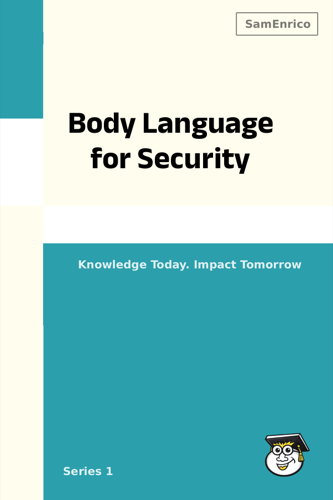
Non-FictionSelf-Help / Security
Body Language for Security eBook
undefined
by Canada Aide
undefined
Formats
Free sample
Chapter 1: The Observation Paradox...--–- The security guard at the Mandalay Bay hotel in Las Vegas had been on duty for eleven hours when he noticed the man pushing a cart stacked with luggage toward the elevators. It was October 1, 2017, just after 9:00 PM. The guard observed that the man’s movements were deliberate, almost rehearsed. His eyes did not wander. He did not check his phone.
He did not acknowledge the other guests milling about the casino floor. The guard felt something—a flicker of unease, a whisper in the back of his mind that said something is off here. But when he later wrote his report, he could not articulate what he had seen. He wrote: "Subject appeared normal. No visible signs of intoxication or distress.
Cleared to proceed."Ninety minutes later, that same man—Stephen Paddock—opened fire from the thirty-second floor of the Mandalay Bay onto a crowd of twenty-two thousand concertgoers below. He killed sixty people. He injured more than four hundred. And the security guard who had stood within ten feet of him, who had looked directly at him, who had felt that inexplicable sense of unease, could not explain why he had let him pass.The guard was not incompetent. He was not lazy.
He was not careless. He was simply untrained. He had a gut feeling, but he did not have a vocabulary for it. He sensed an anomaly, but he did not have a baseline to compare it against. He felt the whisper of danger, but he did not know how to distinguish between social discomfort—a man who simply wanted to be left alone with his luggage—and pre-attack intent—a man who had already rehearsed the massacre in his mind and was now merely executing logistics.This is the observation paradox: security professionals are trained to watch, but they are rarely trained to see.
They are told to trust their instincts, but they are never taught what those instincts are actually detecting. They are evaluated on their vigilance, but they are given no objective framework for distinguishing a genuine threat from a false positive. And so they fail—not because they are blind, but because they are looking without knowing what to look for.This book exists to solve that paradox. And it begins here, with the most fundamental skill in all of security: moving from vague gut feeling to precise behavioral assessment.The Failure of Pop Psychology in Security Before we can build a functional security mindset, we must first tear down the myths that have corrupted security training for decades. Walk into any security conference, browse any online forum, or sit through any basic training course, and you will encounter a series of confidently stated "truths" about body language that are, in fact, dangerously false.Myth One: Liars avoid eye contact.
This is perhaps the most persistent and damaging myth in all of nonverbal communication research. The belief is intuitive: people who are hiding something will look away because they feel shame or fear of detection. The research tells a different story. Multiple meta-analyses have found that liars often over-maintain eye contact, precisely because they know the myth and are trying to appear honest. Worse, anxious but innocent people frequently avoid eye contact precisely because they are anxious—not because they are guilty.
The result is a perfect inversion: the liar stares you down while the innocent person looks at their shoes.Myth Two: Crossed arms mean defensiveness or lying. This myth treats a single posture as a diagnostic window into guilt. In reality, people cross their arms for dozens of reasons: the room is cold, the chair has no armrests, the person is tired, the person is simply comfortable in that position. A security agent who flags every person with crossed arms as suspicious will spend an entire shift chasing false positives while a genuine threat walks past with arms relaxed.Myth Three: Fidgeting means nervousness, and nervousness means guilt. This is actually two myths stacked inside a trench coat.
First, fidgeting does indicate nervousness—but nervousness is a normal human response to being questioned by an authority figure, regardless of innocence or guilt. Second, nervousness does not reliably correlate with deception. The most accomplished liars in the world—career fraudsters, intelligence officers running disinformation, psychopathic predators—often show less nervousness than innocent people because they have either suppressed their anxiety or genuinely do not feel it.Myth Four: You can tell a lie from a "microexpression" of fear or disgust in real time. This myth comes from a well-intentioned but frequently misunderstood interpretation of Paul Ekman's research. Microexpressions are real.
They occur. But they last 1/15th to 1/25th of a second—far too fast for the untrained eye to catch in a dynamic, high-stakes environment. Even trained professionals with years of practice correctly identify microexpressions only slightly above chance when watching real-world footage rather than controlled laboratory videos. The promise of "spotting lies in a split second" is seductive but false. Microexpressions are diagnostic tools for forensic review of recorded interviews, not real-time lie detection.Myth Five: There is a single "tell" that always indicates deception.
This is the most seductive myth of all because it offers certainty in an uncertain profession. If only we could learn that the nose touch means lie or the foot tap means deception, security would be simple. But no such single tell exists. Every behavior that has been proposed as a universal deception cue—gaze aversion, illustrators stopping, posture shifting, face touching, throat clearing—has been shown to occur in innocent people under stress and to be absent in guilty people who are skilled at deception.These myths persist not because they are true but because they are satisfying. They offer the illusion of control.
They transform the messy, probabilistic reality of human behavior into clean, binary rules. And they kill people.A security professional who believes that liars avoid eye contact will release a staring liar while detaining a terrified innocent. A professional who believes that crossed arms mean deception will miss the attacker whose arms are relaxed because he has already decided to kill and no longer feels internal conflict. A professional who searches for a single tell will ignore the cluster of behaviors that actually predicts danger.The first step toward effective security is not learning more cues. It is unlearning the cues that do not work.Gut Feeling vs.
Pattern Recognition: The Crucial Distinction When security professionals are asked why they stopped someone or why they felt uneasy, they often say some version of "I had a gut feeling." This phrase is treated as a mystical gift—an intuition that cannot be explained but should be trusted. In reality, a gut feeling is not magic. It is pattern recognition that has not yet been translated into conscious language.Your brain is constantly processing enormous amounts of sensory information—facial expressions, postures, movements, vocal tones, spatial relationships, contextual cues. Most of this processing happens outside your conscious awareness because your conscious mind can handle only a tiny fraction of the available data. When you experience a gut feeling, what is actually happening is that your unconscious pattern-matching system has…
This is the end of the free sample. Get the eBook to keep going. Buy now
About this book
Details
- Author
- Canada Aide
- Publisher
- SamEnrico
- Language
- English
- Genre
- Non-Fiction, Self-Help / Security
- Released
- 2026-06-09
- Pages (approx.)
- 160
- Available as
- eBook, Audiobook

Read better in the ZLOADR app
Your eBooks on your phone or tablet. Sign in with your SamEnrico account and start reading.
More by Canada Aide
 Vocal Warmup For NervesCanada Aide$11.99
 Handling Q&A Like a ProCanada Aide$11.99
 Senior Yoga BasicsCanada Aide$11.99
 Dot-Bomb Diaries: The Rise and Fall of a Silicon Valley Ghost TownCanada Aide$11.99
 Limbo Pole HolderCanada Aide$11.99
 How to Become a Corset FitterCanada Aide$11.99
 Two Part Tariff Inflation StrategyCanada Aide$12.99
 How to Produce Carbon FiberCanada Aide$11.99
You may also like
 Hong Kong Handover 1997Dunn Johnnie$11.99
 Zumba For Postnatal Recovery CourseNeal Christian$11.99
 Zumba for BeginnersLadner Nikia$11.99
 YouTube Comment Mining GuideHumes Pandora$12.99
 Worry Box MeditationCarlin Rudy$11.99
 Workplace Stress MeditationNguyen Lynn$11.99
 Workplace Stress and Sleep RepairHawley Ivory$11.99
 Workplace Perfectionism CureDelaney Jeffry$11.99
 Workplace Injustice Anger GuideWallen Isabelle$11.99
 Work Addiction and Burnout LinkGreenwood Ester$11.99
 Women in Yoga and WellnessBeattie Galina$11.99
 Women in Stand Up ComedyChun Evangeline$11.99