
Non-FictionSelf-HelpBody Language
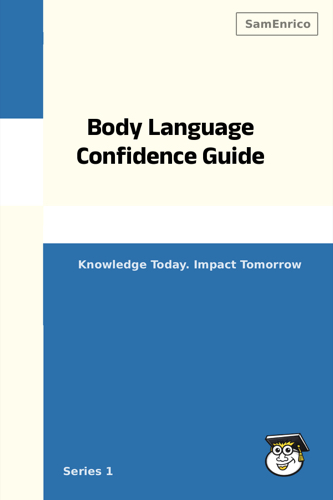
Body Language Confidence Guide eBook
Use posture and nonverbal cues to project and feel
Use posture and nonverbal cues to project and feel more confident.
Formats
Free sample
Chapter 1: The Silent Broadcast...--You are standing in a doorway.Twelve people are seated around a conference table. They have not yet looked up at you. You have not yet spoken a single word. But in less than half a second—faster than a hummingbird beats its wing—seven of those twelve people have already formed a judgment about your confidence, your competence, and your credibility.How do I know this?Because your shoulders are rolled slightly forward. Your weight is resting on your back foot, as if you are preparing to retreat.
Your hands are clutching a notebook against your chest like a shield. And your chin is tucked just one degree lower than neutral.You did not say, "I am nervous and I do not belong here."But your body broadcasted that exact message, at full volume, to every single person in that room.Here is the most disturbing part of this scenario: you probably did not even know you were sending that signal. You were thinking about your opening line, your slide deck, or whether you remembered to silence your phone. Meanwhile, your body was having an entirely different conversation—a silent broadcast that overrides almost everything you are about to say.This chapter is about waking up to that broadcast. It is about understanding that your body is always speaking, whether you want it to or not.
And it is about learning, for the first time, how to turn that silent broadcast from a liability into your greatest asset.The 93 Percent Problem In the 1960s, a psychologist named Albert Mehrabian conducted a series of groundbreaking studies at UCLA on how people communicate feelings and attitudes. His findings, now known as the Mehrabian Rule, have been cited in thousands of books and training programs. But here is what most people get wrong: they think the rule applies to all communication. It does not.Mehrabian’s research specifically examined situations where there was inconsistency between a person’s words, tone, and body language. For example, if someone said “I’m fine” through clenched teeth with their arms crossed, which signal would you believe?
The answer, according to Mehrabian’s data, breaks down like this:55 percent of the message comes from body language (posture, gestures, facial expression, eye contact)38 percent comes from tone of voice (pitch, pace, volume, inflection)Only 7 percent comes from the actual words spoken Let me repeat that: in situations of emotional communication or conflicting signals, your words account for just seven percent of the message. Your body accounts for more than half.Think about what this means for your daily life. You can prepare the perfect script for a job interview. You can rehearse your presentation until you know every slide by heart. You can craft the ideal apology or the perfect sales pitch.
But if your body language contradicts your words, the other person’s brain will literally discard your words and believe your body.Seven percent.This is not a metaphor. This is not self-help exaggeration. This is peer-reviewed behavioral science. And it explains why so many smart, well-prepared, articulate people fail to convince others. They focus on the seven percent.
They ignore the ninety-three percent.The Ancient Wiring That Runs Your Life To understand why your body language is so powerful, you have to go back—way back. About two hundred thousand years, give or take a few millennia.Before humans had complex language, they had posture. A hominid walking across the savanna did not need to hear another hominid say “I am dangerous” or “I am frightened.” The body did all the talking. An expansive, tall posture with open limbs signaled exactly one thing: this creature is strong, healthy, and prepared to fight. Approach with caution.
A hunched, shrinking posture with closed limbs signaled the opposite: this creature is weak, injured, or frightened. Easy prey.Your brain inherited this ancient wiring intact. The parts of your brain that process social status, threat detection, and trust are among the oldest structures in your skull. They operate below the level of conscious thought. They make judgments in milliseconds.
And they have not received a software update in two hundred thousand years.This is why a slouching job candidate triggers a vague sense of unease in an interviewer, even if the interviewer cannot explain why. This is why a speaker who stands with open palms and planted feet feels “authoritative” to an audience, even if the audience does not notice the posture consciously. This is why you instinctively trust the person who walks into a room with their head up and their shoulders back, and why you instinctively distrust the person who enters sideways, hugging the wall.Your ancient brain is not looking for clever words. It is looking for the same signals that kept your ancestors alive: expansiveness signals safety and status; collapse signals danger and submission.And here is the kicker: everyone else’s ancient brain is looking for those same signals in you. Right now.The Amygdala Hijack There is a small, almond-shaped cluster of neurons deep inside your brain called the amygdala.
Its job is to scan for threats. It operates incredibly fast—much faster than your conscious thinking brain. When your amygdala detects a potential threat, it triggers a cascade of physiological responses: your heart rate increases, your breathing becomes shallow, your muscles tense, and your body prepares to fight, flee, or freeze.This system worked beautifully on the savanna. A rustle in the grass might be a predator; better to react first and ask questions later.But here is the problem. Your amygdala cannot tell the difference between a physical predator and a social threat.
When you walk into a room full of strangers, when you stand up to give a presentation, when you enter a job interview, your amygdala processes these situations the same way it would process a lion jumping out of the bushes. The trigger is different. The response is identical.This is called an amygdala hijack. Your threat-detection system floods your body with stress hormones. Your muscles contract.
Your posture collapses. Your gaze drops. Your voice tightens. And suddenly, you are standing in that doorway with your shoulders rounded, your weight on your back foot, and your notebook clutched against your chest like a shield.You have not been attacked. No one has threatened you.
But your body is acting as if they have.The most tragic part of the amygdala hijack is that it creates a self-reinforcing loop. Your body collapses because your brain perceives a threat. Your collapsed posture signals submission to everyone around you. They respond with subtle cues of lowered expectations (less eye contact, less attentive listening). Your brain notices their response and perceives an even greater threat.
Your body collapses further. The loop tightens.This is why “just think positive thoughts” is terrible advice for social anxiety. Positive thoughts are generated in your conscious, thinking brain—the prefrontal cortex. That part of your brain is slow. It takes several seconds to form a conscious thought.
Your amygdala operates in milliseconds. By the time your thinking brain has produced “I am confident and prepared,” your body has already collapsed, your…
This is the end of the free sample. Get the eBook to keep going. Buy now
About this book
Details
- Author
- Jacobson Clora
- Publisher
- SamEnrico
- Language
- English
- Genre
- Non-Fiction, Self-Help, Body Language
- Released
- 2026-06-07
- Pages (approx.)
- 142
- Available as
- eBook, Audiobook

Read better in the ZLOADR app
Your eBooks on your phone or tablet. Sign in with your SamEnrico account and start reading.
More by Jacobson Clora
 Food Theft Anger ManagementJacobson Clora$11.99
 The Virtual Meeting Body LanguageJacobson Clora$11.99
 Relationship Anxiety GuideJacobson Clora$11.99
 Snap Map Location Sharing AnxietyJacobson Clora$11.99
 The Last Gamble of the Tulip ManiaJacobson Clora$11.99
 How to Start a Bulk Liquid and Gases Storage Service for Air Transport Business (Beginners Guide)Jacobson Clora$11.99
 AgTech Capital Deployment GuideJacobson Clora$12.99
 Compliance Checklist GenerationJacobson Clora$12.99
 Understanding Midline Cleft of Lower LipJacobson Clora$17.99
 Behavioral Biometrics AnalystJacobson Clora$11.99
You may also like
 Hong Kong Handover 1997Dunn Johnnie$11.99
 Zumba For Postnatal Recovery CourseNeal Christian$11.99
 Zumba for BeginnersLadner Nikia$11.99
 YouTube Comment Mining GuideHumes Pandora$12.99
 Worry Box MeditationCarlin Rudy$11.99
 Workplace Stress MeditationNguyen Lynn$11.99
 Workplace Stress and Sleep RepairHawley Ivory$11.99
 Workplace Perfectionism CureDelaney Jeffry$11.99
 Workplace Injustice Anger GuideWallen Isabelle$11.99
 Work Addiction and Burnout LinkGreenwood Ester$11.99
 Women in Yoga and WellnessBeattie Galina$11.99
 Women in Stand Up ComedyChun Evangeline$11.99