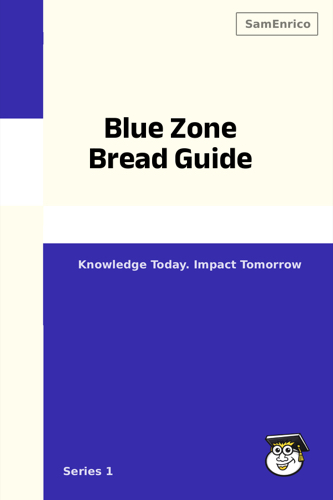
Blue Zone Bread Guide eBook
Eat sourdough for gut health.
Eat sourdough for gut health.
Formats
Free sample
Chapter 1: The Microbial Inheritance--When I first held the glass jar in my hands, I had no idea I was cradling a 90-year-old living organism that had survived two World Wars, the rise of industrial baking, and the death of real bread. The jar was unassuming—a simple mason jar with a rusted lid, wrapped in a stained kitchen towel. Inside was a bubbling, beige paste that smelled of overripe apples and freshly turned earth. This was Nonna Maria’s starter. She had inherited it from her mother, who had inherited it from her grandmother, who had likely inherited it from someone whose name had been erased by time.
The starter had arrived in Sardinia sometime around 1935, though the family stories placed it much earlier. What mattered was not its precise origin but its unbroken lineage: ninety years of daily feeding, daily baking, daily eating. Ninety years of microbes passing from hand to hand, from generation to generation, from gut to gut.Nonna Maria was 104 years old when I met her. She lived in a stone house in the mountains of Barbagia, a region in central Sardinia that has one of the highest concentrations of male centenarians on Earth. She had outlived her husband, two of her three children, and most of her friends.
She had also outlived every commercial bread that had ever been manufactured. She ate her own sourdough every single day—a thick slice, toasted over a gas flame, drizzled with olive oil that she pressed from her own olive trees, and rubbed with a clove of garlic. She ate this with a bowl of bean soup at lunch and again with a piece of pecorino cheese at dinner. She had eaten this exact meal, with minor seasonal variations, for approximately 80 years.I asked her, through a translator, what she thought of modern bread. She laughed—a sound that was surprisingly robust for a woman who had been born before the invention of sliced bread.
She said something that the translator rendered as: “That is not bread. That is air and sadness.”She was not wrong.The industrial loaf that fills supermarket aisles is not bread in any historical or biological sense. It is a processed product made from refined flour, commercial yeast, sugar, soybean oil, dough conditioners, preservatives, and sometimes chalk or sawdust (cellulose fiber, if you prefer the FDA-approved name). It rises in 45 minutes, bakes in 20, and stays “fresh” on a shelf for two weeks because nothing living remains inside it to spoil. The microbes that once accompanied every loaf—the complex community of wild yeasts and lactic acid bacteria that defined human bread for ten thousand years—have been systematically eradicated.
In their place, we have uniformity, shelf stability, and a metabolic disaster that we have somehow normalized as food.This book is an attempt to reclaim what we have lost. It is not merely a baking manual, though you will learn to bake the most extraordinary bread of your life. It is not merely a nutrition guide, though you will discover why your gut has been crying out for this food. It is, at its core, an argument for microbial inheritance—the idea that we have inherited not just recipes from our ancestors but an entire ecosystem of beneficial bacteria that modern life has systematically destroyed. And the most accessible entry point to reclaiming that inheritance is a loaf of real sourdough bread, baked slowly, eaten daily, and shared with the people you love.But before we can understand how sourdough heals, we must understand how bread broke.
And before we can understand how bread broke, we must understand the Blue Zones.The Geography of Longevity In the early 2000s, a National Geographic explorer and journalist named Dan Buettner assembled a team of demographers, anthropologists, and epidemiologists to identify the places on Earth where people lived the longest, healthiest lives. They analyzed mortality data, birth certificates, and population studies. They looked for regions with unusually high concentrations of centenarians—people who had reached 100 years of age while maintaining good physical and cognitive function. They also looked for regions where the average life expectancy was significantly higher than neighboring areas, and where rates of chronic disease (heart disease, cancer, diabetes, dementia) were strikingly low.They found five such regions. Buettner called them the Blue Zones.The five Blue Zones are:Sardinia, Italy – Specifically the mountainous Barbagia region, where a genetic quirk combined with a traditional lifestyle has produced the world’s highest concentration of male centenarians.
(Most longevity hotspots have a female majority; Sardinia is unique.)Ikaria, Greece – A small Aegean island where one in three residents lives into their 90s, and rates of dementia and depression are nearly zero.Okinawa, Japan – An island chain in the southern Pacific where a traditional plant-based diet and strong social networks have produced the longest-disabled life expectancy on Earth.Nicoya, Costa Rica – A peninsula where the water is naturally high in calcium and magnesium, and where a sense of “plan de vida” (life purpose) keeps residents active into old age.Loma Linda, California – A community of Seventh-day Adventists who follow a plant-based diet, avoid alcohol and tobacco, and observe a 24-hour weekly rest (the Sabbath), which appears to dramatically lower stress hormones.Now, here is the clarification that most books about Blue Zones omit: not all Blue Zones eat sourdough bread.Okinawa’s traditional diet is built around sweet potatoes, rice, and fermented soy (tofu, miso, natto). Bread is a modern import, and traditional sourdough is essentially nonexistent. Nicoya’s staple is corn tortillas, not wheat bread, and while fermentation occurs in the nixtamalization process (alkaline cooking), it is not sourdough fermentation. Loma Linda’s Seventh-day Adventists eat whole wheat bread, but it is often commercially yeasted, not traditionally fermented. The longevity benefits of a plant-based lifestyle do not require sourdough.However, the two Mediterranean Blue Zones—Sardinia and Ikaria—present a different picture.
In these regions, sourdough bread is not a luxury or an occasional treat. It is a daily, humble staple, consumed with almost every meal. And the specific type of sourdough they consume—long-fermented, whole grain, baked in wood-fired ovens—contains microbial properties that align remarkably well with the emerging science of gut health.This book focuses on Sardinia and Ikaria precisely because their bread traditions offer a replicable, evidence-based intervention for the modern eater. We cannot all move to a Greek island or a Sardinian mountain village. But we can all learn to bake their bread.Nonna Maria’s Loaf: A Case Study in Microbial Density Before we dive into the science of fermentation, let me describe what Nonna Maria’s bread actually looked like, tasted like, and did to her body.Her loaf was dark—much darker than any supermarket “wheat bread.” This was not because it contained caramel coloring (a common additive in commercial wheat bread) but because she used semola rimacinata, a finely ground durum wheat flour that retains the amber color of the grain’s bran.
The crust was thick, almost leathery, and shattered when you bit into it. The crumb inside was not the uniform, pillowy structure of a commercial loaf. It was irregular, with large holes distributed randomly—a…
This is the end of the free sample. Get the eBook to keep going. Buy now
About this book
Details
- Author
- Pannell Sherita
- Publisher
- SamEnrico
- Language
- English
- Genre
- Non-Fiction, Health & Wellness, Fermented Foods
- Released
- 2026-06-06
- Pages (approx.)
- 152
- Available as
- eBook, Audiobook

Read better in the ZLOADR app
Your eBooks on your phone or tablet. Sign in with your SamEnrico account and start reading.
More by Pannell Sherita
 MS Nerve Pain ReliefPannell Sherita$11.99
 Text Message WholesalingPannell Sherita$11.99
 Test Automation CreativityPannell Sherita$11.99
 Restructuring Anger for BipolarPannell Sherita$11.99
 Marriage After Infant LossPannell Sherita$11.99
 LinkedIn Boundary StrategyPannell Sherita$11.99
 Gambling and DepressionPannell Sherita$11.99
 The Tokyo Witch Hunt: How Forensic Science Exposed a Modern-Day Witch TrialPannell Sherita$11.99
 The Timbuktu Scholars: Guardians of the Golden Age of African KnowledgePannell Sherita$11.99
 The Essential Guide to Drinking SongsPannell Sherita$11.99
 How to Produce Reptile and Amphibian HabitatsPannell Sherita$11.99
 How to Produce Fabric Repair KitsPannell Sherita$11.99