
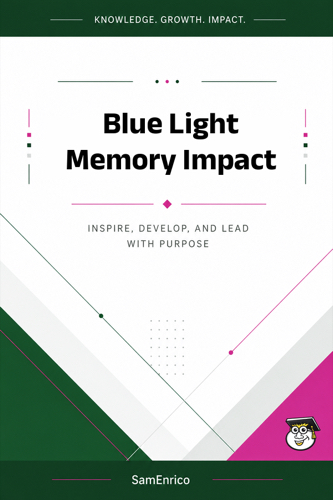
Non-FictionSelf-HelpDigital Health
Blue Light Memory Impact eBook
Reduce evening screen exposure to protect sleep an
Reduce evening screen exposure to protect sleep and memory.
Formats
Free sample
Chapter 1: The Permanent Jet Lag--–- It was 3:47 on a Tuesday afternoon when Sarah realized she could not remember her own daughter's middle name.She sat in the parking lot of a suburban Chicago elementary school, engine off, hands still on the steering wheel. The afternoon sun slanted through the windshield, and somewhere in the back of her mind, she knew she was supposed to be doing something—picking someone up, signing a permission slip, remembering a detail that had evaporated the moment she tried to grasp it. Her daughter, Emma, was eight years old. Sarah had chosen the middle name herself, after her own grandmother. And yet, for a full thirty seconds—an eternity inside a panicking brain—the name was gone.It came back, of course.
Eleanor. Emma Eleanor. The relief was immediate but sour, undercut by a creeping dread that had been building for months. Sarah was thirty-nine years old. She was a senior marketing director at a mid-sized firm, a job that required her to juggle campaign metrics, client communications, and creative strategy across six different software platforms.
She was also a mother, a wife, a daughter, and the unofficial coordinator of her extended family's group chat. By any objective measure, she was successful. But she was also, in ways she could not yet name, failing.The forgetfulness had started subtly. She would walk into a room and forget why. She would read a paragraph from a report, set the paper down, and immediately struggle to recall what it said.
She would listen to her daughter describe a conflict with a classmate, nod sympathetically, and then realize five minutes later that she could not remember the child's name or the nature of the dispute. Her husband, Michael, had begun gently teasing her about her "senior moments," but the joke was wearing thin. At night, after Emma was asleep, Sarah would scroll through her phone for two or three hours—Instagram, work emails, news alerts, Tik Tok—until her eyes burned and her mind raced. Then she would fall into a shallow, restless sleep, wake up feeling worse than when she went to bed, and do it all again.What Sarah did not know, as she sat in that elementary school parking lot, was that she was not alone. And she was not broken.
She was, instead, living inside a biological mismatch that had become the defining hidden epidemic of the twenty-first century.The Paradox of the Exhausted Eight Hours Let us begin with a number that should trouble you: the average American adult spends approximately eight hours and twenty-four minutes in bed each night. This is, by historical standards, a remarkable achievement. A century ago, before electric lighting was ubiquitous, sleep duration varied wildly with the seasons—nine or ten hours in winter, six or seven in summer, with a fragmented pattern that included a "first sleep" and a "second sleep" separated by an hour of quiet wakefulness. Today, we have conquered the darkness. We have filled every evening with light, every bedroom with screens, every waking hour with stimulation.
And yet, despite spending more time in bed than our great-grandparents, we report feeling less rested than any generation in recorded history.This is the paradox at the heart of this book: you can spend eight hours in bed and still be sleep-deprived, not because you are not sleeping, but because the quality of that sleep has been destroyed by a force you cannot see, cannot taste, and cannot feel until it is already inside your brain.That force is blue light. And the mechanism by which it steals your memory is one of the most elegant and terrifying examples of modern technology colliding with ancient biology.The Silent Epidemic in Numbers Before we dive into the biology, let us establish the scope of the problem. The numbers are staggering, and they should make you pause.According to the most recent data from the National Sleep Foundation, ninety percent of American adults report using some form of electronic device within one hour of bedtime. The average is closer to two hours. Among teenagers and young adults, that number rises to ninety-seven percent, with many reporting that they fall asleep with their phone in their hand or on their pillow next to them.
The average person now exposes their eyes to blue light from screens for four to six hours after dark, every single night, seven days a week.The consequences are measurable and severe. A landmark study from the University of California, Berkeley, found that just one hour of evening screen exposure reduced next-day memory recall by an average of nineteen percent across a sample of healthy adults. A follow-up study from Harvard Medical School tracked participants for two weeks and found that those who wore blue-blocking glasses in the evening (a topic we will explore in depth in Chapter 5) performed thirty-four percent better on memory consolidation tasks than those who did not. And a longitudinal study from the University of Oxford, following more than ten thousand adolescents over five years, found that evening screen time was a stronger predictor of academic decline than household income, parental education, or even hours of homework completed.Let those numbers sink in. Thirty-four percent better memory consolidation.
Nineteen percent worse recall after just one hour of screens. A stronger predictor of academic failure than poverty.We are not talking about minor, trivial effects. We are talking about a fundamental re-engineering of the human memory system, happening in real time, in your bedroom, every single night.The Myth of "Feeling Tired"Before we go further, we need to address a dangerous misconception: the belief that if you are not sleepy, you are not suffering from circadian disruption.This is the most common objection the author hears when discussing this topic with friends, colleagues, and strangers at dinner parties. "I don't feel tired," they say. "I sleep fine.
I just have a lot of energy at night, and I like to wind down with my phone." Or worse: "I've always been a night owl. This is just how I'm wired."Here is the truth that the sleep supplement industry does not want you to know: you can feel wide awake and still be in a state of severe circadian misalignment. Your subjective sense of alertness is a poor, unreliable indicator of your brain's internal state. The same blue light that suppresses melatonin and delays your sleep phase also triggers a release of cortisol and adrenaline, creating a state that feels like wakefulness but is actually a low-grade stress response. You are not a night owl.
You are a human being with a hijacked biological clock, running on stress hormones instead of natural circadian rhythms.This distinction matters because it changes the frame of the entire conversation. The problem is not that you are tired. The problem is that your brain has been tricked into believing it is still noon when the clock says midnight. And when your brain believes it is noon, it does not prepare for sleep. It does not consolidate memories.
It does not clear metabolic waste. It does not do any of the thousands of biological tasks that are supposed…
This is the end of the free sample. Get the eBook to keep going. Buy now
About this book
Details
- Author
- Burnside Arnita
- Publisher
- SamEnrico
- Language
- English
- Genre
- Non-Fiction, Self-Help, Digital Health
- Released
- 2026-06-07
- Pages (approx.)
- 136
- Available as
- eBook, Audiobook

Read better in the ZLOADR app
Your eBooks on your phone or tablet. Sign in with your SamEnrico account and start reading.
More by Burnside Arnita
 Memory Peg System GuideBurnside Arnita$11.99
 Internal Comms Channel MatrixBurnside Arnita$12.99
 Conjoint Analysis Mapping GuideBurnside Arnita$11.99
 Digital Planner Commercial Use License GuideBurnside Arnita$11.99
 Kidney Transplant Early FailuresBurnside Arnita$11.99
 The Silent Warnings: Predicting Earthquakes in the Middle East's Fault LinesBurnside Arnita$11.99
 Echoes of the Cosmic Dawn: The Story of the First StarsBurnside Arnita$11.99
 Virtual Mental Health BoardBurnside Arnita$12.99Internal Comms Channel MatrixBurnside Arnita$12.99
 Understanding Chlamydia TrachomatisBurnside Arnita$17.99
 Kombucha BrewerBurnside Arnita$11.99
 How to Become a Butcher ApprenticeBurnside Arnita$11.99
You may also like
 Hong Kong Handover 1997Dunn Johnnie$11.99
 Zumba For Postnatal Recovery CourseNeal Christian$11.99
 Zumba for BeginnersLadner Nikia$11.99
 YouTube Comment Mining GuideHumes Pandora$12.99
 Worry Box MeditationCarlin Rudy$11.99
 Workplace Stress MeditationNguyen Lynn$11.99
 Workplace Stress and Sleep RepairHawley Ivory$11.99
 Workplace Perfectionism CureDelaney Jeffry$11.99
 Workplace Injustice Anger GuideWallen Isabelle$11.99
 Work Addiction and Burnout LinkGreenwood Ester$11.99
 Women in Yoga and WellnessBeattie Galina$11.99
 Women in Stand Up ComedyChun Evangeline$11.99