
Non-FictionProfessional's Cheat SheetPerformance Management
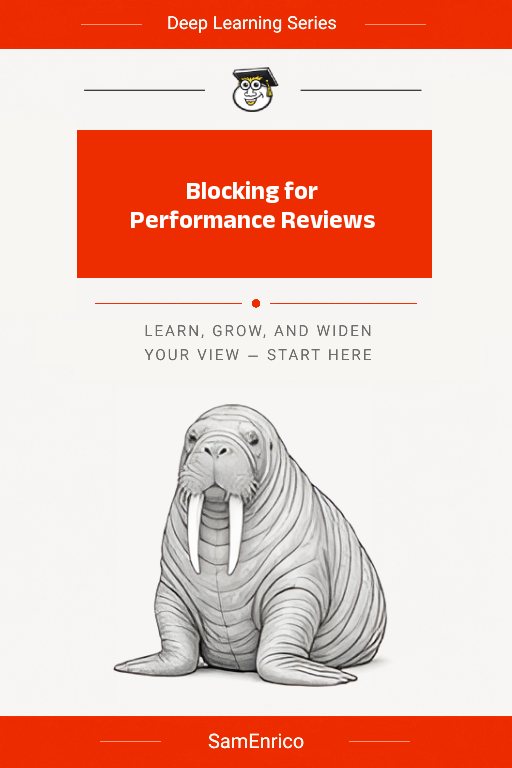
Blocking for Performance Reviews eBook
Schedule annual review prep, writing, and feedback
Schedule annual review prep, writing, and feedback delivery blocks during review cycles.
Formats
Free sample
Chapter 1: The December Crunch--–- It was 11:47 PM on December 14th when Sarah finally closed her laptop, stared at the blinking cursor that had haunted her for the past four hours, and realized she had just written the same sentence three different ways for an employee she actually admired. The performance review was due to HR in 37 hours. She hadn't slept more than five hours in any of the past six nights. Her neck ached. Her inbox had 142 unread messages.
And somewhere in the digital stack of urgent-but-not-important tasks was the feedback that would determine whether her senior developer, Marcus, received the promotion he had been quietly asking about for eight months.Sarah was not a bad manager. She cared about her team. She read books on leadership, attended every HR training, and genuinely believed that feedback was a gift. But here she was, at midnight, trying to remember what Marcus had accomplished in March. She scrolled through her email.
Nothing useful. She checked Slack history. Mostly emoji reactions and inside jokes. She opened her calendar and saw back-to-back meetings for the past eleven months—meetings that had erased any trace of the actual work her people had done.This is not a story about a bad manager. This is a story about a broken system.
And the hero of this book is not Sarah—it is the calendar she will learn to rebuild.The Hidden Epidemic No One Talks About Let us begin with a number that should terrify you: eighty percent of managers dread performance review season. Not just dislike. Not just find inconvenient. Dread. The kind of dread that lives in your chest two weeks before Thanksgiving and doesn't leave until the final sign-off is submitted to HR sometime after New Year's.This statistic comes from decades of research aggregated by the Society for Human Resource Management, Gallup, and Harvard Business Review.
But numbers are cold. Let us make this warm—or rather, let us make it uncomfortable.Consider the manager who spends December trying to remember what their junior designer built in February. Consider the director who gives everyone the same rating because they cannot tell the difference between genuine excellence and three months of recency bias. Consider the employee who receives a glowing review in January, a mediocre one in December, and has absolutely no idea what changed—because nothing changed except their manager's memory.The annual performance review was invented in the mid-twentieth century for a workforce that no longer exists. Back then, jobs were stable, spans of control were narrow, and annual feedback was considered progressive.
Today, in the age of Slack notifications, hybrid teams, and quarterly reorgs, the annual review has become a bureaucratic fossil—expensive, stressful, and surprisingly inaccurate.And yet we keep doing it. Billions of dollars are spent each year on performance management software. Thousands of hours are lost to calibration meetings that produce more anxiety than insight. And every December, millions of managers sit at their desks, scrolling through email threads from nine months ago, trying to reconstruct a year of work from the digital equivalent of smoke signals.This book is not a defense of the annual review. In many ways, the annual review is fundamentally flawed.
But it is also not going away. HR departments rely on them for compensation, promotion, and legal documentation. Executive teams use them to identify high-potential talent. And employees—despite their anxiety—want to know where they stand.So the question is not whether to do annual reviews. The question is how to do them without losing your mind, your team's trust, or your weekend.The answer, as you have probably guessed from the title of this book, is time blocking.
But not the kind of time blocking you have heard about in productivity blogs. Not the kind that tells you to schedule your day in fifteen-minute increments and color-code your calendar like a kindergartner with a new box of crayons.No. The time blocking in this book is a strategic weapon against cognitive bias, managerial procrastination, and the organizational amnesia that plagues every company with more than fifty employees. It is a system designed to make your final review conversation feel anticlimactic—not because it is unimportant, but because nothing in it should be a surprise.Recency Bias Is Not Your Fault (But It Is Your Problem)Before we build the solution, we need to understand the enemy. And the enemy has a name: recency bias.Recency bias is the cognitive tendency to weigh the most recent information more heavily than older information.
In performance reviews, this means that what an employee did in October and November carries approximately three times more weight than what they did in March and April—even if the March work was objectively more important.Here is how recency bias plays out in the real world.Imagine two employees: Alex and Jordan. Alex starts the year strong. In February, they lead a critical product launch that generates $500,000 in new revenue. In March, they cover for a sick colleague without being asked. In April, they volunteer for a difficult client project and deliver early.
Then, in October, they make a minor error on a report—a typo that is caught before it causes any damage. By December, that typo is the only thing their manager vividly remembers.Jordan, meanwhile, does nothing remarkable for the first nine months. They show up, do the minimum, and avoid conflict. Then in October, they complete a routine project ahead of schedule. In November, they help organize the holiday party.
By December, their manager remembers them as a rising star.Which employee gets the higher rating? The research is devastatingly clear: Jordan does. Not because of performance, but because of proximity.This is not a failure of character. It is a failure of memory. And memory, as we will learn throughout this book, is not a reliable recording device.
Memory is a reconstruction. Every time you recall an event, you are not replaying a video—you are reassembling fragments into a story that feels true. And the fragments from last week are much easier to find than the fragments from last February.The problem is worse than simple forgetting. Recency bias interacts with other cognitive biases to create a perfect storm of inaccuracy.The availability heuristic makes us believe that things we can easily remember must be more important. So if you remember Jordan's holiday party organizing (because it happened last week) but struggle to remember Alex's product launch (because it happened nine months ago), your brain will conclude that Jordan must have been more valuable.The peak-end rule, discovered by Nobel laureate Daniel Kahneman, tells us that people judge an experience largely based on how it felt at its peak and at its end.
For performance reviews, the "end" is December—which means the final two months of the year distort the entire twelve-month evaluation.And then there is the simple reality of workload. Even if you wanted to remember everything, you cannot. The average manager is responsible for between seven and twelve direct reports. Each report generates dozens of emails, hundreds of Slack messages, and countless small interactions every week. By…
This is the end of the free sample. Get the eBook to keep going. Buy now
About this book
Details
- Author
- Baca Lakeshia
- Publisher
- SamEnrico
- Language
- English
- Genre
- Non-Fiction, Professional's Cheat Sheet, Performance Management
- Released
- 2026-06-01
- Pages (approx.)
- 152
- Available as
- eBook, Audiobook

Read better in the ZLOADR app
Your eBooks on your phone or tablet. Sign in with your SamEnrico account and start reading.
More by Baca Lakeshia
 Email Privacy and Bcc GuideBaca Lakeshia$11.99
 Breast Cancer Work AccommodationsBaca Lakeshia$11.99
 Meditation for Spinal Cord InjuryBaca Lakeshia$11.99
 The Bone Whisperers of the Spice Islands: Unlocking the Secrets of the Human Body in the Age of DiscoveryBaca Lakeshia$11.99
 The Coral Whisperers: How a Teen Saved a ReefBaca Lakeshia$11.99
 Understanding Collagenous ColitisBaca Lakeshia$17.99
 Singapore Corporate Entity GuideBaca Lakeshia$12.99
 CosmeticianBaca Lakeshia$11.99
 How to Start a Cartage Contractor Business (Beginners Guide)Baca Lakeshia$11.99
You may also like
 Hong Kong Handover 1997Dunn Johnnie$11.99
 Zumba For Postnatal Recovery CourseNeal Christian$11.99
 Zumba for BeginnersLadner Nikia$11.99
 YouTube Comment Mining GuideHumes Pandora$12.99
 Worry Box MeditationCarlin Rudy$11.99
 Workplace Stress MeditationNguyen Lynn$11.99
 Workplace Stress and Sleep RepairHawley Ivory$11.99
 Workplace Perfectionism CureDelaney Jeffry$11.99
 Workplace Injustice Anger GuideWallen Isabelle$11.99
 Work Addiction and Burnout LinkGreenwood Ester$11.99
 Women in Yoga and WellnessBeattie Galina$11.99
 Women in Stand Up ComedyChun Evangeline$11.99