
Non-FictionTrue CrimeWrongful Conviction
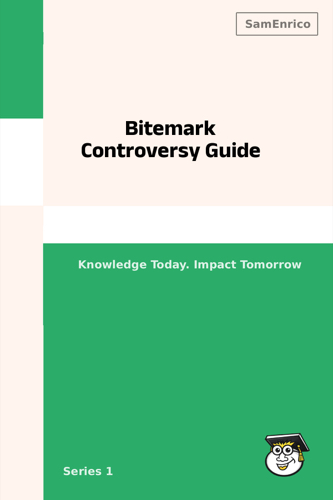
Bitemark Controversy Guide
Examine wrongful convictions based on flawed bite
by Pullen Keith
Examine wrongful convictions based on flawed bite mark analysis.
Formats
About this book
Free sample
Chapter 1: The Bundy Precedent...--–- In the summer of 1979, a jury in Miami, Florida, watched a forensic dentist place a set of plaster dental casts next to a photograph of a bruised and battered human buttock. The dentist, Dr. Richard Souviron, pointed to a series of irregular marks on the skin and then to the jagged edge of a tooth on the cast. They aligned, he said. They matched.
The man on trial was Theodore Robert Bundy, already America’s most infamous serial killer, and the bite mark on the buttock of victim Lisa Levy would become the cornerstone of the prosecution’s case. The jury deliberated for less than seven hours before returning a verdict of guilty. Bundy was sentenced to death. And in that moment, bite mark analysis was born—not in a laboratory, not through peer-reviewed research, but in a courtroom, under the glare of television lights, baptized by the twin gods of necessity and spectacle.The problem, as this chapter will reveal, is that the science behind that testimony never existed. It was a mirage.
And yet, the Bundy trial created a precedent that would endure for four decades, sending scores of innocent men to prison and at least one to his execution before the illusion finally began to crack. This chapter examines how a technique with no empirical foundation became the "glamour science" of the 1970s and 80s, why prosecutors and juries found it irresistible, and how the seduction of certainty—the desperate human need for answers in the face of unspeakable violence—overwhelmed the basic safeguards of the scientific method. The bite mark did not convict Ted Bundy because it was reliable. The bite mark convicted Ted Bundy because everyone wanted to believe it was.The Crime That Changed Forensics On the morning of January 15, 1978, students at the Chi Omega sorority house at Florida State University began waking to a nightmare. Over the course of several hours during the night, an intruder had entered the house and attacked four young women with a blunt instrument, fracturing skulls, tearing flesh, and leaving a trail of…
This is the end of the free sample. Get the eBook to keep going. Buy now
Contents
- Chapter 1
- Chapter 2
- Chapter 3
- Chapter 4
- Chapter 5
- Chapter 6
- Chapter 7
- Chapter 8
- Chapter 9
- Chapter 10
- Chapter 11
- Chapter 12
Details
- Author
- Pullen Keith
- Publisher
- SamEnrico
- Language
- English
- Genre
- Non-Fiction, True Crime, Wrongful Conviction
- Released
- 2026-06-11
- Pages (approx.)
- 129
- Available as
- eBook, Audiobook

Read better in the ZLOADR app
Your eBooks on your phone or tablet. Sign in with your SamEnrico account and start reading.
More by Pullen Keith
 Keto for Cancer AdjunctPullen Keith$11.99
 Teresa of Ávila Autobiography StudyPullen Keith$11.99
 Sleep Meditation for Noisy NeighborsPullen Keith$11.99
 The Water Hydration Weight GuidePullen Keith$11.99
 Neon Serpents: The Untold War of Miami’s Cocaine QueensPullen Keith$11.99
 Wave Energy TechnicianPullen Keith$11.99
 Faceless YouTube Sports ChannelPullen Keith$12.99
 PayPal Pivot StoryPullen Keith$12.99
 Learn to Play the Janggu (Janggo, Changgo)Pullen Keith$11.99
 How to Become a Lime Mixer TenderPullen Keith$11.99
You may also like
 Hong Kong Handover 1997Dunn Johnnie$11.99
 Zumba For Postnatal Recovery CourseNeal Christian$11.99
 Zumba for BeginnersLadner Nikia$11.99
 YouTube Comment Mining GuideHumes Pandora$12.99
 Worry Box MeditationCarlin Rudy$11.99
 Workplace Stress MeditationNguyen Lynn$11.99
 Workplace Stress and Sleep RepairHawley Ivory$11.99
 Workplace Perfectionism CureDelaney Jeffry$11.99
 Workplace Injustice Anger GuideWallen Isabelle$11.99
 Work Addiction and Burnout LinkGreenwood Ester$11.99
 Women in Yoga and WellnessBeattie Galina$11.99
 Women in Stand Up ComedyChun Evangeline$11.99