
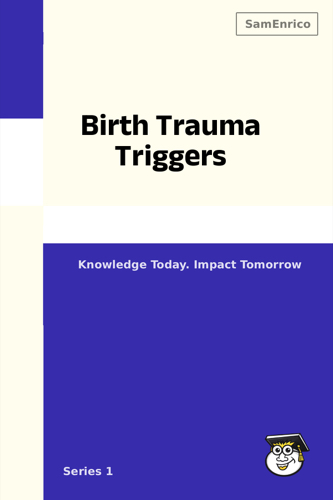
Birth Trauma Triggers
Addresses triggers from difficult labor and delive
by Watson Neil
Addresses triggers from difficult labor and delivery.
Formats
About this book
Free sample
Chapter 1: The 35%...--–- The first time someone told me her birth story didn’t “count” as traumatic, she was sitting in my office six years after delivering a healthy baby girl. She had no hemorrhage, no crash cesarean, no NICU stay. By every medical metric, her birth was unremarkable. But she described the labor in a voice so flat and removed that I initially thought she was reading from a script. “They left me on my back for four hours,” she said.
“The resident checked my cervix without saying her name. I asked for an epidural and the anesthesiologist told me to stop being dramatic. When my daughter was born, they put her on the warmer and no one looked at me for twenty minutes. I just lay there. Bleeding.
Shaking. And then they handed me a baby and said, ‘Congratulations.’”She paused. Then she asked me a question I have never forgotten: “Why do I feel like I almost died when no one else thought anything went wrong?”That question is the reason this book exists.For decades, the medical and psychological establishment has operated under a narrow definition of birth trauma. To be traumatized, the thinking went, something must have gone medically wrong. A shoulder dystocia.
A postpartum hemorrhage. An emergency cesarean under general anesthesia. A baby who needed resuscitation. These events are undeniably traumatic, and the survivors of such births deserve recognition, validation, and targeted support. But the research that emerged in the late 2010s and early 2020s tells a different, more complicated story.
The largest studies on birth-related post-traumatic stress now consistently report that between 35 and 45 percent of birthing people describe their birth as traumatic, yet only 4 to 6 percent meet the full diagnostic criteria for post-traumatic stress disorder as defined by the Diagnostic and Statistical Manual of Mental Disorders. That gap—nearly thirty percentage points—represents millions of women, trans men, and nonbinary people whose births were medically “normal” but psychologically devastating.This chapter is called The 35% for a reason. It is not a statistic. It is a population. And if you are…
This is the end of the free sample. Get the eBook to keep going. Buy now
Contents
- Chapter 1
- Chapter 2
- Chapter 3
- Chapter 4
- Chapter 5
- Chapter 6
- Chapter 7
- Chapter 8
- Chapter 9
- Chapter 10
- Chapter 11
- Chapter 12
Details
- Author
- Watson Neil
- Publisher
- SamEnrico
- Language
- English
- Genre
- Non-Fiction, Self-Help
- Released
- 2026-06-07
- Pages (approx.)
- 153
- Available as
- eBook, Audiobook

Read better in the ZLOADR app
Your eBooks on your phone or tablet. Sign in with your SamEnrico account and start reading.
More by Watson Neil
 Burn Dressing SelectionWatson Neil$11.99
 Exhaustion Recovery WorkbookWatson Neil$11.99
 EQ for Sales ProfessionalsWatson Neil$11.99
 Glucose Alcohol Detox GuideWatson Neil$11.99
 The Remote HR Time GuideWatson Neil$11.99
 Tennis Serve Hypnosis GuideWatson Neil$11.99
 Influence Triggers At WorkWatson Neil$11.99
 Ultimate Handbook Guide to Jiangyin : (China) Travel GuideWatson Neil$11.99
 The Ghosts of the Andes: The First Credit Card Fraud RingWatson Neil$11.99
 The Bone Thieves of New Orleans: The Unsolved Grave Robbing Spree of the 1960sWatson Neil$11.99
 How to Produce Sandblasting CabinetsWatson Neil$11.99
 Reverse Auction Pricing WorkbookWatson Neil$12.99
You may also like
 Hong Kong Handover 1997Dunn Johnnie$11.99
 Zumba For Postnatal Recovery CourseNeal Christian$11.99
 Zumba for BeginnersLadner Nikia$11.99
 YouTube Comment Mining GuideHumes Pandora$12.99
 Worry Box MeditationCarlin Rudy$11.99
 Workplace Stress MeditationNguyen Lynn$11.99
 Workplace Stress and Sleep RepairHawley Ivory$11.99
 Workplace Perfectionism CureDelaney Jeffry$11.99
 Workplace Injustice Anger GuideWallen Isabelle$11.99
 Work Addiction and Burnout LinkGreenwood Ester$11.99
 Women in Yoga and WellnessBeattie Galina$11.99
 Women in Stand Up ComedyChun Evangeline$11.99