
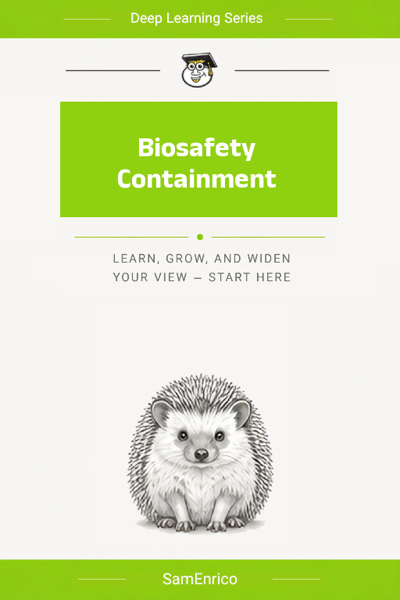
Non-FictionInformativeEducational
Biosafety Containment eBook
A Coursebook on Biosafety Containment
A Coursebook on Biosafety Containment
Formats
Free sample
Chapter 1: The Invisible Assassin--– The first time I heard about a laboratory-acquired infection, I was sitting in a windowless conference room at a biosafety training course, half-caff coffee in hand, assuming I was about to sit through another tedious compliance lecture. The instructor, a woman who had spent twenty years as a biosafety officer at a maximum containment facility, dimmed the lights and pulled up a photograph of a young researcher in her late twenties. The woman in the photo was smiling, holding a microtiter plate like a trophy. She had died eleven days after that photograph was taken. Not from a dramatic explosion or a visible chemical burn.
She died because she pipetted something she couldn't see, something that weighed less than a single grain of salt, something that replicated inside her body until her immune system collapsed. The pathogen was Ebola Zaire. The route of exposure: inoculation via a single unnoticed needlestick while handling an infected mouse. The lesson was not about faulty equipment or inadequate facilities. The lesson was about the assassin that works without sound, without smell, without warning.
That assassin is the biological hazard.Defining the Invisible A biohazard, officially defined, is any biological material that poses a threat to the health of living organisms—most often humans, but also animals, plants, or entire ecosystems. The term encompasses a staggering range of agents: bacteria like Bacillus anthracis (the cause of anthrax), viruses like Ebola and SARS-Co V-2, fungi like Coccidioides immitis (Valley fever), prions (the misfolded proteins responsible for Creutzfeldt-Jakob disease and mad cow), and biological toxins derived from living sources, such as ricin from castor beans or botulinum toxin from Clostridium botulinum. Unlike chemical hazards, which are dangerous because of their intrinsic molecular properties (corrosivity, flammability, toxicity), biological hazards possess a terrifying additional characteristic: they replicate. Pour a gallon of hydrochloric acid onto the floor, and within hours it will be diluted, neutralized, or evaporate. The danger diminishes over time.
Spill a milliliter of Ebola virus onto the same floor, and if not properly decontaminated, that milliliter contains enough viral particles to infect every person on Earth several times over—and each infected person becomes a factory producing millions more. This is the fundamental distinction that every biosafety professional must internalize: chemical agents dilute; biological agents amplify.The Four Doors to Disaster Understanding how biohazards enter the human body is the first step in preventing them. There are exactly four routes of exposure in the laboratory environment. Memorize them. They will not be repeated in this book as new information, but they are the foundation upon which everything else is built.Inhalation.
The most dangerous route by a wide margin. When a researcher works with a liquid culture of bacteria or viruses, the simple act of opening a tube, pipetting, vortexing, centrifuging, or even removing a cap can generate aerosols—invisible clouds of microscopic droplets ranging from less than one micron to several microns in diameter. A single sneeze produces approximately 40,000 droplets. A careless pipetting motion produces thousands. These droplets remain suspended in the air for hours, drift on air currents, and can be inhaled deep into the alveoli of the lungs.
From there, the pathogen has direct access to the bloodstream and the entire body. The infectious dose for some agents via inhalation is astonishingly low: for Francisella tularensis (tularemia), as few as ten organisms can cause fatal disease. For Coxiella burnetii (Q fever), a single organism may be sufficient. The 2001 anthrax letters in the United States demonstrated that a few grams of powdered spores, dispersed through the air, could kill five people and infect seventeen others—not because anthrax is the deadliest pathogen, but because inhalation is the most efficient delivery system.Ingestion. The second most common route in laboratory-acquired infections, though often underreported because researchers are embarrassed to admit they pipetted by mouth.
Before the 1970s, mouth pipetting was standard practice in laboratories worldwide. Researchers would place their lips directly on a glass pipette and suck up liquid containing pathogens. The practice was banned after decades of documented infections, including multiple fatalities from hepatitis B, typhoid, and Salmonella. Today, mouth pipetting is universally prohibited in any accredited laboratory, but ingestion still occurs through hand-to-mouth transfer: eating or drinking in the lab (also universally prohibited, yet still happens), touching contaminated surfaces and then touching food, or licking a label while writing on a tube. A 2011 survey of academic laboratories found that nearly 15% of researchers admitted to having eaten or drunk in a lab where biohazards were present within the past year.Inoculation.
Needlesticks and sharps injuries. This route accounts for approximately 30% of reported laboratory-acquired infections, making it the most common single cause after inhalation. A researcher handling a syringe containing a pathogen, an infected animal biting through a glove, a broken glass tube cutting through a glove, or a scalpel slipping during necropsy—all create a direct conduit from the contaminated surface into the bloodstream or tissue. The volume transferred is tiny, often invisible to the naked eye, but sufficient to deliver an infectious dose for most pathogens. Hepatitis B virus, for example, requires only 0.0001 milliliters of infected blood to cause transmission.
A needlestick from a hollow-bore needle can transfer up to one microliter of fluid—ten times the infectious dose for hepatitis B, hepatitis C, and HIV.Mucocutaneous Contact. The splash route. A drop of infected liquid lands on the conjunctiva of the eye, the mucous membrane of the nose, the lips, or through a crack in chapped skin. This route is often dismissed as "low risk" compared to inhalation or inoculation, but documented cases tell a different story. In 2004, a researcher at the National Institute of Infectious Diseases in Tokyo was working with Ebola virus in a BSL-4 suit.
A leak in the suit went unnoticed for several minutes. Contaminated liquid seeped through her undergarments and contacted her skin. She developed Ebola, survived, and her case led to worldwide revisions in BSL-4 suit protocols. In 2018, a laboratory worker in Moscow died from Crimea-Congo hemorrhagic fever after a splash to the face while opening a centrifuge rotor outside a biosafety cabinet.A History Written in Blood The history of biosafety is not a history of academic papers and committee meetings. It is a history of people who died because the science outpaced the safety.
The first documented laboratory-acquired infection occurred in the 1880s, when multiple physicians working with typhoid cultures in Europe developed typhoid themselves. But it was the mid-twentieth century, with the explosion of microbiological research after World War II, that the pattern became undeniable. Between 1930 and 1978, a systematic review identified over 4,000 laboratory-acquired infections and 168 deaths. The true numbers are certainly higher, because LAIs were and remain underreported due to liability concerns, institutional reputation management, and simple failure to connect an illness to a laboratory exposure weeks earlier.The 1940s and 1950s saw a cluster of LAIs from brucellosis (caused by Brucella species), a bacterial pathogen that is highly infectious via aerosol and causes undulant fever, arthritis, and endocarditis. Brucella became known as the "laboratory worker's disease" because so many researchers acquired it.
In the 1950s, the United States Army Biological Warfare Laboratories at Fort Detrick, Maryland, documented over 300 LAIs among military…
This is the end of the free sample. Get the eBook to keep going. Buy now
About this book
Details
- Author
- Mcgrew Zachery
- Publisher
- SamEnrico
- Language
- English
- Genre
- Non-Fiction, Informative, Educational
- Released
- 2026-05-04
- Pages (approx.)
- 158
- Available as
- eBook, Audiobook

Read better in the ZLOADR app
Your eBooks on your phone or tablet. Sign in with your SamEnrico account and start reading.
More by Mcgrew Zachery
 The Body Scan for Daily LifeMcgrew Zachery$11.99
 The Workaholic Delegation Mastery CourseMcgrew Zachery$11.99
 Stress and Allergy SeverityMcgrew Zachery$11.99
 French Revolutionary CalendarMcgrew Zachery$11.99
 Beethoven's Immortal Symphony: The Ninth's Triumph Over AdversityMcgrew Zachery$11.99
 How to Produce Balustrades and HandrailsMcgrew Zachery$11.99
 India Diwali Bonus TimingMcgrew Zachery$12.99
 How to Start a Beer Gardens (tenanted) Business (Beginners Guide)Mcgrew Zachery$11.99
You may also like
 Hong Kong Handover 1997Dunn Johnnie$11.99
 Zumba For Postnatal Recovery CourseNeal Christian$11.99
 Zumba for BeginnersLadner Nikia$11.99
 YouTube Comment Mining GuideHumes Pandora$12.99
 Worry Box MeditationCarlin Rudy$11.99
 Workplace Stress MeditationNguyen Lynn$11.99
 Workplace Stress and Sleep RepairHawley Ivory$11.99
 Workplace Perfectionism CureDelaney Jeffry$11.99
 Workplace Injustice Anger GuideWallen Isabelle$11.99
 Work Addiction and Burnout LinkGreenwood Ester$11.99
 Women in Yoga and WellnessBeattie Galina$11.99
 Women in Stand Up ComedyChun Evangeline$11.99