
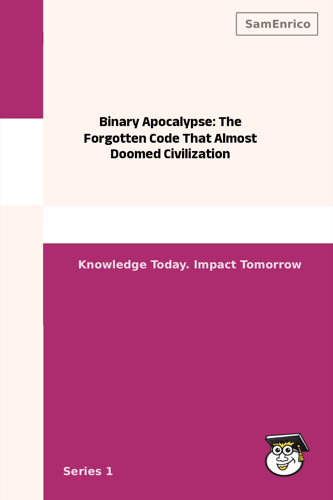
Binary Apocalypse: The Forgotten Code That Almost Doomed Civilization eBook
Plunge into the untold story of the Y2K crisis thr
by Rice Rhonda
Plunge into the untold story of the Y2K crisis through the lens of a shadowy programming error buried in Cold War-era nuclear systems, where a single overlooked line of code threatened global annihilation.
Formats
Free sample
Chapter 1: The 46-Cent Memory...--–- The problem began, as most apocalypses do, with an attempt to save money.In the winter of 1968, a young programmer named Edith Keller sat before an IBM System/360 mainframe at a military contracting facility outside Colorado Springs. The machine cost $3.5 million in 1968 dollars—nearly $30 million today. It filled an entire room. Its magnetic core memory had a capacity of 512 kilobytes, less than the space required to store a single modern smartphone photograph. And every kilobyte cost approximately $1.50 to manufacture, a fortune in an era when programmers earned $12,000 a year.Edith's task was straightforward: write the date-handling routines for a new nuclear command-and-control system that would connect missile silos across the Great Plains to the NORAD command center inside Cheyenne Mountain.
The system, designated 427M, was the military's first attempt to digitize the chain of command between the President's nuclear authorization and the launch officers in the silos. Previously, orders had been transmitted by voice radio and sealed envelopes. Now they would travel through wire and silicon. It was faster, more reliable, and—everyone assumed—safer.But there was a problem. The IBM System/360 stored dates in a format called "packed decimal," which allocated two bytes per field.
Two bytes could hold exactly two digits. So when Edith wrote the code to record the year, she had only two spaces: "YY." The century—"19"—had to be hard-coded elsewhere, assumed, invisible.She remembers the conversation with her supervisor, a man named Harold Finch who had cut his teeth on punch-card systems during the Korean War. "We'll fix it in the nineties," he told her. "By then, memory will be cheap. We'll add the century field in a software update."Edith was twenty-four years old.
She had been one of four women in her computer science program at the University of Michigan, and she had learned to pick her battles. She pushed back once. "What if there's no update?" she asked. "What if this code is still running in thirty years?"Finch laughed. "Thirty years?
This hardware will be obsolete in ten. We'll have replaced the whole system twice by 1990."He was wrong about the hardware. He was wrong about the software. And that conversation, preserved in a memo that Edith filed in her personal journal and later donated to the Computer History Museum, would become the epigraph for the quietest near-disaster in modern history.The Shortcut That Built a Doomsday Machine To understand why a two-digit date field nearly ended the world, you have to understand the economics of early computing. In 1968, every kilobyte of memory cost roughly $1.50 to manufacture.
A single megabyte—unimaginably vast at the time—would have cost $1,500. A gigabyte would have been $1.5 million. By comparison, a gigabyte of memory today costs about two cents.Programmers in the 1960s and 1970s lived under constant pressure to economize. Every character mattered. Every byte was sacred.
The two-digit year field was not a mistake; it was a rational engineering decision given the constraints of the era. The mistake was assuming that the decision would be temporary.This assumption was baked into the culture of early computing. The industry moved so fast that five-year plans were considered laughably optimistic. Machines were replaced every three to four years. Software was rewritten constantly.
The idea that code written in 1968 would still be running in 1999 was not just improbable—it was professionally ridiculous.And yet, that is exactly what happened. Not because the code was good, but because the systems it controlled were too dangerous to replace.The Nuclear Paradox The Cold War created a technological paradox that no one fully appreciated at the time. Nuclear command systems had to be reliable beyond any reasonable standard. But they also had to be frozen in time. Once a missile silo's computer passed its certification tests, no one was allowed to touch it.
Any change—even a bug fix—required recertification, which could take months and cost millions.As a result, the code written for the 427M system in 1968 was still running, almost entirely unchanged, when the Berlin Wall fell in 1989. It was still running when the Soviet Union dissolved in 1991. And it was still running on December 31, 1999, when the two-digit year field finally, catastrophically, rolled over to "00."The 427M system was not unique. Across the military-industrial complex, thousands of systems relied on the same shortcut. The Army's logistics network.
The Navy's submarine communication arrays. The Air Force's early warning radar. And—most critically—the Strategic Air Command's nuclear launch control system, known as SACCS, which linked every Minuteman missile in the United States to the National Command Authority in Washington.All of them assumed that the year began with "19." All of them were about to discover that "00" looks nothing like "19" to a computer.The 1978 Memo That Predicted Everything On March 14, 1978, a programmer named Thomas Mc Elroy submitted a memorandum to his superiors at NORAD's Combat Operations Division. Mc Elroy was thirty-seven years old, a veteran of the Air Force's computer corps, and he had spent the previous six months auditing the date-handling routines in the 427M system.His findings were alarming.Mc Elroy's memo, which remained classified until 2005, ran twelve pages. It began with a technical explanation of the two-digit year field and its vulnerabilities.
It then listed twenty-three specific points of failure in the nuclear command system, including:The missile status display system, which compared launch readiness dates to determine if a missile was operational. When "00" is compared to "78" (for 1978), the system would conclude that 2000 came before 1978—a logical impossibility that could cause the display to blank or, worse, to show incorrect readiness status.The launch authorization code validation routine, which timestamped each command. A timestamp of 01-01-00 would be interpreted as January 1, 1900, potentially invalidating legitimate launch orders while accepting replayed commands from decades earlier.The automated fault-checking system, which tracked the maintenance history of each silo. A missile that had been serviced in 1999 would show a last-service date of "99." When the clock rolled to "00," the system might conclude that the missile had not been serviced in a century—and automatically shut it down as unsafe.Mc Elroy's conclusion was stark: "When 01-01-00 arrives, the system will interpret this as 1900, with unpredictable results. The range of possible outcomes includes complete loss of launch capability, spurious launch warnings, and—in a worst-case scenario—unauthorized launch authorization."He recommended an immediate audit of all date-handling routines in the nuclear command network, followed by a phased replacement of the two-digit year fields with four-digit fields.
The cost, he estimated, would be $400 million over five years.The memo was reviewed by Mc Elroy's superiors, who forwarded it to the Deputy Chief of Staff for Operations. It was then reviewed by the Air Force's Directorate of Computer Resources, which concluded that the risk was "theoretical" and that the cost of remediation was "unacceptable given current budget priorities."The memo was filed away. Mc Elroy was reassigned to a logistics unit in Nebraska, where he spent the remaining seven years of his career tracking inventory. He retired in 1985 and died in 2003, never knowing that his warnings had been prophetic.But he did not give up easily. Declassified records show that Mc Elroy filed…
This is the end of the free sample. Get the eBook to keep going. Buy now
About this book
Details
- Author
- Rice Rhonda
- Publisher
- SamEnrico
- Language
- English
- Genre
- Non-Fiction, Y2K Crisis
- Released
- 2026-06-04
- Pages (approx.)
- 120
- Available as
- eBook, Audiobook

Read better in the ZLOADR app
Your eBooks on your phone or tablet. Sign in with your SamEnrico account and start reading.
More by Rice Rhonda
 Personal Ing For Success Personal VisionRice Rhonda$11.99
 The Talent Mobility Technology GuideRice Rhonda$11.99
 Intuitive Eating For Chronic Dieters CourseRice Rhonda$11.99
 Opioid Induced HyperalgesiaRice Rhonda$11.99
 Free Clinic to Med SchoolRice Rhonda$11.99
 The Vanishing of Flight 447: The Black Box ConspiracyRice Rhonda$11.99
 Ultimate Handbook Guide to Ramallah and Gaza : (State of Palestine) Travel GuideRice Rhonda$11.99
 Merging Multiple Non Resident LLCsRice Rhonda$12.99
 Indian IT Degree DominanceRice Rhonda$12.99
 SalesmanRice Rhonda$11.99
 Understanding Bindewald–ulmer–muller SyndromeRice Rhonda$17.99
You may also like
 Hong Kong Handover 1997Dunn Johnnie$11.99
 Zumba For Postnatal Recovery CourseNeal Christian$11.99
 Zumba for BeginnersLadner Nikia$11.99
 YouTube Comment Mining GuideHumes Pandora$12.99
 Worry Box MeditationCarlin Rudy$11.99
 Workplace Stress MeditationNguyen Lynn$11.99
 Workplace Stress and Sleep RepairHawley Ivory$11.99
 Workplace Perfectionism CureDelaney Jeffry$11.99
 Workplace Injustice Anger GuideWallen Isabelle$11.99
 Work Addiction and Burnout LinkGreenwood Ester$11.99
 Women in Yoga and WellnessBeattie Galina$11.99
 Women in Stand Up ComedyChun Evangeline$11.99