
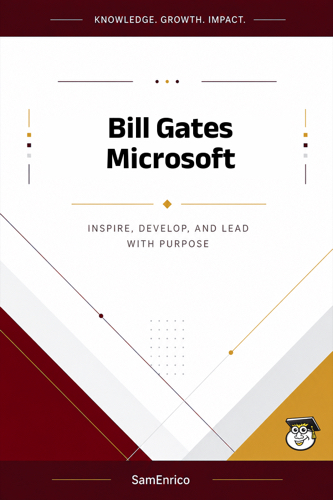
Non-FictionBiographyTech Founder
Bill Gates Microsoft eBook
Traces the Harvard dropout who built the PC softwa
Traces the Harvard dropout who built the PC software empire.
Formats
Free sample
Chapter 1: The Privileged Terminal...–- In the autumn of 1968, a thirteen-year-old boy with thick glasses and a voice that had not yet finished cracking walked into the Mothers’ Room at the Lakeside School in Seattle, sat down in front of a teletype machine the size of a small refrigerator, and began to rewrite the rules of the twentieth century. He did not know it at the time. Neither did anyone else. The machine was an ASR-33 Teletype, leased by the Mothers’ Club using proceeds from a rummage sale, connected by a telephone coupler to a General Electric time-sharing computer miles away. It printed on rolls of yellow paper, and it made a sound like a thousand angry insects when it worked.
Most of the time, it did not work. But when it did, Bill Gates discovered something that would shape the rest of his life: the machine did exactly what he told it to do. Not what his parents told it to do. Not what his teachers told it to do. What he told it to do.
That feeling—total, unambiguous, logical control—became his North Star. He would spend the next fifty years chasing it, building empires and burning relationships in pursuit of a perfect system that never quite existed.The myth of the self-made dropout begins with a young man who walks away from Harvard with nothing but a dream and a few thousand dollars. It is a seductive story, especially in America, where the frontier mentality survives in the language of startups and disruption. But the myth collapses under the weight of its own omissions. Bill Gates did not start with nothing.
He started with a private school that had a computer terminal in 1968—a luxury that ninety-nine percent of American high schools could not dream of affording. He started with a family that had enough money to send him to Harvard without loans, enough connections to open doors, and enough psychological pressure to make failure feel like extinction. He started, in other words, with privilege. This chapter does not diminish Gates’ achievements by acknowledging that privilege. On the contrary, it argues that the real story is more interesting than the myth: what happens when extraordinary talent meets extraordinary access?
The answer is not a hero’s journey. It is a systems story—one that traces the development of a mind that would come to see the entire world as a system to be optimized, debugged, and controlled.The Grandfather’s Probability Before the teletype, there was the banker. Bill Gates’ maternal grandfather, J.W. Maxwell, was a man who understood odds. He worked for the National City Bank of Seattle, rose to become its president, and carried himself with the quiet confidence of someone who had survived the Depression by being smarter than the panic.
On rainy afternoons, he taught his grandson how to play card games—not for fun, but for strategy. He explained probability in terms that a child could grasp: if you hold these cards, what are the chances that the other player holds those cards? If you bet now, what is the expected value of your position? The lessons were not abstract. Maxwell was training Gates to think in expected value, to calculate risk before committing, to understand that the world was not governed by luck but by the mathematics of information asymmetry.This early training mattered more than any formal education Gates would receive for the next decade.
While his classmates memorized dates and conjugations, Gates was internalizing a worldview: every situation is a system, every system can be modeled, and every model can be exploited. The card games became a kind of social laboratory. He learned to read opponents, to hide his tells, to calculate when to bluff and when to fold. These were not lessons in cheating; they were lessons in competitive intelligence. And they would serve him well when he sat across the table from IBM executives, from venture capitalists, from federal prosecutors.
The teletype gave him control over machines; the card games gave him control over the humans who built the machines.Maxwell died in 1964, when Gates was nine years old. But the lessons persisted. Gates would later describe his grandfather as “the smartest person I ever knew” – a striking claim given that he would later meet Nobel laureates and heads of state. What Maxwell taught was not just probability but a posture toward the world: assume that everything is knowable, assume that the data is available if you look hard enough, assume that the person who calculates best wins. That posture became the operating system of Gates’ mind.
It made him brilliant. It also made him cold. The same calculus that allowed him to outmaneuver competitors also allowed him to dismiss employees, to parse legal language with amoral precision, to treat relationships as transactions. The grandfather’s gift was a double-edged sword, and Gates would spend decades learning to handle the blade.The Lakeside School: Privilege as Platform Lakeside School was founded in 1919 as a private academy for the children of Seattle’s elite. By the time Gates arrived in 1965, it had a reputation for academic rigor, small classes, and a certain progressive ethos that encouraged students to pursue their obsessions.
But the school’s most important feature, for Gates, was not the curriculum or the faculty. It was the Mothers’ Club. In 1968, the Mothers’ Club decided to use proceeds from its annual rummage sale—a charmingly domestic origin for a technological revolution—to lease a teletype terminal and buy computer time from General Electric. The cost was considerable: several thousand dollars a year at a time when most schools spent that much on textbooks. But Lakeside could afford it.
The parents were lawyers, doctors, bankers, executives. They believed that their children should have every advantage. That belief, more than any single invention, made Microsoft possible.The teletype was installed in a small room that had previously been used by mothers to nurse infants. The room had no windows, no air conditioning, and a distinct smell of ozone and warm paper. It became a sanctuary.
Gates, along with a handful of other students, spent every free hour in that room. They learned to log into the GE system, to write simple programs in BASIC, to make the machine print jokes and geometric patterns. The experience was intoxicating. For the first time in his life, Gates found something that rewarded his intensity rather than punishing it. At home, his parents wanted him to be more social, more conventional, less likely to argue about every point.
At school, his teachers wanted him to show his work, follow instructions, respect authority. The teletype asked for none of that. It asked only for correct syntax. If you wrote the right code, the machine obeyed. If you wrote the wrong code, the machine did nothing.
The feedback was immediate, unambiguous, and impersonal. For a boy who felt misunderstood by almost everyone around him, that impersonality was a relief.The other boys in the programming group came from similar backgrounds. Paul Allen was two years older, tall, lanky, with a passion for hardware that bordered on religious. He could look at a circuit…
This is the end of the free sample. Get the eBook to keep going. Buy now
About this book
Details
- Author
- Zamora Yanira
- Publisher
- SamEnrico
- Language
- English
- Genre
- Non-Fiction, Biography, Tech Founder
- Released
- 2026-06-05
- Pages (approx.)
- 106
- Available as
- eBook, Audiobook

Read better in the ZLOADR app
Your eBooks on your phone or tablet. Sign in with your SamEnrico account and start reading.
More by Zamora Yanira
 CRE Market Analysis FrameworkZamora Yanira$11.99
 Library Reading NookZamora Yanira$11.99
 Loving Kindness for an Endangered SpeciesZamora Yanira$11.99
 Letting Go of Friendship HurtsZamora Yanira$11.99
 1031 Exchange Reverse Exchange ParkingZamora Yanira$11.99
 The Attention Recovery PlanZamora Yanira$11.99
 Cover Letter Resume PairingZamora Yanira$11.99
 Flying SR 71 BlackbirdZamora Yanira$11.99
 Gold and Guns: The Hidden Costs of Vietnam's First WarZamora Yanira$11.99
 The Lost Tongues of the Cosmos: Decoding Earth's First Space LanguageZamora Yanira$11.99
 The Last Flight of the Enola Gay: The Untold Story of Hiroshima’s ShadowZamora Yanira$11.99
 Understanding Alopecia Contractures Dwarfism Mental RetardationZamora Yanira$17.99
You may also like
 Hong Kong Handover 1997Dunn Johnnie$11.99
 Zumba For Postnatal Recovery CourseNeal Christian$11.99
 Zumba for BeginnersLadner Nikia$11.99
 YouTube Comment Mining GuideHumes Pandora$12.99
 Worry Box MeditationCarlin Rudy$11.99
 Workplace Stress MeditationNguyen Lynn$11.99
 Workplace Stress and Sleep RepairHawley Ivory$11.99
 Workplace Perfectionism CureDelaney Jeffry$11.99
 Workplace Injustice Anger GuideWallen Isabelle$11.99
 Work Addiction and Burnout LinkGreenwood Ester$11.99
 Women in Yoga and WellnessBeattie Galina$11.99
 Women in Stand Up ComedyChun Evangeline$11.99