
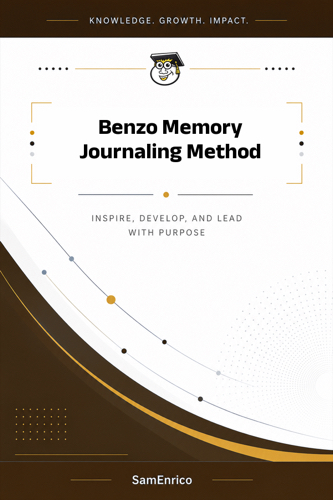
Non-FictionSelf-HelpJournal Therapy
Benzo Memory Journaling Method eBook
Uses journaling to track and rebuild cognitive fun
by Yi Julianne
Uses journaling to track and rebuild cognitive function after benzos.
Formats
Free sample
Chapter 1: The Stolen Years...--The morning it happened, I was standing in my own kitchen, holding a coffee mug that did not feel like mine. The ceramic was warm—I could register that much—but the sensation arrived late, as if transmitted through water. My hand looked like my hand. The freckle on my thumb was still there. But the me that usually lived behind my eyes had stepped out for a cigarette and never came back.I remembered buying the mug.
I thought I did, anyway. There was a fragment: a Target receipt, a blue sky, a Tuesday. But the memory had no weight. It was a photograph of someone else's life. I turned the mug over, looking for a clue—a date, a name, a reason to believe I had existed before this moment.
There was nothing. Just ceramic. Just me. Just a kitchen I had lived in for six years that now looked like a stage set.My daughter walked in. She was seven.
She said, "Mom, can I have pancakes?" And I could not, for the life of me, remember her name.Not her name like a word I had forgotten. I knew her name in the abstract—it started with an L, I was almost sure—but the connection between that string of letters and the small human in front of me had been severed. She was a child. I was an adult. We were in a kitchen.
That was all I knew.I said, "Sure, sweetheart." I called her sweetheart because I did not know what else to call her. She did not notice. Seven-year-olds do not notice when their mothers forget their names. They notice when there are no pancakes. So I made pancakes.
I cracked eggs into a bowl. My hands knew what to do even when my brain did not. Muscle memory is stored in the cerebellum, not the hippocampus. That is the first thing I learned about the benzo brain: your hands will remember what your mind has lost.But here is what I did not know that morning: I was not losing my mind. I was not developing early-onset dementia.
I was not having a psychotic break. I was not dying. I was in the middle of what the literature would later call benzodiazepine-induced neurological dysfunction—BIND, for those who like their suffering reduced to acronyms—but what I came to call, in the privacy of my own raw journal, the years the brain ate itself.I started journaling because I could not think. That is the honest truth. I did not start because I was wise or disciplined or spiritually evolved.
I started because I was losing time in five-minute increments and I needed something—anything—to prove that I had existed between breakfast and lunch. The first entry was not profound. It read: "Tuesday. Ate eggs. Walked around the block.
Forgot why I walked around the block. Came home. Ate eggs again? Maybe. Not sure."That entry was not healing.
It was not therapeutic. It was not even particularly coherent. But it was true. It was the first true thing my brain had produced in weeks. And writing it down—seeing it on the page in my own looping, handwriting—did something that no amount of internal reassurance could do.
It stopped the spiral. Because here is the secret that no one tells you about benzo withdrawal: your thoughts are not real until you write them down. In your head, a fear can loop forever, gaining weight with each repetition, until it crushes you. On paper, that same fear is just a sentence. You can look at it.
You can say, "Oh, that's what that is." And then you can close the notebook and walk away.This book is about that gap. The gap between the fear in your head and the fear on the page. The gap between the years you have lost and the years you will rebuild, one sentence at a time. The gap between the person you were before benzos and the person you are becoming—not in spite of withdrawal, but through it.And it starts with a single, brutal, necessary question: What the hell happened to your brain?The Benzo Blunder: A Name for the Thing That Has No Name Let us begin with a term that does not exist in the medical literature but should: the Benzo Blunder. This is not your mistake.
You did not do this to yourself. The Benzo Blunder is what your brain did—unconsciously, automatically, desperately—in response to prolonged benzodiazepine use. It is the brain's misguided attempt to protect you from overstimulation that ended up locking you in a cage of understimulation.Here is the simplified neurobiology. You do not need a medical degree to understand this. You need only a metaphor.Imagine your brain is a house.
In the basement, there is a smoke alarm. That is your amygdala—the fear center. Its job is simple: detect a threat (smoke, a burglar, a text message from your boss at 11 PM) and sound the alarm so you can respond. Above the smoke alarm, in the living room, there is a volume knob. That is your GABA system.
Its job is to turn down the smoke alarm when the threat has passed. You do not need the alarm blaring after you have already put out the kitchen fire.Benzodiazepines are like a hand that reaches into your house and cranks the volume knob all the way to the right. For a while, this feels wonderful. The smoke alarm is quiet. Too quiet, actually.
You can sleep. You can relax. You can finally stop jumping at every creak in the floorboards. This is why benzos are prescribed: they amplify the GABA system, which quiets the amygdala, which reduces anxiety and panic.But your brain is not stupid. It notices that the volume knob is stuck on maximum.
It says, "Well, if someone is going to keep turning up the volume, I will just turn down the speakers." So your brain begins to downregulate its GABA receptors. It makes fewer of them. It makes the remaining ones less sensitive. It is trying to restore balance. It is doing its job.The problem comes when you stop taking the benzodiazepine.
Your hand leaves the volume knob. But your brain has already turned down the speakers. Now you have a normal signal (no extra volume) going into damaged speakers (reduced GABA receptors). The result is chaos. The smoke alarm—your amygdala—suddenly has no volume knob at all.
It blares at everything. A car door slams outside? Alarm. Your own heartbeat? Alarm.
A thought about something you said in 2007? Full-scale five-alarm fire.This is the Benzo Blunder. Your brain, trying to help you, accidentally locked you in a state of neurological whiplash. It cranked down the brakes (GABA) and then you removed the foot from the gas (the benzo), leaving you with no brakes at all.And the smoke alarm? It has been blaring for so long that it has started to hallucinate threats.
That is the life review. That is the intrusive memory from 1998. That is the terror that you have a…
This is the end of the free sample. Get the eBook to keep going. Buy now
About this book
Details
- Author
- Yi Julianne
- Publisher
- SamEnrico
- Language
- English
- Genre
- Non-Fiction, Self-Help, Journal Therapy
- Released
- 2026-06-06
- Pages (approx.)
- 149
- Available as
- eBook, Audiobook

Read better in the ZLOADR app
Your eBooks on your phone or tablet. Sign in with your SamEnrico account and start reading.
More by Yi Julianne
 Personal OKR Template HandbookYi Julianne$11.99
 US Carbon Capture CreditYi Julianne$11.99
 King Queen Dream Symbols GuideYi Julianne$11.99
 Nutrition for Alcohol Recovery CookbookYi Julianne$11.99
 The Phantom Pitch: How a 19th-Century Baseball Mystery Changed the GameYi Julianne$11.99
 AI Enforcement Penalty ManualYi Julianne$12.99
 Education Long Term Tech OutlookYi Julianne$12.99
 Understanding Idiopathic Adult NeutropeniaYi Julianne$17.99
 Ultimate Handbook Guide to Tirana : (Albania) Travel GuideYi Julianne$11.99
 Principal DeveloperYi Julianne$11.99
You may also like
 Hong Kong Handover 1997Dunn Johnnie$11.99
 Zumba For Postnatal Recovery CourseNeal Christian$11.99
 Zumba for BeginnersLadner Nikia$11.99
 YouTube Comment Mining GuideHumes Pandora$12.99
 Worry Box MeditationCarlin Rudy$11.99
 Workplace Stress MeditationNguyen Lynn$11.99
 Workplace Stress and Sleep RepairHawley Ivory$11.99
 Workplace Perfectionism CureDelaney Jeffry$11.99
 Workplace Injustice Anger GuideWallen Isabelle$11.99
 Work Addiction and Burnout LinkGreenwood Ester$11.99
 Women in Yoga and WellnessBeattie Galina$11.99
 Women in Stand Up ComedyChun Evangeline$11.99