
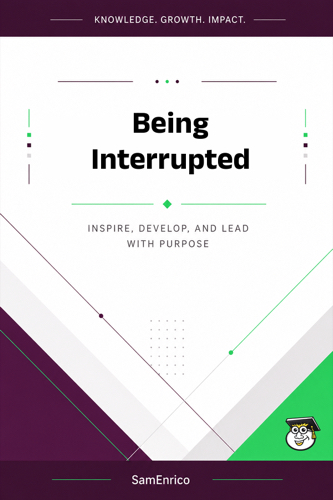
Non-FictionSelf-HelpConversation Skills
Being Interrupted eBook
Reveals being cut off in conversation as trigger a
Reveals being cut off in conversation as trigger and assertive interruption handling.
Formats
Free sample
Chapter 1: The Hidden Power Dynamics...--–- It happens in less than two seconds. You are speaking—making a point you have rehearsed, sharing an idea you believe in, or simply answering a question. Then, without warning, a voice cuts across yours. The words stop. Your throat tightens.
Your mind, which moments ago was clear and organized, becomes a blank wall. You smile—or maybe you don't. You wait. And somewhere beneath the politeness, beneath the conditioned reflex to let the other person speak, something small and vital shrinks.If you have ever been interrupted, you know this sequence intimately. What you may not know is that those two seconds are not merely frustrating or rude.
They are a physiological event. They are a power play disguised as enthusiasm. And they are, for millions of people, a daily occurrence that shapes who gets heard, who gets promoted, who gets believed, and who eventually stops trying to speak at all.This book is not about blaming every interrupter as a villain. It is not about teaching you to shout louder or become the person who steamrolls others. It is about something far more precise and far more liberating: understanding exactly what happens when you are cut off, why your body and mind react the way they do, and how to reclaim your turn without losing your dignity or your relationships.But before we can talk about solutions—the scripts, the pauses, the strategic questions that will populate later chapters—we have to talk about the problem itself.
And the problem is not simply that people interrupt. The problem is that interruptions are not equal. They carry different meanings, different intentions, and vastly different consequences depending on who is speaking, who is interrupting, and what is at stake.This chapter dismantles three dangerous myths. The first myth: that all interruptions are the same. The second myth: that being interrupted is merely annoying, not harmful.
The third myth: that if you are frequently interrupted, it must be your fault—you are too soft, too slow, or too unclear.None of these myths survive contact with the data. So let us begin where all change must begin: with clear eyes and a willingness to see what has been hiding in plain sight.The Two Faces of Interruption: Enthusiasm vs. Control Imagine two different scenarios.In the first, you are telling a friend about a promotion you just received. Mid-sentence, she gasps and says, "Oh my god, that's amazing! I knew you would get it!" She has spoken over you, yes.
But you do not feel silenced. You feel celebrated. Her interruption carries no sting because its intention is not to stop you but to join you. Communication researchers call this cooperative overlap—a conversational crossover that signals alignment, excitement, or empathy. It is the verbal equivalent of a high-five.In the second scenario, you are in a team meeting, presenting an idea you have worked on for weeks.
A colleague cuts across you: "Yeah, but that won't work because we tried something similar last year." He does not apologize. He does not circle back. He simply takes the floor and redirects the conversation. This is dominant interruption—a verbal power move designed to dismiss, control, or subordinate the original speaker.The difference between these two scenarios is not subtle. Yet many people, especially those who have been socialized to be polite, treat all interruptions as if they belong to the first category.
They laugh it off. They assume good intent. They tell themselves the interrupter was just excited.And sometimes, that is true.But sometimes it is not. And the inability to distinguish between cooperative overlap and dominant interruption is the first reason people remain silent when they should speak up.Dominant interruptions follow predictable patterns. They tend to occur more frequently when the speaker holds less perceived power than the interrupter—a junior employee speaking to a senior manager, a woman speaking in a male-dominated room, a person of color speaking in a predominantly white setting.
They tend to occur at specific moments: when the speaker is about to make a critical point, when the speaker is disagreeing with the interrupter, or when the speaker is about to receive credit for an idea.Perhaps most importantly, dominant interruptions rarely come with acknowledgment. The interrupter does not say, "Sorry to cut in." They do not say, "Let me just add one thing and then you can continue." They simply take. And because they take without permission, the original speaker is left holding an unfinished sentence, a derailed thought, and a quiet sense of having been erased.The first task of this chapter—and of this book—is to teach you to see the difference in real time. Cooperative overlap feels like a duet. Dominant interruption feels like a takeover.
And once you learn to recognize that feeling in your body, you will never mistake one for the other again.The Physiology of Being Cut Off: Why Your Mind Goes Blank Here is something most self-help books never tell you: when you are interrupted, your body responds as if you have been physically struck.Not metaphorically. Not "kind of." Neurologically, the same threat-detection systems that activate when you see a predator or feel a sudden impact also activate when someone speaks over you. Your amygdala—the brain's alarm system—releases a cascade of stress hormones. Cortisol floods your system. Your heart rate increases.
Your prefrontal cortex, the part of your brain responsible for complex thinking and verbal fluency, literally down-regulates.This is why you cannot find your words after being interrupted. It is not because you are inarticulate. It is not because the interrupter had a better point. It is because your brain has temporarily shifted resources away from language production and toward survival monitoring. You are, in that moment, having a low-grade threat response.The psychologist Stephen Porges, who developed Polyvagal Theory, describes this as the body's hierarchical response to social threat.
First, we seek connection (social engagement). If that fails, we mobilize (fight or flight). If mobilization is impossible or unsuccessful, we immobilize (freeze). Interruption, particularly when it happens repeatedly or in a high-stakes setting, can trigger any of these responses.For many people—especially those with a history of being dismissed, ignored, or talked over—the default response is freeze. The words stop.
The voice tightens. The face goes blank. And the interrupter, seeing no resistance, continues speaking, interpreting your silence as either agreement or permission.This is not weakness. This is biology. Your nervous system has learned, through experience, that freezing is safer than fighting.
And in many contexts, it is right. Interrupting an interrupter can escalate conflict. Challenging a powerful person can carry professional or social consequences. Your body is not failing you; it is trying to protect you.But here is the problem: protection becomes a prison when it is automatic. When your nervous system defaults to freeze every time someone speaks over you—even when the stakes are low, even when you are among allies, even when your voice matters—you are no longer choosing silence.
Silence is choosing you.The goal of this book is not to eliminate your freeze response. A certain amount of caution…
This is the end of the free sample. Get the eBook to keep going. Buy now
About this book
Details
- Author
- Forman Sharika
- Publisher
- SamEnrico
- Language
- English
- Genre
- Non-Fiction, Self-Help, Conversation Skills
- Released
- 2026-06-06
- Pages (approx.)
- 133
- Available as
- eBook, Audiobook

Read better in the ZLOADR app
Your eBooks on your phone or tablet. Sign in with your SamEnrico account and start reading.
More by Forman Sharika
 Sobriety in Early Recovery GuideForman Sharika$11.99
 Nicotine Withdrawal GuideForman Sharika$11.99
 The Poverty Child AdultForman Sharika$11.99
 Leni Riefenstahl's Olympic Shadows: Art, Propaganda, and the 1936 Berlin GamesForman Sharika$11.99
 Remote Hiring in Kenya Philippines Poland GuideForman Sharika$12.99
 Software Staff EngineerForman Sharika$11.99
 10 Ways to Use ABB Grain (Recipe Book)Forman Sharika$11.99
You may also like
 Hong Kong Handover 1997Dunn Johnnie$11.99
 Zumba For Postnatal Recovery CourseNeal Christian$11.99
 Zumba for BeginnersLadner Nikia$11.99
 YouTube Comment Mining GuideHumes Pandora$12.99
 Worry Box MeditationCarlin Rudy$11.99
 Workplace Stress MeditationNguyen Lynn$11.99
 Workplace Stress and Sleep RepairHawley Ivory$11.99
 Workplace Perfectionism CureDelaney Jeffry$11.99
 Workplace Injustice Anger GuideWallen Isabelle$11.99
 Work Addiction and Burnout LinkGreenwood Ester$11.99
 Women in Yoga and WellnessBeattie Galina$11.99
 Women in Stand Up ComedyChun Evangeline$11.99