
Non-FictionSelf-HelpOverthinkingRumination
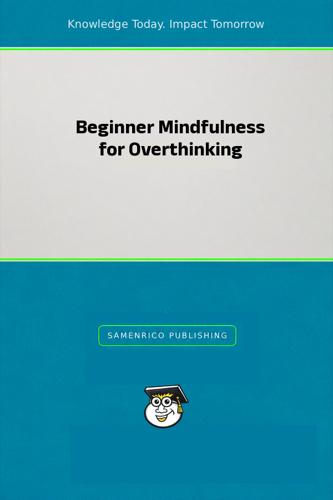
Beginner Mindfulness for Overthinking eBook
Label thoughts as thinking and return to breath wi
by Lackey Cris
Label thoughts as thinking and return to breath without engagement.
Formats
Free sample
Chapter 1: The White Bear Lie--–- It begins, as it always does, with a command you never asked to receive. Someone—a well-meaning friend, a self-help article, your own exhausted mind at 2 AM—tells you to stop thinking so much. Don’t worry. Let it go. Just don’t go there.
And so you try. You clench your mental fists and you push against the thought like a swimmer pushing against a current. And for one glorious, fleeting second, you succeed. The thought vanishes. You feel a breath of relief.
And then, like a jack-in-the-box springing back with malicious glee, the thought returns—louder, stickier, more convincing than before. Now you’re not just thinking the thought. You’re thinking about why you can’t stop thinking the thought. You’re thinking about what’s wrong with you. You’re thinking about how everyone else seems to manage their minds just fine.
Congratulations. You have just turned a single passing cloud into a hurricane. And you have no idea that the very act of trying to stop the thought is the thing that gave it wings.This is the trap that every overthinker knows intimately but cannot name. The trap has a name, and it is one of the most counterintuitive discoveries in the history of psychology. It is called ironic process theory, though you may know it by its more famous disguise: the White Bear Problem.
In the 1980s, the social psychologist Daniel Wegner asked a simple question that would upend everything we think we know about thought control. He gathered a group of participants and gave them a single instruction: for five minutes, do not think about a white bear. Every time the white bear appears in your mind, ring this bell. The results were devastating. The participants rang the bell again and again and again.
The white bear, a creature none of them had been thinking about five minutes earlier, became an obsession. Then Wegner ran the second phase of the experiment. He told a new group of participants to think about a white bear for five minutes. But these participants had not been instructed to suppress anything. They were simply asked to hold the image in mind.
And here is the astonishing finding: the suppression group thought about the white bear significantly more than the expression group. Trying not to think about something does not reduce it. It multiplies it. The act of suppression is, itself, an act of attention. You cannot push against a thought without first holding onto it.
And holding onto it, even in the form of resistance, is still holding on.This is the lie you have been sold your entire life. The lie whispers that overthinking is a failure of will. That if you just tried harder, concentrated more fiercely, clamped down with greater determination, you could silence the mental noise. The lie promises that the strong, disciplined mind is an empty mind. The lie tells you that thoughts are intruders to be ejected, enemies to be defeated, stains to be scrubbed away.
And every time you believe this lie and try to suppress a thought, you prove the lie wrong—but you blame yourself for the failure. You think, “I didn’t try hard enough.” You think, “My mind is broken.” You think, “Other people can do this, so why can’t I?” The truth is far stranger and far more liberating. The truth is that the harder you try not to think about something, the more you guarantee that you will think about it. The effort to suppress is the fuel that powers the very engine you are trying to shut down.The Anatomy of a Thought Loop To understand why suppression fails, you must first understand what a thought actually is. Not in the abstract philosophical sense, but in the practical, experiential sense that mindfulness practice reveals.
A thought is not a solid object. It is not a possession. It is not a command. A thought is a transient mental event—a brief pattern of neural firing that creates a temporary experience of meaning. Think of a thought as a bubble rising through a glass of sparkling water.
It forms, it rises, it reaches the surface, and it pops. The entire lifecycle of a natural, untampered thought is measured in seconds. The bubble does not cling to the side of the glass. It does not argue with other bubbles. It does not demand that you analyze it.
It simply arises and passes away, making room for the next bubble.But here is what happens when you try to suppress a thought. You see the bubble begin to form, and instead of letting it rise and pop on its own, you slap your hand over the top of the glass. You trap the bubble beneath your palm. And the bubble, now prevented from completing its natural cycle, does not disappear. It merges with other trapped bubbles.
It grows larger. It becomes more insistent. It presses against your hand with increasing pressure. You have taken a fleeting, harmless mental event and transformed it into a solid, stubborn, seemingly permanent object. This is the mechanism of every overthinking loop.
The thought itself is never the problem. The problem is the resistance to the thought. The problem is the secondary thought that says, “I shouldn’t be having this thought.” The problem is the tertiary thought that says, “What does it mean about me that I’m having this thought?” The problem is the quaternary thought that says, “I need to figure out how to stop having these thoughts so I can finally be at peace.”Each layer of resistance adds mass to the original bubble. Each attempt to push the thought away pulls it closer. Each moment of self-criticism for overthinking is, itself, another thought about overthinking.
You are not trapped by your thoughts. You are trapped by your relationship to your thoughts. And that relationship has been shaped, from your earliest years, by a culture that treats unwanted thoughts as problems to be solved rather than as weather to be observed.The Culture of Thought Suppression We live in an age of extraordinary mental pressure. We are told to optimize our brains, to hack our habits, to master our minds. The self-help industry, for all its genuine value, has accidentally reinforced the very pattern that keeps us stuck.
The implicit promise of most productivity and positivity systems is that the right technique, applied with sufficient discipline, will finally give you control over your inner world. You will be able to think only the thoughts you choose. You will be able to feel only the emotions you prefer. You will become the CEO of your own consciousness. This promise is seductive because it offers hope.
But it is also a lie, and it is a dangerous lie because it sets you up for perpetual failure. No human being in the history of the species has ever achieved reliable, complete control over the contents of their own mind. The Buddhists recognized this twenty-five hundred years ago. The Stoics recognized it two thousand years ago. The cognitive scientists are finally catching up.The problem…
This is the end of the free sample. Get the eBook to keep going. Buy now
About this book
Details
- Author
- Lackey Cris
- Publisher
- SamEnrico
- Language
- English
- Genre
- Non-Fiction, Self-Help, Overthinking, Rumination
- Released
- 2026-06-09
- Pages (approx.)
- 117
- Available as
- eBook, Audiobook

Read better in the ZLOADR app
Your eBooks on your phone or tablet. Sign in with your SamEnrico account and start reading.
More by Lackey Cris
 Euthanasia Decision CompanionLackey Cris$11.99
 The Complicated Grief Family GuideLackey Cris$11.99
 HR Creative Problem SolvingLackey Cris$11.99
 The Validating Anxiety GuideLackey Cris$11.99
 Sands of the Forgotten: The Lost City of UbarLackey Cris$11.99
 Understanding Stiff Skin SyndromeLackey Cris$17.99
 Procurement Robotic AutomationLackey Cris$12.99
 Compliance AI AccountingLackey Cris$12.99
 Civil Engineer Specialized in StructureLackey Cris$11.99
 How to Start a Academic Sales Business (Beginners Guide)Lackey Cris$11.99
You may also like
 Hong Kong Handover 1997Dunn Johnnie$11.99
 Zumba For Postnatal Recovery CourseNeal Christian$11.99
 Zumba for BeginnersLadner Nikia$11.99
 YouTube Comment Mining GuideHumes Pandora$12.99
 Worry Box MeditationCarlin Rudy$11.99
 Workplace Stress MeditationNguyen Lynn$11.99
 Workplace Stress and Sleep RepairHawley Ivory$11.99
 Workplace Perfectionism CureDelaney Jeffry$11.99
 Workplace Injustice Anger GuideWallen Isabelle$11.99
 Work Addiction and Burnout LinkGreenwood Ester$11.99
 Women in Yoga and WellnessBeattie Galina$11.99
 Women in Stand Up ComedyChun Evangeline$11.99