
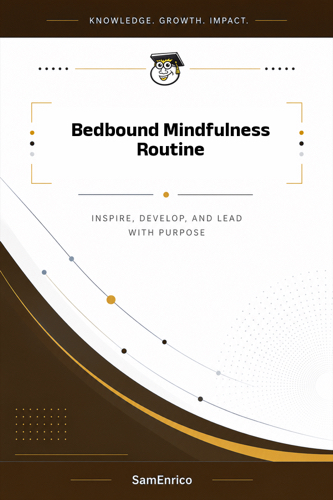
Bedbound Mindfulness Routine eBook
Complete meditation practice for those confined to
Complete meditation practice for those confined to bed with severe illness.
Formats
Free sample
Chapter 1: The First Breath...--–- Before we begin anything—before we speak of posture, practice, or peace—we must speak of the breath. Not because breath is magical or mystical, though it can be both, but because breath is the only thing that has stayed with you. The diagnosis took your plans. The illness took your mobility. The treatments took your energy.
The isolation took your company. But the breath? The breath has not left. Even now, as you lie there, it arrives and departs, arrives and departs, without asking permission, without demanding anything in return. This chapter is about reclaiming the one thing that has never abandoned you: the simple, ordinary, extraordinary act of breathing.The Collision of Two Realities Every morning brings a collision.
On one side stands the memory of a former life—the life where you woke up, swung your legs out of bed, and moved through the world without calculating how much energy each action would cost. That life had its own problems, of course. Everyone’s does. But it had something you now recognize as unimaginable luxury: the assumption that your body would cooperate. You didn’t know then how precious that assumption was.
No one does, until it shatters.On the other side of the collision stands your present reality. The bed. The ceiling. The four walls that have become your geography. The particular weight of your body against the mattress—a weight that used to feel neutral but now feels like a sentence.
The morning arrives, and before you have fully surfaced from sleep, the two realities crash into each other. And in that crash, despair often speaks first.This is not a failure on your part. It is not a lack of willpower or spiritual maturity. It is the brain doing exactly what the brain evolved to do: comparing present experience to past memory, scanning for threats, and sounding the alarm when things do not match. Your brain is not broken.
It is working precisely as designed. The problem is that its design assumed a world where you could get up and walk away from the alarm. You cannot. And so the alarm keeps ringing.The morning collision is real. It is painful.
And it is the very place where mindfulness becomes not a luxury but a lifeline.Why Most Meditation Advice Fails the Bedbound Before we go any further, let us name something that most mindfulness books will not say: the standard advice does not work for you. Not because you are doing it wrong, but because it was written for a different body.Traditional meditation instructions assume you can sit upright. They assume you have enough core strength to hold your spine straight without pain. They assume you can close your eyes without triggering vertigo or fear. They assume you can breathe deeply without coughing or feeling suffocated.
They assume you have the energy to sustain focus for ten, twenty, or forty-five minutes. They assume silence is restful rather than terrifying. They assume that bringing attention to your body will feel grounding rather than like being trapped inside a prison of sensation.None of these assumptions are true for you. And that is not your fault.This chapter—and this entire book—operates from a different set of assumptions. You are lying down, and that is not a compromise.
It is your posture. You have limited energy, and that is not a failure. It is your reality. You may be on medications that fog your thinking, and that is not a character flaw. It is a medical fact.
You may wake up each morning already exhausted, and that is not a spiritual problem. It is a physiological one.The practices in this book are designed for exactly this body, exactly this bed, exactly this life. You do not need to adapt yourself to the practice. The practice adapts to you.The 3-Breath Welcome: A Micro-Practice for the First Moment of Waking Let us begin with something so small that you cannot possibly do it wrong. This is the 3-Breath Welcome.
It takes less than sixty seconds. It requires no movement. It does not ask you to feel good or positive or grateful. It asks only that you breathe three times before your mind runs away with the morning collision.Here is how it works. You are still lying down.
Your eyes may be open or closed—whichever feels safer. You have just become aware that you are awake. Before you do anything else—before you check your phone, before you catalog your pain, before you replay yesterday’s suffering or anticipate today’s—you take three breaths. Just three.Breath One: "I am still here."On the first breath, you say to yourself, silently, these four words: I am still here. You are not saying it with enthusiasm or gratitude or any forced emotion.
You are saying it as a simple statement of fact. I am still here. The breath arrived. The heart beat through the night. Whatever else is true, this is also true: you are still here.Breath Two: "What is my primary sensation right now?"On the second breath, you ask yourself a question: What is my primary sensation right now?
Not all of your sensations—that would be overwhelming. Just the strongest one. The weight of the blanket. The coolness of the pillow. The ache in your lower back.
The dryness of your mouth. The sound of the fan. You are not trying to change the sensation. You are not judging it as good or bad. You are simply noticing it, the way you might notice the weather when you look out a window.
This is what is here right now.Breath Three: "What is one tiny thing I will notice today?"On the third breath, you set a single, minuscule intention: What is one tiny thing I will notice today? Not a goal. Not an accomplishment. Just something to pay attention to. The weight of the blanket when you adjust it.
The taste of water. The sound of your caregiver’s footsteps. The way the light changes on the ceiling in the afternoon. You are not promising to notice it all day. You are just picking one thing to come back to, whenever you remember.That is the entire practice.
Three breaths. Three simple phrases. Less than one minute.You have now completed the first micro-practice of this book. Well done.The Difference Between Fact and Story Now that you have taken those three breaths, let us introduce a distinction that will serve as the backbone for everything that follows. It is the difference between the fact of illness and the story of illness.A fact is verifiable.
It is neutral. It does not argue or persuade. Examples of facts: "I have a fever of 101 degrees." "I am unable to lift my right arm." "My breathing is shallow this morning." "I have been in this bed for three hours." Facts are not good or bad. They simply are.A story is the meaning the mind attaches to the fact. Stories are not wrong—they are often completely understandable and even accurate.
But they are not the same as facts. Examples of stories: "This fever means I am getting worse." "Not being…
This is the end of the free sample. Get the eBook to keep going. Buy now
About this book
Details
- Author
- Adamson Anthony
- Publisher
- SamEnrico
- Language
- English
- Genre
- Non-Fiction, Self-Help
- Released
- 2026-06-05
- Pages (approx.)
- 156
- Available as
- eBook, Audiobook

Read better in the ZLOADR app
Your eBooks on your phone or tablet. Sign in with your SamEnrico account and start reading.
More by Adamson Anthony
 Behavioral Weight WorkbookAdamson Anthony$11.99
 Yakuza Retirement ProblemsAdamson Anthony$11.99
 Anki For Chemistry ElementsAdamson Anthony$11.99
 Spouse Loss Adult ChildrenAdamson Anthony$11.99
 Self Hypnosis For Emetophobia GuideAdamson Anthony$11.99
 NYC Bodega Pop Up HybridAdamson Anthony$11.99
 Planet Dream Jungian ViewAdamson Anthony$11.99
 Loving Kindness for a Demanding ClientAdamson Anthony$11.99
 The Green Alchemists: How Black Botanists Transformed MedicineAdamson Anthony$11.99
 The Ghost of the Kremlin: How a CIA Operative Outsmarted the Soviet Union in Plain SightAdamson Anthony$11.99
 The Germ Hunters: Billionaires, Bacteria, and the Race to Save the WorldAdamson Anthony$11.99
 The Complete Guide to the Every Other Day DietAdamson Anthony$11.99
You may also like
 Hong Kong Handover 1997Dunn Johnnie$11.99
 Zumba For Postnatal Recovery CourseNeal Christian$11.99
 Zumba for BeginnersLadner Nikia$11.99
 YouTube Comment Mining GuideHumes Pandora$12.99
 Worry Box MeditationCarlin Rudy$11.99
 Workplace Stress MeditationNguyen Lynn$11.99
 Workplace Stress and Sleep RepairHawley Ivory$11.99
 Workplace Perfectionism CureDelaney Jeffry$11.99
 Workplace Injustice Anger GuideWallen Isabelle$11.99
 Work Addiction and Burnout LinkGreenwood Ester$11.99
 Women in Yoga and WellnessBeattie Galina$11.99
 Women in Stand Up ComedyChun Evangeline$11.99