
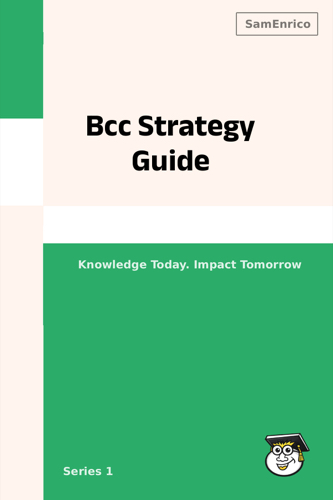
Bcc Strategy Guide eBook
Appropriate use of blind carbon copy to reduce rep
Appropriate use of blind carbon copy to reduce reply-all chains.
Formats
Free sample
Chapter 1: The Fifteen-Million-Dollar Button--–- The email arrived at 10:17 AM on a Tuesday. Within ninety minutes, it had cost the organization $1.8 million in lost productivity. By Thursday, the total exceeded $15 million. The message itself was innocuous—a routine announcement about a company-wide “baby shower” for an employee expecting twins. The sender, well-intentioned but untrained, had placed four thousand employees in the “To” field.
What happened next became a case study in digital chaos, a warning etched into the memory of everyone who lived through it, and the reason this book exists.This is the story of the Fifteen-Million-Dollar Button.The setting was NASA’s Jet Propulsion Laboratory in Pasadena, California—though the same story has played out at Google, Microsoft, the FBI, and thousands of Fortune 500 companies. On that Tuesday, an administrator sent an invitation to a baby shower. Within minutes, the first reply appeared: “Congratulations!” Then another. Then fifty more. Then hundreds.
Employees who had never met the expecting parents felt compelled to add their well-wishes. Each reply triggered a new email to every single person on the original four-thousand-person list. Servers groaned. Inboxes overflowed. Employees lost hours of work time deleting, scrolling, and muting threads that refused to die.The aftermath was quantified by a JPL engineer who calculated the cost: approximately four thousand employees spending an average of fifteen minutes dealing with the chain, multiplied by an average loaded labor rate of roughly $150 per hour.
The math was brutal. Fifteen minutes times four thousand people equals one thousand hours of lost work. One thousand hours times $150 equals $150,000. That was just the first hour. By the time the chain finally died—after IT intervened and forcibly deleted the thread from the server—the total exceeded $15 million in wasted labor.The kicker?
The employee who started the chain never even had the baby shower. The flood of replies was so disruptive that the event was quietly canceled.This chapter diagnoses the reply-all apocalypse: why it happens, why it feels so good to hit that button, and why blind carbon copy is the only cure. We will dissect the anatomy of disaster, explore the psychology of digital addiction, and establish the foundation for every strategy that follows in this book. By the end of this chapter, you will never look at the “Reply All” button the same way again.THE FOUR HORSEMEN OF THE INBOX APOCALYPSEEvery reply-all disaster follows one of four archetypes. Recognize these patterns, and you will spot danger before it strikes.The First Horseman: The Welcome Aboard A new hire joins the company.
Their manager sends a warm introduction to the department: “Please join me in welcoming Sarah to the team!” The manager places thirty people in the “To” field. Within minutes, twenty-nine replies appear: “Welcome, Sarah!” “So glad to have you!” “Sarah, you’re going to love it here!” Each reply includes the original message. Each reply goes to all thirty people. Sarah, the new hire, now has thirty emails in her inbox before she has even set up her signature line.The problem is not the welcome. The problem is the audience.
A welcome message is a one-to-many broadcast. It should be treated as such. But because the sender used “To” instead of BCC, they transformed a simple greeting into an open microphone for every team member to perform their thoughtfulness in front of the entire group.The Second Horseman: The Office Party Similar to the welcome aboard, but with higher stakes. Someone sends a message about an upcoming social event: “Who can bring a dish for the holiday potluck?” The sender puts fifty people in “To.” The replies come fast and furious: “I’ll bring cookies.” “I’ve got a veggie tray.” “Can someone bring gluten-free options?” Within an hour, the thread contains 120 replies. Anyone who joined the thread late must scroll through five pages of responses to find the original question.
The person organizing the potluck cannot find the replies because they are buried in everyone else’s commentary.The office party disaster reveals a deeper truth: most people do not need to see most replies. The organizer needs to see them. The person bringing cookies does not need to see the veggie tray person’s reply. But because the thread uses “To” for everyone, every participant receives every reply—whether they need it or not.The Third Horseman: The Mass Update IT announces a server outage. HR shares the new benefits enrollment period.
Facilities sends a parking lot closure notice. These are legitimate, important communications. The sender, wanting to be thorough, puts the entire company in the “To” field. And then it happens: the first reply. “Thanks for the update.” The second: “Got it.” The third: “When will service be restored?” The fourth: “Why wasn’t this communicated sooner?” The fifth through the four hundredth: a cascade of questions, complaints, and gratitude that no one asked for.The mass update disaster is particularly insidious because the original message was necessary.
The sender did nothing wrong by broadcasting information. The problem is that broadcast communications should never include a reply-all invitation. By putting everyone in “To,” the sender implicitly said, “Please reply to everyone with your thoughts.” They did not mean to say that. But the technology interprets intent poorly, and humans interpret ambiguity poorly, and together they create chaos.The Fourth Horseman: The Thanks Storm This is the most dangerous of all because it seems so innocent. A manager sends a message to five people: “Great work on the Jones project.” One of the five replies: “Thanks!” That reply goes to all five.
A second person, seeing the thanks, replies: “Yes, great team effort!” That goes to all five. A third person, feeling left out, replies: “Couldn’t have done it without everyone’s support!” Now the thread has six messages, all saying essentially the same thing. The manager’s original compliment is buried. Everyone’s inbox is clogged. And no one can figure out how to stop it without being rude.The thanks storm reveals the addictive nature of reply-all.
Each person who replies receives a small dopamine hit: they have been seen, they have contributed, they have performed social belonging in front of an audience. The audience, however, did not ask for the performance. They are trapped in it.THE DOPAMINE LOOP: WHY WE CANNOT STOP REPLYING-ALLTo understand why reply-all chains persist, we must understand the brain chemistry that drives them. Dopamine is a neurotransmitter associated with reward, pleasure, and anticipation. Every time you receive a notification—a new email, a like on social media, a text message—your brain releases a small amount of dopamine.
The anticipation of the notification is often more rewarding than the notification itself.The reply-all button exploits this mechanism perfectly.When you hit “Reply All,” several things happen simultaneously. First, you anticipate the reaction of your audience. Will they agree? Will they thank you? Will they acknowledge your contribution?
This anticipation triggers dopamine. Second, when the replies start arriving—when people respond to your message—you receive a second wave of dopamine. Third, the visibility of your name in the thread (displayed prominently in everyone’s inbox) provides social validation. You exist. You matter.
You are part of the conversation.This is the reply-all dopamine loop: anticipation, action, validation, repeat.The loop is self-reinforcing. Each reply…
This is the end of the free sample. Get the eBook to keep going. Buy now
About this book
Details
- Author
- Hines Raymond
- Publisher
- SamEnrico
- Language
- English
- Genre
- Non-Fiction, Business Brief, Email Etiquette
- Released
- 2026-06-11
- Pages (approx.)
- 145
- Available as
- eBook, Audiobook

Read better in the ZLOADR app
Your eBooks on your phone or tablet. Sign in with your SamEnrico account and start reading.
More by Hines Raymond
 The Mayor's FuneralHines Raymond$11.99
 Data Leak Business Customer ScriptsHines Raymond$11.99
 IBS Mast Cell Activation GuideHines Raymond$11.99
 Digital Communication EthicsHines Raymond$11.99
 Chasing the Phantom: The Unstoppable Heist of the 1960 Ferrari 250 GTOHines Raymond$11.99
 The Fire Below: How a Victorian Explorer Mapped the World’s Most Dangerous VolcanoHines Raymond$11.99
 Understanding Cloverleaf Skull Bone DysplasiaHines Raymond$17.99
 Ultimate Handbook Guide to Shimkent : (Kazakhstan) Travel GuideHines Raymond$11.99
 Treepz YC Application GuideHines Raymond$12.99
 Multi Site Production PlanningHines Raymond$12.99
 Woodwind Repair TechnicianHines Raymond$11.99