
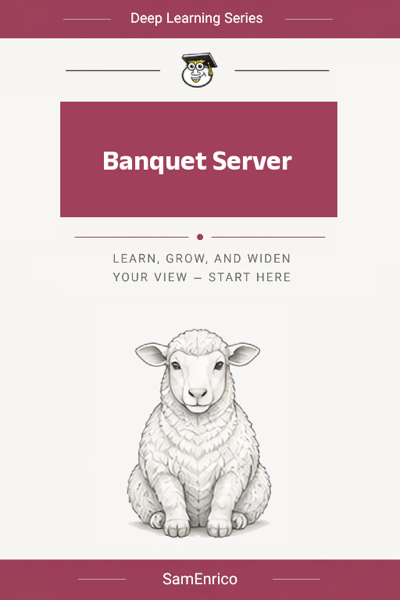
Non-FictionInformativeEducational
Banquet Server eBook
A Coursebook on Banquet Server
by Davies Neda
A Coursebook on Banquet Server
Formats
Free sample
Chapter 1: The Invisible Actor--–- You are about to learn a secret that most banquet servers spend years learning the hard way: the best service is the service no one remembers.Walk into any busy restaurant and you will see them—servers weaving between tables, dropping off checks, refilling water, cracking jokes with regulars, and collecting tips based on the strength of their individual personality. The restaurant server is a solo performer, a one-person show working a stage of four to six tables. Their name is on the guest's mind. Their face is associated with the meal. When something goes wrong, the guest looks for them.Now walk into a ballroom thirty minutes before a four hundred-person wedding reception.
What do you see? Dozens of servers in identical uniforms moving in what appears to be organized chaos. Tables are being draped in white linen. Glassware is being polished under bright lights. Napkins are being folded into perfect fans.
And here is the first truth you must accept if you want to succeed in this industry: no one in that ballroom is trying to be remembered.The banquet server operates under a completely different set of rules than the restaurant server. Your goal is not to make friends with the guests. Your goal is not to have the bride remember your name. Your goal is to deliver flawless service so seamlessly that the guest never thinks about you at all—they only remember that the evening was perfect, the food arrived hot, the wine glasses were always full, and the night felt effortless.This is the philosophy of the Invisible Actor.The Core Contradiction Let us resolve a tension that confuses nearly every new banquet server. You will hear some trainers say, "Be invisible—blend into the background, never draw attention to yourself." You will hear other trainers say, "Treat every event as a performance—you are on stage, so act like it." Both statements are true, and both statements are incomplete.The Invisible Actor resolves this contradiction.
You are, in fact, performing. Your posture, your pace, your facial expressions, and your timing are all part of a deliberate performance. But the audience—the guests—should never see the effort behind that performance. When a stage actor is playing a role, the audience sees the character, not the actor's preparation. When you are working a banquet, the guests should see the seamless flow of service, not the server who is making it happen.Here is the practical application of this philosophy.
When you are performing a task—pouring wine, setting a plate, clearing a crumb—you are visible. The guest sees you. But they see only the action, not the person. You do not make eye contact longer than necessary. You do not introduce yourself by name.
You do not engage in conversation beyond the absolute essentials. You execute the task with precision, and then you become invisible again—blending into the room, observing, anticipating, waiting for the next need.The restaurant server builds relationships through conversation. The banquet server builds trust through competence.The Numbers That Change Everything Let us look at the mathematics of banquet service because the numbers explain why this job is fundamentally different from anything in a restaurant.A restaurant server typically handles four to six tables at a time. Each table has two to four guests. That means the restaurant server is responsible for anywhere from eight to twenty-four guests at once.
They take orders, run food, refill drinks, process payments, and reset tables. They have time to chat because the volume is manageable.A banquet server handles a station of twenty to forty guests. During a plated dinner, you will serve all of those guests the same courses at roughly the same time. You are not taking individual orders—the menu is predetermined. You are not processing payments at the table—the client has already paid.
You are not building individual relationships—you are executing a synchronized operation.But here is what the numbers do not tell you. In a restaurant, if you make a mistake, it affects one table. In a banquet, if you make a mistake, it affects your entire station. And if multiple servers on your team make mistakes, the entire event suffers. A restaurant server can recover from a wrong order with a free dessert and a smile.
A banquet server who serves the wrong plate to an allergy guest does not get a recovery—they get an ambulance.The pressure is different. The stakes are higher. And the margin for error is much, much smaller.The Four Event Types and Their Personalities Not all banquets are the same. Each type of event has its own rhythm, its own pressure points, and its own expectations. You will learn to read an event within the first ten minutes and adjust your performance accordingly.Weddings are emotional nuclear reactors.
You are serving one of the most expensive and emotionally charged days of the couple's life. The bride's mother is watching everything. The photographer is documenting every moment. The timeline is tight—cocktail hour, grand entrance, first dance, dinner service, toasts, cake cutting, dancing. A delay in one part of the service creates a cascade of delays.
The wedding crowd drinks more than any other event type. They stay later. They are louder. And they are the most likely to tip in cash at the end of the night if you have served them well. The key to wedding service: smile through everything, move faster than you think you need to, and never, ever roll your eyes where a guest can see you.Corporate Meetings and Conferences are the opposite of weddings.
These guests are working. They are often tired from travel. They want efficiency, not charm. They want their coffee hot and their lunch served within twenty-five minutes so they can get back to the breakout session. These events are rarely emotional—they are transactional.
The client (the meeting planner) is watching you more than the guests are. If the meeting planner is happy, you will be invited back. If the meeting planner is unhappy, the venue loses a contract. The key to corporate service: speed, accuracy, and silence. Do not chat with the guests.
Do not ask how their day is going. Serve and disappear.Conventions are corporate events on steroids. You are serving hundreds or thousands of people over multiple days. The pace is relentless. You will set up, serve, break down, reset, and do it again three times in one day.
The guests are badge-wearing, schedule-following professionals who expect consistency. The same lunch served on Tuesday should look exactly like the same lunch served on Wednesday. The key to convention service: consistency and stamina. Show up early, work fast, and do not complain about the hours—everyone is tired.Galas and Fundraisers are high-stakes events with wealthy attendees and strict timelines. These events often include live auctions, paddle raises, and speeches from important people.
The service must be silent during speeches. The wine must flow but not too fast—these guests need their wits about them when they start bidding on a vacation package. The key to gala service: anticipation.…
This is the end of the free sample. Get the eBook to keep going. Buy now
About this book
Details
- Author
- Davies Neda
- Publisher
- SamEnrico
- Language
- English
- Genre
- Non-Fiction, Informative, Educational
- Released
- 2026-06-02
- Pages (approx.)
- 112
- Available as
- eBook, Audiobook

Read better in the ZLOADR app
Your eBooks on your phone or tablet. Sign in with your SamEnrico account and start reading.
More by Davies Neda
 Pet Loss and HolidaysDavies Neda$11.99
 First Responder Stress Inoculation CourseDavies Neda$11.99
 Body Language for Security GuardsDavies Neda$11.99
 Body Image and Prosthetic Limb AcceptanceDavies Neda$11.99
 Anthony the Great AccountDavies Neda$11.99
 The Dot-Com Bubble Burst: When the Internet Almost Broke UsDavies Neda$11.99
 Green Steel Production ForecastDavies Neda$12.99
 Automated Rejection Messaging ManualDavies Neda$12.99
 Understanding Kyasanur Forest DiseaseDavies Neda$17.99
 How to Start a Baize Business (Beginners Guide)Davies Neda$11.99
You may also like
 Hong Kong Handover 1997Dunn Johnnie$11.99
 Zumba For Postnatal Recovery CourseNeal Christian$11.99
 Zumba for BeginnersLadner Nikia$11.99
 YouTube Comment Mining GuideHumes Pandora$12.99
 Worry Box MeditationCarlin Rudy$11.99
 Workplace Stress MeditationNguyen Lynn$11.99
 Workplace Stress and Sleep RepairHawley Ivory$11.99
 Workplace Perfectionism CureDelaney Jeffry$11.99
 Workplace Injustice Anger GuideWallen Isabelle$11.99
 Work Addiction and Burnout LinkGreenwood Ester$11.99
 Women in Yoga and WellnessBeattie Galina$11.99
 Women in Stand Up ComedyChun Evangeline$11.99