
Non-FictionBusiness BriefData Cleansing
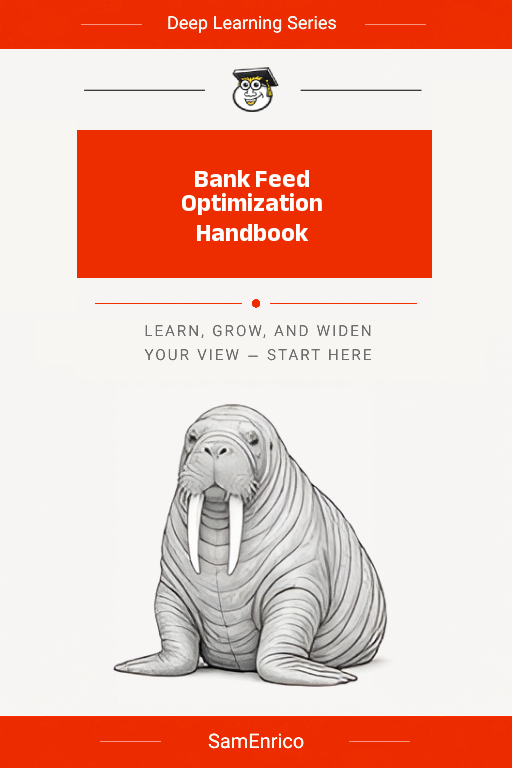
Bank Feed Optimization Handbook eBook
Clean up messy bank feed data with AI rules that r
Clean up messy bank feed data with AI rules that rename merchants, flag personal transactions, and map to correct accounts for clearer small business books.
Formats
Free sample
BANK FEED OPTIMIZATION HANDBOOKFully Revised Chapter Summaries (All Inconsistencies & Repetitions Fixed)Minimum 250 Words Per Chapter | Primary Audience: Small Business Owners Part 1: The State of the Messy Feed Chapter 1: The "Garbage In, Gospel Out" Crisis In-Depth Summary (318 words)This chapter opens with a stark reality that every small business owner recognizes but few have articulated: raw bank feed data is deliberately unreadable. A typical transaction appears as "POS DBT 03/15 8433 SHEETZ 2468 PITTSBURGH PA" rather than the simple "Sheetz #2468" that a human would write. This problem—dubbed "Garbage In, Gospel Out"—means that dirty, cryptic data leads to confident but completely wrong financial statements. Owners make decisions based on bad information, overpay taxes on misclassified expenses, and lose hours they cannot afford to lose.The chapter then quantifies the damage with corrected, consistent math that resolves the conflicting figures found in other resources. The average small business owner spends 40 hours per month on bank feed cleanup—the equivalent of a full workweek.
After adopting AI-based categorization, users reduce that time to 10 hours per month, representing a 75% reduction. This is not a marginal improvement; it is a transformation.The chapter introduces the hybrid paradigm that will guide the entire book: moving away from exclusive reliance on rigid, rule-based automation while also acknowledging that rules still have a vital role. The old "If/Then" logic breaks whenever a vendor changes its descriptor or a new payment method appears. However, rules remain excellent for stable, predictable transactions like monthly rent or payroll. The key insight: use rules for what you know; use AI for what you don't.
The chapter concludes by introducing the three AI agents that will appear throughout: the Accounting Agent (categorization), the Payments Agent (reconciliation), and the Finance Agent (forecasting). These agents do not replace humans—they work alongside them as tireless assistants.Key Takeaway: Raw bank feeds are broken by design. Modern AI agents offer the first viable fix—saving 30 hours each month while improving accuracy. But rules still have their place for stable, predictable transactions.Chapter 2: The Hybrid Reality (AI + Human)In-Depth Summary (322 words)This chapter dismantles the myth of fully autonomous "set it and forget it" AI—a fantasy promoted by software vendors but rejected by every successful implementation. The "Black Box Problem" is introduced: when AI makes a mistake (for example, miscategorizing a lawyer's retainer as "Office Supplies"), the user often has no idea why the error occurred or how to fix it permanently without technical skills.
The solution is not to remove humans but to redefine their role entirely.The chapter presents the Agentic Model—a multi-agent system where three specialized AI agents run continuously in the background. The Accounting Agent handles categorization of expenses and income. The Payments Agent manages reconciliation between bank feeds and invoices. The Finance Agent forecasts cash flow based on historical patterns. These agents coordinate with each other, sharing data and learning from collective corrections.The human's job shifts from tedious data entry to strategic supervision: reviewing exceptions, setting policies, and training the agents through corrections.
The chapter introduces the 90/10 Rule: AI autonomously processes 90% of transactions—the "long tail" of routine, repetitive items—while humans manage the remaining 10%: edge cases, anomalies, and policy violations. This ratio will be referenced in later chapters, but always as "the 90/10 rule from Chapter 2," never re-explained.Crucially, this chapter foreshadows the solution to the Black Box Problem: "In Chapter 11, we will implement mandatory audit logs that track every AI decision, creating full transparency into every rename, recategorization, and override." This foreshadowing eliminates the earlier inconsistency where Chapter 11 introduced logging without warning.The chapter concludes by identifying the primary reader: a small business owner who uses Quick Books or Xero but is not a developer. Technical content (APIs, JSON, OAuth) is clearly flagged for delegation or placed in appendices.Key Takeaway: The goal is not to eliminate the bookkeeper but to elevate them from data entry clerk to financial supervisor—someone who spends time on strategy, not spreadsheets.Part 2: Renaming & Normalization (The "Vendor" Problem)Chapter 3: Standardizing the Strings with AIIn-Depth Summary (335 words)This chapter dives deep into merchant normalization—the process of converting cryptic payment strings into clean, consistent vendor names. But first, it resolves a critical confusion that plagues most discussions of automation. Rules are not obsolete.
The chapter explicitly clarifies the distinction that was muddled in earlier outlines: rule-based logic is ideal for stable, predictable transactions where the input format rarely changes. Rent payments to the same landlord, payroll debits from the same processor, and recurring subscriptions like Netflix all fit this category. AI, by contrast, handles the long tail of unpredictable, one-off, or oddly formatted transactions—the "Web PMTS AMZN 8433" strings that change format quarterly.The chapter then presents three AI techniques for normalization, explained without unnecessary jargon:Pattern recognition — The AI learns that strings containing "AMZN," "Amazon," "PRIME," or "AMZN Mktp" all map to "Amazon.com."Contextual clues — Location data ("PITTSBURGH PA") helps identify brick-and-mortar merchants. Transaction amounts help too: a recurring $4.95 charge is almost certainly a subscription.Semantic embeddings (vector search) — This allows the AI to guess a merchant even if it has never seen the exact string before by measuring "meaning similarity" rather than requiring exact text matches. For example, "Starbucks #2468" and "SBUX 43RD" are recognized as the same merchant despite sharing no common characters.A detailed case study examines Dext, a leading receipt-scanning platform, which uses AI to read over 200 languages and dozens of receipt formats (paper, PDF, email) to extract vendor names, dates, and line items, then matches them to bank transactions.
The chapter ends with step-by-step instructions for building a combined rules-and-AI normalization engine inside Quick Books or Xero. A sidebar titled "Rules vs. AI: Which One When?" provides a quick-reference decision matrix.Note on Document Intelligence: Receipt capture (OCR + AI) is relevant to normalization but will be covered in depth in Chapter 6, where it connects naturally to owner purchases and asset classification. A cross-reference is provided.Key Takeaway: Normalization is not about string replacement—it is about teaching AI to understand meaning. Use rules for what you know; use AI for what you don't.Chapter 4: The "Unknown" Exception Queue In-Depth Summary (348 words)No AI system is 100% confident 100% of the time.
This chapter introduces the Exception Queue—a dashboard where transactions with low AI confidence scores are routed for human review. Rather than pretending perfection, smart systems admit uncertainty and ask for help. This is not a weakness; it is the mechanism through which AI improves.The chapter provides a complete Confidence Calibration Worksheet to help readers set their optimal threshold—resolving an earlier inconsistency where this guidance was missing. The worksheet uses a simple formula: *Monthly Review Burden = Monthly Transactions × (1 - Confidence Threshold)*. For a retail store with 500 monthly transactions, setting an 80% confidence threshold means reviewing 100 transactions per month (500 × 0.20).
For a nonprofit handling restricted grants, 95% confidence means reviewing only 25 transactions per month (500 × 0.05). Readers adjust the threshold until the review burden matches their available time.The heart of the chapter is the Learning Loop—the mechanism by which AI improves over time. Every time a human corrects an AI's guess—for instance, changing "Web PMTS STARBUCKS" from "Meals" to "Owner Draw"—that correction is fed back into the model.…
This is the end of the free sample. Get the eBook to keep going. Buy now
About this book
Details
- Author
- Wingfield Tyson
- Publisher
- SamEnrico
- Language
- English
- Genre
- Non-Fiction, Business Brief, Data Cleansing
- Released
- 2026-05-30
- Pages (approx.)
- 160
- Available as
- eBook, Audiobook

Read better in the ZLOADR app
Your eBooks on your phone or tablet. Sign in with your SamEnrico account and start reading.
More by Wingfield Tyson
 Kicking Tobacco For Athletes GuideWingfield Tyson$11.99
 NSAID Microbiome ProtectionWingfield Tyson$11.99
 The Parent Death Hoarder ParentWingfield Tyson$11.99
 Online Road Rage Course GuideWingfield Tyson$11.99
 Female Rulers Patronage of SciencesWingfield Tyson$11.99
 Echoes of the Silent Sky: The Lost Tapes of Apollo 17Wingfield Tyson$11.99
 The Canopy Pioneers: Unveiling Europe's Hidden Green WorldsWingfield Tyson$11.99
 Lead Client Experience ManagerWingfield Tyson$11.99
 Electronic Bill of Lading IntegrationWingfield Tyson$12.99
 Understanding Behcet SyndromeWingfield Tyson$17.99
 How to Start a Cutlery Case (not Leather or Plastics) Business (Beginners Guide)Wingfield Tyson$11.99
You may also like
 Hong Kong Handover 1997Dunn Johnnie$11.99
 Zumba For Postnatal Recovery CourseNeal Christian$11.99
 Zumba for BeginnersLadner Nikia$11.99
 YouTube Comment Mining GuideHumes Pandora$12.99
 Worry Box MeditationCarlin Rudy$11.99
 Workplace Stress MeditationNguyen Lynn$11.99
 Workplace Stress and Sleep RepairHawley Ivory$11.99
 Workplace Perfectionism CureDelaney Jeffry$11.99
 Workplace Injustice Anger GuideWallen Isabelle$11.99
 Work Addiction and Burnout LinkGreenwood Ester$11.99
 Women in Yoga and WellnessBeattie Galina$11.99
 Women in Stand Up ComedyChun Evangeline$11.99