
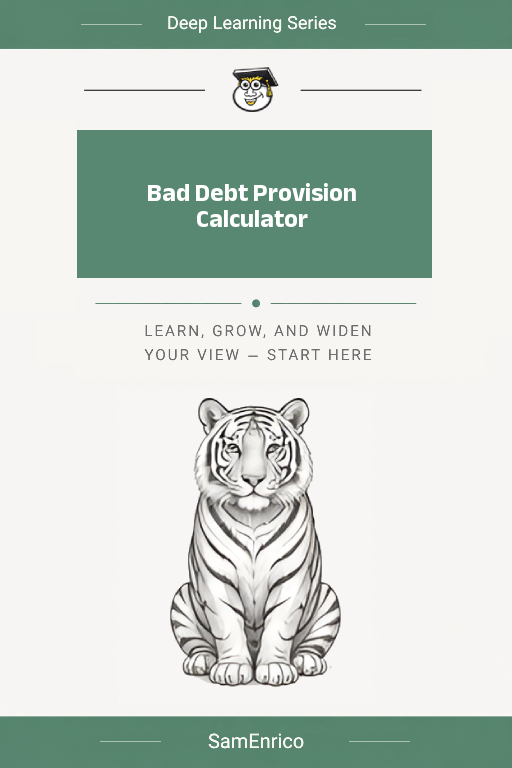
Non-FictionBusiness BriefCredit Risk
Bad Debt Provision Calculator
Use AI to analyze aging receivables and historical
by Woody Meagan
Use AI to analyze aging receivables and historical write-offs, automatically calculating and journalizing your allowance for doubtful accounts each period.
Formats
About this book
Free sample
Chapter 1: The 2% Lie--–- The phone rang at 11:47 PM on a Tuesday. I know the exact time because I was staring at my spreadsheet, watching a company die in slow motion.The voice on the other end belonged to David, the CFO of a mid-sized industrial distributor—let’s call it Midway Supply. He wasn’t panicking. He was past panic. His voice had the flat, exhausted quality of someone who had just watched a three-year construction project collapse in an afternoon.“You were right,” he said.
“The aging report was wrong.”I didn’t say “I told you so.” I didn’t need to. The numbers spoke for themselves.Three months earlier, Midway Supply’s aging report showed a clean portfolio. Their manual allowance calculation—the same one they had used for eleven years—estimated that 2% of their 24millioninaccountsreceivablewouldeventuallygobad.Thatmeanttheyhadsetaside24 million in accounts receivable would eventually go bad. That meant they had set aside 24millioninaccountsreceivablewouldeventuallygobad.Thatmeanttheyhadsetaside480,000 as their allowance for doubtful accounts. Their net income for the quarter was projected at $1.2 million.
Everything looked healthy.Then their largest customer, a regional retail chain representing 18% of Midway’s receivables, filed for Chapter 11. No warning. No slow payment history. No disputed invoices. Just a sudden, brutal bankruptcy announcement.Within sixty days, Midway Supply wrote off 2.1millionofthatcustomer’sbalance.Theiractualbaddebtrateforthequarterwasnot22.1 million of that customer’s balance.
Their actual bad debt rate for the quarter was not 2%. It was 15% of total receivables. The 2.1millionofthatcustomer’sbalance.Theiractualbaddebtrateforthequarterwasnot2480,000 allowance covered less than a quarter of the actual loss. The remaining 1.62millionhittheincomestatementasanunexpectedexpense,turningtheir1.62 million hit the income statement as an unexpected expense, turning their 1.62millionhittheincomestatementasanunexpectedexpense,turningtheir1.2 million profit into a $420,000 loss.The bank called. The auditors asked questions.
The board wanted heads.And David, sitting in his home office at midnight, asked me the question that changed how I think about bad debt forever: “How did we not see this coming?”That question is the reason this book exists.The Silent Killer on Your Balance Sheet Let me be direct with you: if you are manually calculating your bad debt provision using spreadsheets and historical loss rates, your balance sheet…
This is the end of the free sample. Get the eBook to keep going. Buy now
Contents
- Chapter 1
- Chapter 2
- Chapter 3
- Chapter 4
- Chapter 5
- Chapter 6
- Chapter 7
- Chapter 8
- Chapter 9
- Chapter 10
- Chapter 11
- Chapter 12
Details
- Author
- Woody Meagan
- Publisher
- SamEnrico
- Language
- English
- Genre
- Non-Fiction, Business Brief, Credit Risk
- Released
- 2026-05-29
- Pages (approx.)
- 133
- Available as
- eBook, Audiobook

Read better in the ZLOADR app
Your eBooks on your phone or tablet. Sign in with your SamEnrico account and start reading.
More by Woody Meagan
 Artichoke Leaf Gut GuideWoody Meagan$11.99
 Daily Review for Massage TherapistsWoody Meagan$11.99
 The Semiconductor Talent WarWoody Meagan$11.99
 Making Peace With Food WorkbookWoody Meagan$11.99
 Catherine the Great Masonic Lodge RelationsWoody Meagan$11.99
 Pixel Pioneers: The Untold Story of the First Female Game DeveloperWoody Meagan$11.99
 Ripple Effect: How a Single Instagram Post Toppled a Billion-Dollar Fashion EmpireWoody Meagan$11.99
 Office CleanerWoody Meagan$11.99
 Registered Agent Service ExplainedWoody Meagan$12.99
 Understanding Benzodiazepine Withdrawal SyndromeWoody Meagan$17.99
 How to Start a Power Supply Unit for Electronic Applications Business (Beginners Guide)Woody Meagan$11.99
You may also like
 Hong Kong Handover 1997Dunn Johnnie$11.99
 Zumba For Postnatal Recovery CourseNeal Christian$11.99
 Zumba for BeginnersLadner Nikia$11.99
 YouTube Comment Mining GuideHumes Pandora$12.99
 Worry Box MeditationCarlin Rudy$11.99
 Workplace Stress MeditationNguyen Lynn$11.99
 Workplace Stress and Sleep RepairHawley Ivory$11.99
 Workplace Perfectionism CureDelaney Jeffry$11.99
 Workplace Injustice Anger GuideWallen Isabelle$11.99
 Work Addiction and Burnout LinkGreenwood Ester$11.99
 Women in Yoga and WellnessBeattie Galina$11.99
 Women in Stand Up ComedyChun Evangeline$11.99