
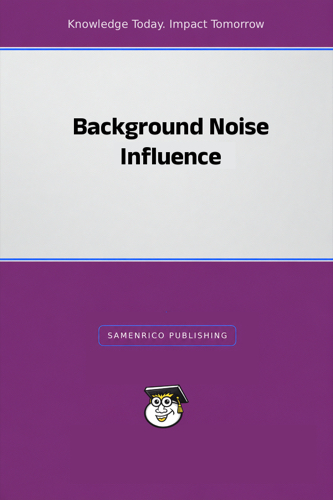
Background Noise Influence eBook
Moderate noise enhances creative persuasion.
Moderate noise enhances creative persuasion.
Formats
Free sample
Chapter 1: The Quiet Cage--–- The most productive room in your office might be the one you have been desperately trying to escape. It is not the corner office with the floor-to-ceiling windows or the minimalist conference room with the whiteboard wall. It is not the library carrel where you have spent countless hours grinding through difficult problems or the home office you painstakingly soundproofed during the pandemic. The most productive room is louder than all of those. It smells like burnt coffee and stale pastries.
The furniture is uncomfortable. The Wi-Fi is unreliable. And yet, somehow, the best ideas of your career are waiting for you there.This is not a metaphor. I am talking about the crowded coffee shop, the bustling office kitchen, the university atrium between classes, the airport gate during a delay, the food court at lunch hour, and any other environment where the ambient noise hovers around 70 decibels. These are the places where creativity goes to thrive, where persuasion becomes effortless, and where the mental blocks that silence erects come crashing down.
These are the places this book will teach you to seek out, to curate, and to weaponize in the service of better thinking.But first, we have to confront the sacred cow of modern productivity: the belief that silence is the supreme condition for difficult thinking. This belief is so deeply embedded in our culture that questioning it feels almost heretical. We have built libraries around it, designed offices around it, and constructed our personal work habits around it. We buy noise-canceling headphones as if they were tickets to a higher plane of cognition. We apologize when our environment intrudes on our silence.
We treat distraction as a moral failing rather than a cognitive variable.Everything you have been told about silence and focus is wrong. Not slightly mistaken, not overdue for a minor correction, but fundamentally, systematically, provably wrong. The evidence has been accumulating for decades, replicated across hundreds of studies and thousands of participants. And yet, the myth persists because it feels true. Silence feels focused.
Noise feels distracting. Our intuition, in this case, is not just unreliable. It is actively misleading.This chapter will introduce you to the central paradox of this book: the conditions that feel most conducive to creativity are often the conditions that suppress it. The places where your brain feels most comfortable are the places where it does its laziest thinking. And the secret to unlocking your creative potential lies not in finding more silence, but in learning to embrace the right kind of noise.The Day Everything Changed Let me tell you about a study that should have changed the way we work.
In 2012, three researchers at the University of British Columbia—Ravi Mehta, Rui Zhu, and Amar Cheema—ran a simple experiment. They brought participants into a laboratory and asked them to complete a series of creative problem-solving tasks. Some participants worked in silence. Others worked with ambient noise playing through headphones: 50 decibels, 70 decibels, or 85 decibels. The noise was not music or white noise.
It was the recording of a real coffee shop—murmuring voices, clinking cups, the occasional burst of laughter.The results were striking and unambiguous. Participants in the 70 decibel condition significantly outperformed those in silence. They generated more creative solutions, their solutions were rated as more original by independent judges, and they reported feeling less mentally blocked during the task. The 50 decibel group performed slightly better than silence but not significantly so. The 85 decibel group performed worse than silence.In other words, there was a Goldilocks zone for noise: not too quiet, not too loud, but just right.
And the difference between the 70 decibel group and the silence group was not a subtle statistical artifact. It was a meaningful, practical gap in creative output. If you were to translate the effect size into real-world terms, it would be the difference between a middle-of-the-pack marketing campaign and one that wins industry awards. The difference between a functional product and an innovative one. The difference between a good solution and a brilliant one.This finding should have triggered a revolution in how we design workplaces, structure our workdays, and think about the relationship between environment and cognition.
It should have made coffee shops the new cathedrals of creativity. It should have made every open office manager reconsider their assumption that noise is the enemy. It should have made every knowledge worker question their reflexive reach for noise-canceling headphones.It did not. The study was published in one of the top journals in consumer psychology. It was covered by major media outlets.
It was cited by hundreds of subsequent papers. And yet, if you walk into any office building today, you will find people sitting in silence, wearing noise-canceling headphones, trying desperately to focus their way to creativity. The myth survived the evidence. It is time to kill it.The Shape of Optimal Distraction To understand why moderate noise works and silence fails, we need to understand the shape of the relationship between noise and cognitive performance. Most people intuitively believe that this relationship is linear: more noise equals worse performance, less noise equals better performance.
Draw that line in your mind. It is a straight diagonal descending from left to right. This intuition is wrong. It is wrong because it confuses comfort with effectiveness.The actual relationship is an upside-down U. Imagine a graph where the horizontal axis represents increasing noise levels, from absolute silence on the far left to deafening chaos on the far right.
The vertical axis represents creative performance. Starting from the left, performance is low in absolute silence. As noise increases to moderate levels, performance rises to a peak. As noise continues to increase past that peak, performance falls, eventually dropping below the silence baseline.This is called the Inverted-U relationship , and it appears in dozens of domains beyond noise. The Yerkes-Dodson law describes the same shape for arousal and performance.
The Goldilocks principle in developmental psychology describes the same shape for environmental stimulation and learning. The reason this shape is so universal is that it reflects a fundamental trade-off in biological systems: too little stimulation leads to under-arousal and boredom; too much leads to overload and anxiety; somewhere in between lies the sweet spot of optimal functioning.For noise specifically, the Inverted-U relationship works through two competing mechanisms. On the left side of the curve, in silence, the brain suffers from under-stimulation. There is not enough environmental input to disrupt your habitual patterns of thought. Your brain defaults to the most accessible associations, the most well-worn neural pathways, the solutions that have worked before.
This is efficient for routine tasks. For creative tasks, it is a prison. You are not thinking badly; you are thinking predictably. And predictability is the enemy of originality.As noise increases into the moderate range, the brain experiences optimal disruption. The ambient sound is just distracting enough to prevent your brain from settling into its usual ruts, but not so distracting that it overwhelms your working memory.
You cannot rely on automatic processing, so your brain must engage more effortful, more flexible, more abstract modes of thinking. This is the engine of creativity.On…
This is the end of the free sample. Get the eBook to keep going. Buy now
About this book
Details
- Author
- Wilkinson Shaunda
- Publisher
- SamEnrico
- Language
- English
- Genre
- Non-Fiction, Self-Help, Noise
- Released
- 2026-06-07
- Pages (approx.)
- 144
- Available as
- eBook, Audiobook

Read better in the ZLOADR app
Your eBooks on your phone or tablet. Sign in with your SamEnrico account and start reading.
More by Wilkinson Shaunda
 Hospitality Sector Transaction GuideWilkinson Shaunda$11.99
 Binge Eating and ADHD MedicationWilkinson Shaunda$11.99
 Ayurvedic Oral HealthWilkinson Shaunda$11.99
 Sobriety First Year PlanWilkinson Shaunda$11.99
 Police Suggestion and Contaminated LineupsWilkinson Shaunda$11.99
 Cholesterol and DementiaWilkinson Shaunda$11.99
 Omega 3 SADWilkinson Shaunda$11.99
 Gaugamela: Alexander's Lightning Strike Against DariusWilkinson Shaunda$11.99
 The Iron Spine: Eiffel and the Birth of Modern EngineeringWilkinson Shaunda$11.99
 Service Providers Guide to Gas Leak RepairWilkinson Shaunda$11.99
 How to Produce Textile and Leather ProductsWilkinson Shaunda$11.99
 How to Produce Horse Grooming Combs, Brushes and MittsWilkinson Shaunda$11.99
You may also like
 Hong Kong Handover 1997Dunn Johnnie$11.99
 Zumba For Postnatal Recovery CourseNeal Christian$11.99
 Zumba for BeginnersLadner Nikia$11.99
 YouTube Comment Mining GuideHumes Pandora$12.99
 Worry Box MeditationCarlin Rudy$11.99
 Workplace Stress MeditationNguyen Lynn$11.99
 Workplace Stress and Sleep RepairHawley Ivory$11.99
 Workplace Perfectionism CureDelaney Jeffry$11.99
 Workplace Injustice Anger GuideWallen Isabelle$11.99
 Work Addiction and Burnout LinkGreenwood Ester$11.99
 Women in Yoga and WellnessBeattie Galina$11.99
 Women in Stand Up ComedyChun Evangeline$11.99