
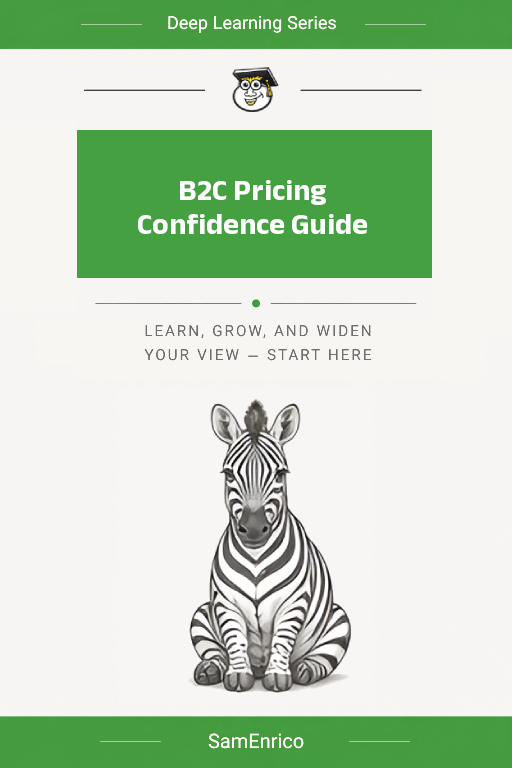
Non-FictionFirst 30 DaysB2C Pricing
B2C Pricing Confidence Guide eBook
Prices direct-to-consumer products without fear, u
Prices direct-to-consumer products without fear, using psychological pricing and consumer behavior insights.
Formats
Free sample
Chapter 1: The Discounting Disease--–- I almost went bankrupt because I was too nice. That sentence still feels strange to say out loud. I was not lazy. I was not incompetent. I was not selling a bad product.
In fact, my product was objectively excellent. Customers told me so constantly. They sent me handwritten notes. They posted photos on social media. They recommended me to their friends.
And yet, after eighteen months in business, I had exactly four hundred and twelve dollars in my bank account, a credit card maxed out at twenty-three thousand dollars, and a growing certainty that I was fundamentally broken as an entrepreneur.The problem was not my product. The problem was my price. More specifically, the problem was my fear of my own price.I remember the exact moment this fear took root. I had just finished designing my first product, a handcrafted leather bag that took me three days to make. I calculated my material costs at sixty-two dollars.
I added a modest markup to cover my time, landing at one hundred and twenty dollars. I thought this was reasonable. My partner looked at the number and said, "That seems low." But I had already convinced myself that one hundred and twenty dollars was pushing the limit. What if people laughed? What if they clicked away?
What if they bought from someone else who charged ninety dollars?So I did what so many founders do. I discounted myself before any customer ever had the chance.I launched at ninety-nine dollars. I told myself it was a "launch special." I told myself I would raise the price later. I told myself that getting sales was more important than making profit. These were lies I believed because believing them felt better than facing the truth: I was terrified of rejection.This chapter is for anyone who has ever felt that terror.
It is for the Etsy seller who holds her breath every time she posts a new price. It is for the DTC founder who adds a "contact for discount" button to his website because he is afraid of the silence that follows a posted number. It is for the entrepreneur who has convinced herself that low prices make her "accessible" or "fair" or "customer-friendly." They do not. Low prices make you invisible. Low prices attract the wrong customers.
And low prices will kill your business slowly enough that you will not even notice until you are already broke.I wrote this book because I eventually recovered from my pricing disease. I learned the hard way, through bankruptcy and rebuilding, what actually works. And I am here to tell you that the most important thing you will ever do for your business is not improving your product, not hiring better people, not running more ads. It is setting a price that scares you a little and then refusing to apologize for it.Before we fix your pricing, we must first diagnose your disease. And the disease has a name.The Discounting Death Spiral The Discounting Death Spiral begins with a simple, seemingly rational thought: "I will lower my price to get my first few customers." This is the entry point.
It feels like strategy. It feels like humility. It feels like the smart thing to do when you have no reputation and no reviews.Here is what actually happens.You set your price at ninety dollars instead of one hundred and twenty dollars. You get a few sales. You feel validated.
But then those first customers tell their friends, and what do they say? They do not say, "This product is a steal at ninety dollars." They say, "I got it for ninety dollars." The number sticks. The value perception sticks. You have now trained your first cohort to believe that ninety dollars is the normal price.When you try to raise to one hundred and twenty dollars later, those same customers feel cheated. They remember paying ninety.
They feel like you are taking something away from them. This is loss aversion in action, a concept we will explore throughout this book. But for now, understand this: your customers feel the pain of a price increase twice as intensely as they feel the pleasure of a quality product.So you keep the price at ninety dollars. But now you need more customers. Your ads are not performing.
Your conversion rate is stagnant. So you think, "I will run a small discount. Just ten percent off. Just for a weekend." This is the second turn of the spiral.You send the email. You post on social media.
Sales spike. You feel like a genius. But what have you actually done? You have trained your email list to wait for discounts. They learn that your product goes on sale regularly.
They learn that patience pays off. They stop buying at full price. Your baseline revenue drops.Now you need even more sales to make up for the lower margins. So you discount again. And again.
And again. Each discount trains your customers more deeply. Each discount lowers your perceived value. Each discount makes it harder to ever charge a fair price.This is the Discounting Death Spiral. It is a self-reinforcing loop of fear, discounting, margin erosion, and value destruction.
It does not kill you in one dramatic moment. It kills you with a thousand small cuts. And the cruelest part is that you will blame everything else. You will blame your product. You will blame your marketing.
You will blame the economy. You will blame the algorithm. But the problem was always the price.I have seen this pattern in hundreds of DTC businesses. The founder starts with a reasonable price, gets scared, discounts, gets more scared, discounts more, and eventually ends up working sixty hours a week to make less money than they would at a coffee shop. The spiral is predictable.
It is preventable. And it is almost always fatal to the business.The Two Types of Fear: Loss Aversion and Seller's Remorse To understand why we discount so readily, we must understand two distinct but related psychological forces. The first is loss aversion. The second I call seller's remorse.Loss aversion is one of the most well-documented phenomena in behavioral economics. It was first identified by Daniel Kahneman and Amos Tversky in their work on prospect theory, which later won Kahneman a Nobel Prize.
The principle is simple: humans feel the pain of a loss approximately twice as intensely as they feel the pleasure of an equivalent gain. Losing one hundred dollars hurts twice as much as finding one hundred dollars feels good.This is hardwired into our brains. It was evolutionarily adaptive for our ancestors to be more sensitive to threats than to opportunities. The caveman who ignored a potential predator died. The caveman who ignored a potential meal just got hungry.
So our brains developed a powerful asymmetry: losses loom larger than gains.In the context of pricing, loss aversion works against you in two ways. First, your customers are loss averse. They feel the pain of spending money more intensely than they feel the pleasure of acquiring your product. This is why…
This is the end of the free sample. Get the eBook to keep going. Buy now
About this book
Details
- Author
- Lewandowski Sharmaine
- Publisher
- SamEnrico
- Language
- English
- Genre
- Non-Fiction, First 30 Days, B2C Pricing
- Released
- 2026-05-30
- Pages (approx.)
- 146
- Available as
- eBook, Audiobook

Read better in the ZLOADR app
Your eBooks on your phone or tablet. Sign in with your SamEnrico account and start reading.
More by Lewandowski Sharmaine
 The Morning Commute Anxiety ReductionLewandowski Sharmaine$11.99
 European Freight ForecastLewandowski Sharmaine$11.99
 NVC In The Workplace WorkbookLewandowski Sharmaine$11.99
 Assertiveness for LGBTQ FolksLewandowski Sharmaine$11.99
 Debt Tranching StrategiesLewandowski Sharmaine$11.99
 The Rose of Agincourt: Love and Valor in the Hundred Years' WarLewandowski Sharmaine$11.99
 Store DirectorLewandowski Sharmaine$11.99
 Middle East Business Gifts GuideLewandowski Sharmaine$12.99
 Understanding Sino-auricular Heart BlockLewandowski Sharmaine$17.99
 How to Become a Letter-of-credit ClerkLewandowski Sharmaine$11.99
You may also like
 Hong Kong Handover 1997Dunn Johnnie$11.99
 Zumba For Postnatal Recovery CourseNeal Christian$11.99
 Zumba for BeginnersLadner Nikia$11.99
 YouTube Comment Mining GuideHumes Pandora$12.99
 Worry Box MeditationCarlin Rudy$11.99
 Workplace Stress MeditationNguyen Lynn$11.99
 Workplace Stress and Sleep RepairHawley Ivory$11.99
 Workplace Perfectionism CureDelaney Jeffry$11.99
 Workplace Injustice Anger GuideWallen Isabelle$11.99
 Work Addiction and Burnout LinkGreenwood Ester$11.99
 Women in Yoga and WellnessBeattie Galina$11.99
 Women in Stand Up ComedyChun Evangeline$11.99