
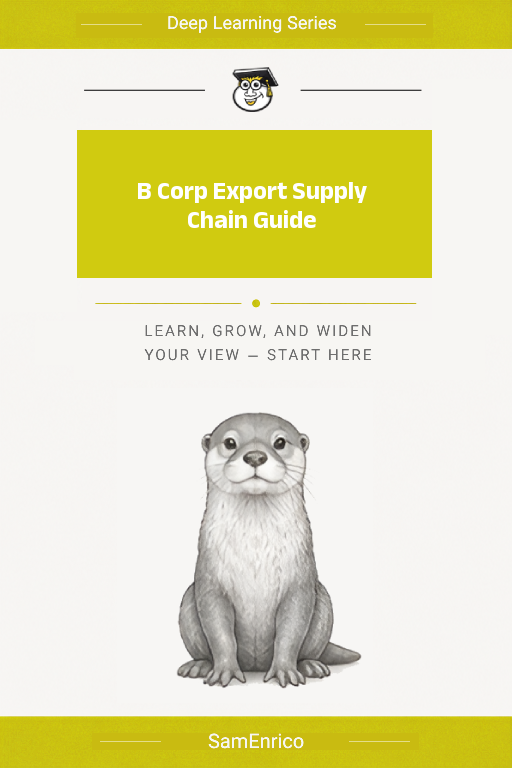
B Corp Export Supply Chain Guide eBook
Certify your export business as a B Corp to attrac
by Lehmann Lan
Certify your export business as a B Corp to attract sustainability-focused international buyers, completing impact assessments and legal amendments.
Formats
Free sample
Chapter 1: The Gatekeepers’ Gambit--–- In the winter of 2023, a mid-sized organic tea exporter from Sri Lanka lost a €4.2 million contract with a German retail cooperative. The price was right. The quality was certified organic. The delivery timeline was aggressive but achievable. The reason for rejection, printed on a single sheet of procurement stationery, was six words: “No verified third-party ESG data provided.”The Sri Lankan exporter had never heard the acronym ESG.
Neither had most of their competitors. Within eighteen months, that same German retailer would require all 4,500 of its global suppliers to submit verified environmental, social, and governance data as a condition of renewal. The exporter that lost the contract is now scrambling to retroactively build systems that their competitors had already put in place. This book exists to ensure you are not that exporter.The Invisible Revolution in Global Procurement For the past three decades, international trade operated on a relatively simple set of rules. Price, quality, and delivery reliability were the three pillars of every buyer-supplier relationship.
If your product met specifications, arrived on time, and cost less than the next bid, you won the contract. Sustainability was a footnote—a nice story for the annual report, but rarely a deal-breaker.That era ended quietly, without a single dramatic announcement. Instead, it died through a thousand procurement policy updates, each one tightening the screws on unverified claims. The transformation began in Northern Europe, spread to the large American retailers, and is now accelerating toward a legal climax in September 2026, when the European Union’s Empowering Consumers for the Green Transition Directive (ECGTD) takes full effect. (For a detailed explanation of the ECGTD, including its penalty structure of fines up to 4% of annual turnover, see the Glossary at the end of this book.)Here is what that means for your export business: Within the next twenty-four months, your ability to access the world’s most lucrative markets—Germany, France, the Netherlands, the United Kingdom, and increasingly the United States—will depend on whether you can prove, through third-party verification, that your company operates sustainably.
Not just your product. Not just your factory. Your entire company: your governance structure, your treatment of workers, your supply chain ethics, your environmental management, and your community impact.This is not speculation. As of the data synthesized for this chapter, 67% of global buyers now require ESG data as a non-price factor, meaning a bid can be rejected on sustainability grounds even if the price is lower. Among large European firms with annual revenue exceeding €500 million, that figure approaches 80%.
The era of the “good enough” exporter—the one who could talk about sustainability without proving it—is legally ending.Why B Corp, and Why Now?Among the dozens of sustainability certifications available to exporters, B Corp stands apart for three reasons that matter specifically to international trade.First, B Corp is the only certification that verifies the entire company rather than a single product or process. ISO 14001 verifies your environmental management system. Fair Trade verifies your sourcing practices for specific commodities. A carbon footprint label verifies the emissions of a specific product shipped along a specific route. B Corp verifies everything: how you write your corporate bylaws, how you pay your sales staff in Singapore, how your Vietnamese supplier treats its factory workers, how you dispose of returned goods in the Dutch port of Rotterdam.This matters because international buyers are increasingly liable for their suppliers’ actions.
Under the EU’s Corporate Sustainability Due Diligence Directive (CSDDD), a European buyer can be sued for human rights violations occurring in your supplier’s supplier’s factory. That buyer will therefore demand a certification that covers the entire supply chain, not just your own factory gates. B Corp provides that coverage.Second, B Corp is the most recognized cross-border certification for sustainability. As of 2025, there are over 8,000 certified B Corps across 95 countries, with particularly dense networks in the United States, Canada, the United Kingdom, Australia, New Zealand, and the European Union. A buyer in Berlin knows what B Corp means.
A procurement officer in Tokyo has likely encountered it. A logistics manager in Chicago has seen the logo on packaging. This recognition matters because certification is only valuable if your buyer trusts it.Third, and most urgently, B Corp certification meets the third-party verification requirement of the September 2026 ECGTD. After that date, any company using sustainability labels—including generic terms like “eco-friendly,” “green,” or “sustainable”—on products sold in the European Union must have those claims verified by an accredited third party. B Corp is explicitly structured to provide that verification.
Without it, your packaging, your website, and your marketing materials could become legal liabilities.The Two Case Studies That Changed Everything To understand how B Corp transforms export businesses, we need to look at real companies that used certification to break through distribution barriers that had nothing to do with price or product quality.ŌKU: The Organic Supplement That Bypassed Australian GatekeepersŌKU is a New Zealand-based organic supplement brand that sells adaptogenic mushroom powders and herbal blends. For years, the company faced the same problem as every other New Zealand exporter targeting Australia: Australian retailers, wary of greenwashing claims, had been systematically rejecting New Zealand brands unless they carried expensive, brand-specific audits.The retailers’ logic was defensible. The Australian consumer protection regulator had been aggressively fining companies for unsubstantiated environmental claims. Retailers, caught in the middle, decided to outsource the verification burden to their suppliers. But because each retailer had its own proprietary sustainability scorecard, a New Zealand exporter might need to complete four different audits to sell to four different Australian chains.
The cost was prohibitive.ŌKU solved this problem by obtaining B Corp certification. Instead of completing four separate retailer audits, the company presented its B Corp certificate as a single, third-party-verified document covering governance, worker treatment, environmental management, and supply chain ethics. Within 90 days of certification, ŌKU had secured shelf space in three major Australian retailers that had previously rejected them. The retailers accepted B Corp because B Lab—not the exporter—bore the liability for verification.BLUNT Umbrellas: Circular Economy as an Export Advantage BLUNT Umbrellas, another New Zealand company, faced a different barrier when targeting the United Kingdom. British retailers, particularly high-end department stores like Selfridges and John Lewis, had begun demanding proof of circular economy practices.
They wanted to know: Can the umbrella be repaired? Are spare parts available? What happens at end of life?BLUNT had already designed its umbrellas for repairability, with replaceable canopy fabrics and tension systems. But the company had never documented these practices in a format that buyers recognized. B Corp certification changed that.
The certification process required BLUNT to formalize its circular economy policies, document spare parts availability, and create an end-of-life recycling program. Once certified, BLUNT could present its B Corp certificate as third-party proof of circularity.The result: BLUNT broke into the UK market within six months, securing distribution through retailers that had previously required expensive, bespoke circular economy audits. The B Corp certificate served as a passport, not a replacement for good practices—but it was a passport that unlocked doors that had previously been locked.What These Case Studies Reveal…
This is the end of the free sample. Get the eBook to keep going. Buy now
About this book
Details
- Author
- Lehmann Lan
- Publisher
- SamEnrico
- Language
- English
- Genre
- Non-Fiction, Business Brief
- Released
- 2026-05-30
- Pages (approx.)
- 158
- Available as
- eBook, Audiobook

Read better in the ZLOADR app
Your eBooks on your phone or tablet. Sign in with your SamEnrico account and start reading.
More by Lehmann Lan
 Food Addiction Recovery for Bariatric PatientsLehmann Lan$11.99
 Ayurvedic Postpartum GuideLehmann Lan$11.99
 Affirmations for UnemploymentLehmann Lan$11.99
 Rock Slide EvasionLehmann Lan$11.99
 Labeling Influence GuideLehmann Lan$11.99
 The Pimp Controlled SurvivorLehmann Lan$11.99
 Home Decor Shopping AddictionLehmann Lan$11.99
 Carbamazepine GuideLehmann Lan$11.99
 The Timbuktu Renaissance: When Africa's Scholars Lit the World's Intellectual TorchLehmann Lan$11.99
 The Healing Hands of Africa: The Musical Legacy of the Dogon HealersLehmann Lan$11.99
 Service Providers Guide to Concrete Driveway InstallationLehmann Lan$11.99
 How to Produce Tent VestibulesLehmann Lan$11.99
You may also like
 Hong Kong Handover 1997Dunn Johnnie$11.99
 Zumba For Postnatal Recovery CourseNeal Christian$11.99
 Zumba for BeginnersLadner Nikia$11.99
 YouTube Comment Mining GuideHumes Pandora$12.99
 Worry Box MeditationCarlin Rudy$11.99
 Workplace Stress MeditationNguyen Lynn$11.99
 Workplace Stress and Sleep RepairHawley Ivory$11.99
 Workplace Perfectionism CureDelaney Jeffry$11.99
 Workplace Injustice Anger GuideWallen Isabelle$11.99
 Work Addiction and Burnout LinkGreenwood Ester$11.99
 Women in Yoga and WellnessBeattie Galina$11.99
 Women in Stand Up ComedyChun Evangeline$11.99